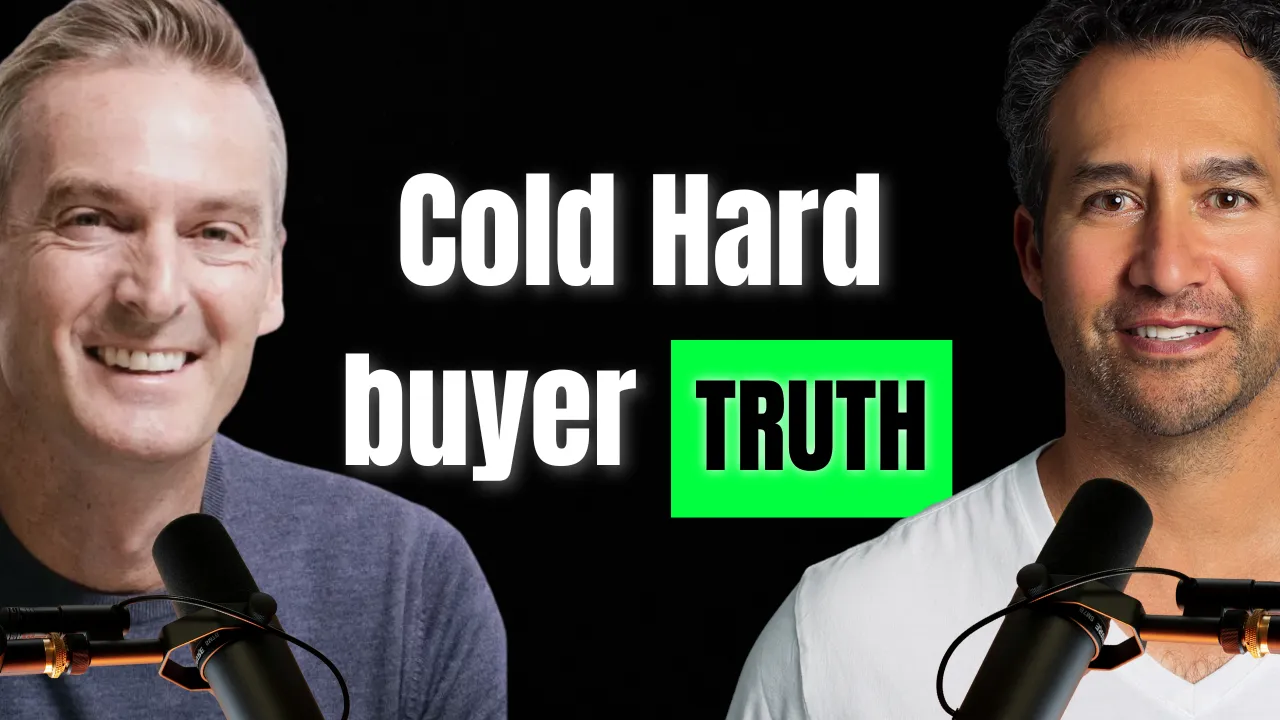
Jake Aaron Villarreal: I'm Jake Aaron Villarreal, born and raised in Silicon Valley. I'm here to take you behind the scenes to share what it's like to be a startup founder, the journey they're on, problems they face, the products they build in an effort to make our lives better. I'm excited to have with us today the founder and CEO of HMX.ai, Kim Mayyasi. Kim, welcome to the show.
Kim Mayyasi: Thanks, Jake. Glad to be here.
Jake Aaron Villarreal: I'm glad to have you. Before we jump in on your background, Kim, where are you joining us from today?
Kim Mayyasi: So, I'm just outside Boston in a, a small town called Plymouth, Massachusetts. I'm uh, I'm right overlooking the harbor and what's considered the most disappointing national historic landmark, Plymouth Rock.
Jake Aaron Villarreal: Well, it's one that I can recall learning, I think I was in kindergarten or first grade, and I've never got there yet, but it's stuck in my mind as a place I got to get to at some point. I mean, you know, the founding fathers, innovation, I mean, what a better tie-in to what's happening in today's world with, you know, people coming from all over the world to build products and technology that are changing our world. And you're really at, you know, one epicenter of it as well.
So, a little bit more about Kim. He's survived six technology startups and two public company turnarounds. His adventures include first movers in cellular, CRM, web conferencing, and the first AI company spun out of MIT. He's currently CEO of HMX, developing and deploying AI technology that unifies human experience, expertise with ML. Developing artificial intelligence that combines human thinking with machine logic is his north star. On the side, he's an ordained Taoist. I think I'm pronouncing, pronouncing that right. Is it Taoist priest?
Kim Mayyasi: Yep.
Jake Aaron Villarreal: And published a book tracing historical definitions of character to the rise and fall of nations. God, I'd love to learn a lot more about that. But thanks for uh, hopping on here. This platform, this show is about startups and founders and really understanding, you know, what you've learned and how we can share that with the world that might help others, inspire others as well. So before we jump in on you as the leader of the company, let's go back a little bit. And you've had a lot of experience in technology and startups, but what are some of those experiences early on that shaped you into really wanting to be a leader, wanting to be an entrepreneur?
Kim Mayyasi: Yeah, I'd say, you know, early on, I guess right out of school, um, I had a job with an IBM startup. And, um, it was...
[Launching the First Cellular Network]
...being part of IBM, it was part of the big company environment and uh that was my first experience in business. My boss at the time took a job to build the first cellular network in the world. That was here in Boston, Massachusetts. So he enlisted me and one other guy and we were sitting in a warehouse outside Boston and we put radio, cellular radio transmitters on nine towers around Boston and launched the first cellular network operationally in the world. So that was here in Boston, Massachusetts.
And the interesting thing is we got into it and all the market studies told us, you know, the best to expect in terms of adoption was 1% of the market. It would just be doctors and lawyers who could afford cellular phones in their cars. And about a year into it, after we launched, I remember all the phones in those days had to be installed in cars. I noticed that what's coming into our installation center wasn't Jags and it wasn't Mercedes, it was pickup trucks. And I said, "Wow, that's interesting."
And so I talked to these early adopters of a never-before-heard-of technology and they're contractors. I'm like, "Hold it. AT&T just did a $7 million a year study that said you should be a doctor or lawyer." And I'm looking at pickup trucks full of contractors getting these phones. And he explained, "Look, my office is in the car. This phone is extending my business so I can grow it from my truck." And that's when I was like, "Wow, so this is going to be bigger than 1% of the market." And sure enough, fast forward now, what is that, almost 40 years later? You know, every, every teenager has a cellular phone in their pocket.
And what that taught me really way early on was, you know, these transformational technologies are often not understood and their impact cannot be predicted. And that was a huge one for me. Now, ever since that day, I was like, you know, this startup world is great. You go into it, you deal with technologies. In many cases, you're beating... you're almost like uh Don Quixote tilting at windmills. You've got a technology that no one knows that they need. But I was like, "This is great. This is a world I want to play in."
So that was cellular, you know, two companies later. That was great. Then I, then I discovered this thing called... what did I call it? Marketing and sales productivity. And no one knew what that was. I say... I said, "Look, why can't you apply the world of production into... bring that into the world of sales and marketing?" And so I built an expert system that did that. Well, that's CRM. I mean, I would go and pitch marketing and sales productivity and eventually got some traction that became CRM. Now everybody knows what CRM is.
So I guess what I'm saying is from those early days, you know, I always found it really interesting how these technologies that can be transformational, initially are very tough. And then they catch on and then it's uh, can be you know, change society. That was really what inspired me.
Jake Aaron Villarreal: Yeah, that's great. That's amazing. You know, share... and now you're in AI and it's transforming so many different industries and sectors. And you say that human thinking with machine logic is your north star. What, what does that mean to you?
Kim Mayyasi: So right. So I've been in AI almost 30 years and the first wave of AI was known as expert systems. Basically rules-based processing, right? And in those days we did mission-critical stuff, right? So we did the... managed the last two minutes of the space shuttle countdowns. We did battle planning for the liberation of Kuwait. We did all the abnormal situation detection in Shell processing plants. You know, all that kind of, I'm going to call it real stuff, right? We weren't worried about Netflix recommendations. We were worried about, you know, is this polymer plant going to have some kind of malfunction that destroys hundreds of thousand dollars of material or worse, blows up?
And what I learned in those early days of AI, that basically what we were doing was taking what people knew in their heads and turning it into rules that then a machine would implement for them. And that was the very first stage of AI.
[Merging Human Expertise with Machine Learning]
Some people call it the first wave of AI. And then it hit what some people call the AI, first AI winter because rules could only go so far. Then came big data and machine learning. And now you had the incredible possibilities from machines learning pattern detections and finding some tendencies that could go beyond the human. And what was lost in that was the experience and the logic that experts had.
So kind of the first wave captured what humans had and codified that. The second wave of AI said, "Yeah, we don't need that stinking human logic. We're going to go with what a machine knows, what we can learn off pattern detection." It turns out that both is needed. It turns out that just like Star Trek, you need both Spock, who's the machine logic guy, and you need Captain Kirk, which is the human experience. Those two together, Kirk and Spock, you know, save planets, right? Either one alone, you know, would have failed.
We like to say human expertise plus machine logic is better than either alone. So that's the challenge. How do you take human understanding, human reasoning, capture that and then marry it, marry it with the power of machine logic? That's, that's the Rosetta... if you could, you do that, and that's the Rosetta Stone. So that's what we've done over the past 10 years, is find how to do that unification. That's my north star, right? No black boxes. AI should be just as understandable as your wingman in the cockpit with you. And that's what we're, we're doing here with HMX.
Jake Aaron Villarreal: I like that. Yeah, I like that analogy too of Spock and Captain Kirk. And, you know, it's, you know, the practical knowledge of the world and also machines that are helping find the data and create, you know, answers with that data. But there's a lot of interaction that happens. I think the big, the big thought is that you know, it's... AI is going to replace everybody and your work and your job and systems and industries and then we have to find a purpose of how we live because the work that we typically do today, we're not going to have to do anymore. I think that's pretty far out there. I don't know if it's actually the ultimate result that'll happen. I guess we'll see. But when you talk about your company that you've had now, what is the... what does it do? What do you do now? And what problem is it solving? Right?
Kim Mayyasi: So, I want to just mention in terms of this um, so-called existential outlook that I'm reading about and I hear... and you know, it's so... I mean, it's a little bit silly. So, yeah, you know, we could be Luddites and you know, we could talk about you know, we don't want you know weaving to replace manual labor and looms, automated you know mechanical looms to replace human labor. But the fact of the matter is, you know, AI is going to take much of the drudgery and I'll call it stupid work um off the table. And so I guess people could resent that. But if we do our job right as innovators in artificial intelligence, we're going to do the opposite. We're going to say to those people, "You know what? We're going to tap what's the best of human nature, of human minds, and we're going to accelerate or amplify that."
So, I don't view this as a new world of opportunity. That's not one where you're going to have robots replacing humans. That's just silly. There'll be some jobs that get replaced. Yeah, right. The real fun of this is not worrying about that existential problem. The real fun of what we're doing, the joy and passion of what we're bringing to the artificial intelligence world, is how do you take the best of both worlds and bring them together? If you do that, very, very special things can happen. I mean, we're looking at some... and some people talk about it, you know, another Industrial Revolution probably, but we've got to meet that challenge. Okay? So, I'm not...
[Is AI Really Going to Replace Jobs?]
...seeing this existential future. I'm seeing a world that's really quite more remarkable than it is today. Okay? So, I just wanted to get that on the table. So if we do our job right, we really have a wonderful, wonderful future ahead of us. And it's not that far. You know, it's years, single-digit years away. It's not decades. Okay.
So that's what HMX is committed to doing, right? We are the pathfinders in our small way to show how you can take what's the best of human experts, capture that and join it with machine learning technologies in a single platform, operationalize it, and turn it into, by the way, into mission-critical solutions. Guys, I'm not interested in many of the problems in terms of um... I joke about Netflix recommendations, right? I'm much more interested about these very, very tough problems that challenge us to do things that neither the human nor the machine have a prayer in doing. Those are the ones that we task ourselves at HMX.ai.
So how do we do that? Long-winded way. We've got a platform. We've built a platform. We call it C-REX. It's C-REX stands for Cognitive Reasoning Engine. And what we do is uh we take the experience, the methods, the thinking and so on that a human operator has, for example. We capture that and put it into our way of thinking about problems. So our first... and I'll, I'll give you an example that'll bring it all clear in a minute. But our first problem was we needed to have what we call a cognitive model. A way to think about the world that applies to everything. And given our um experience in mission critical, what we found out is everyone thinks in situations. Everyone thinks in situations.
It was easy for us to come to that conclusion 'cause when you're dealing with pilots and astronauts and, you know, war fighters, they all think in situations. If, if, if you were teaching someone to do your job, Jake, and you sat him down in front of that microphone, in front of a camera, you would tell them, "Okay, you push this button, you do this. If this happens, you say this. If the guy you're interviewing does this, you say this." When you think about it, you would end up talking about situations.
Jake Aaron Villarreal: Right. Right.
Kim Mayyasi: So, the, the Rosetta Stone for all of this is a situational way to think about problems and make sure that they're tied to goals. We borrowed this from a cognitive model designed by a researcher for the US Air Force. She was Chief Scientist for the US Air Force. It's called the situation awareness model. So if you go on Wikipedia, you type in situation awareness, that will come... that model. Okay. So that's the brain of C-REX. Everything we do and we...
[How the C-REX Cognitive Engine Works]
...capture will be related to what are your goals and the situations that impact those. From that point our engine runs and it does amazing stuff. It's got all kinds of causal reasoning and so on. But the secret sauce is that. So your next obvious question, "All right, that makes sense. You get from the expert goals and situations, that goes into C-REX. How do you capture that? How do you suck that out of a person in an efficient way?" Right?
Prior to a year ago, we had to do it the hard way. We had to do it with almost a little consulting engagement. We'd go through an interview process. "What are your goals? What are your situations that impact these goals?" It was, it frankly a little bit of drudgery. It was a speed bump in terms of adoption. We got people excited about C-REX and they say, "Okay, how do we do this?" We thought, "Well, we're going to do a consulting study." I mean, you know, I mean, might as well just end it right there, right?
So what we did, what we've been able to do, is come up with a way to use large language models to be that front end to suck that knowledge out. So what happens is, at a, a simplistic level, we can take standard operating procedures that someone has. Could be for customer service, it could be for polymer production, it could be for... we're doing anti-drone warfare stuff right now. We can just feed those PDFs into our language, language model that we've trained to turn that into a cognitive map with goals and situations. So you just feed this stuff in, out comes a cognitive map. It's exactly organized in the way we want. And by the way, because we've trained it so well, once you're satisfied with that, you press a button, it goes into our scalable engine. Boom. You now have a fully deployed cognitive agent that started with what you knew, and then it can add all this machine logic, pattern detection and so on. That's what that... that was our mission and that's what we've done.
Last, the last piece of that is, you remember the holy grail is fixing the black box problem. AI today, you've heard it all, everybody reads about it. LLMs are a black box, right? You create an agent using a large language model, you don't know how it's thinking. You just know how it might have been trained maybe, but you don't know how it's thinking. And frankly, you don't even know if it's going to give you the same answer tomorrow that it gave you today. The CEO of Google just did an article, an interview with the BBC that said, "Look, you can't trust this stuff." You know, this is the guy with Gemini, and he's saying, "If you're a user, you need to have another tool next to you to work with your ChatGPT or your Gemini and so on." So, and why is that? Because it's a black box. You don't know how it works.
So with our approach with C-REX, there's natural language explainability associated with everything. So not only do we get all your human expert knowledge in there, we supercharge it. Once it's running, you just ask it, "Why did you, why did you come up with what you did?" Remember, because it's thinking in situations and goals that you experts put in there, it's going to explain it in the logic that you understand, right? It's going to be in your language. So, it's natural language, but in the vernacular that you are comfortable with. So, in this one aha moment of 'there's a cognitive way to think.' It's a big word, but there's a way to think about problems situationally. We've solved the black box problem. We've solved the human plus machine problem. All in what we've done with C-REX.
Jake Aaron Villarreal: Wow, that's amazing. Yeah. If you are, I don't know, give, give me a scenario where there's a problem around this issue that needs to be solved. And like, let's bring it home for the listeners where they go, "Oh, okay. This is actually a problem that I could actually use in my company or maybe, you know, different form."
Kim Mayyasi: Yeah, great question. Because I got to admit in my self-talk right now, it sounds right, but it's still kind of obtuse to grasp. So, let me give you a, a real-world example. There's a state in Brazil, I won't mention their name, the eighth largest state in Brazil, and they're uh, in Brazil, their taxes are value-added taxes. So, it's not an income tax. It's known value-added taxes. And this state in Brazil had um flat tax collections for years. And they knew it was due to fraud. Okay, they knew that a huge amount, 30 to 40% of taxes, were not collected due to people gaming the system, right? So, they put a call out to AI companies to help them with that problem. We went in and we sat down with the team which included auditors, the head of the auditing group to talk about our technology. And we started talking about, as I looked around the room, I said...
[Eliminating the Artificial Intelligence Black Box]
..."You auditors have probably 500 years of experience sitting in this room detecting fraud. We're going to start by capturing that, and then we're going to put it in our AI system to augment that." And the head of auditing, he was like, "You've got our business." He goes, "Every other AI company came in here and talked about doing pattern detection with our data and not using any of the knowledge that our auditors had. And you were the first that came in here and said, 'Let's start with experience and then take that and add to it with some of the pattern detection stuff.'" So, we launched that, did exactly that. We launched it, and there, the first cognitive map had 10 situations. So, think of those as red flags for fraud. Okay. And um within a year, their tax collections went up 7%. Which is huge.
Jake Aaron Villarreal: Wow.
Kim Mayyasi: Now, here's where it gets... why I'm so proud of this one particular example is within 18 months, that map went from seven situations or red flags, fraud, red flags to 90.
Jake Aaron Villarreal: 90.
Kim Mayyasi: Most, those 90 red flags came from auditors themselves. I like to say there's a kind of a virtuous um cycle here where the machine taught the human and then the human taught the machine. And so for three years in a row, they averaged an additional 7% in increased tax collections. By the way, this was audited by a um international development fund agency and um, yeah, so very practical. Auditors. [snorts] How do you take our knowledge, supercharge it, end up with a tremendous result in terms of increased tax collections?
Jake Aaron Villarreal: That's great. Is that, that's a one-off or is that a focus? Are you going after, you know, statewide opportunities? Like who's the ideal persona that you're targeting?
Kim Mayyasi: Yeah, we've, you know, I think we talked about this earlier, Jake, before we got on this uh podcast. You know, we've got a platform that can do everything and that just makes it terribly tough to sell. So, we've...
[Real-World Case Study on Tax Fraud Detection]
...narrowed our focus to fintech. Uh fintech, a few industrial verticals where there's high risk we enjoy, but really that kind of fintech, of course, there's a lot happening in things like fraud, but there's other risk. There's compliance risk and so on, but we like that space a lot. Basically, anything with risk seems to resonate very well with situational type thinking. I don't know, maybe someone can figure that out. I can't, but whenever we present to folks that are dealing with fraud risk, compliance risk, industrial risk related to production problems, risk seems to resonate with situational thinking. And so that seems from a sales standpoint to be much easier.
Jake Aaron Villarreal: Yeah. Gotcha. You know, it's a challenge with I think a lot of companies in the space where there's like 1500 AI startups launching a month, and what do they solve and how do you get awareness about what you're building? And we're seeing this trend of a lot of companies hiring go-to-market teams a lot faster than we have in traditional startups just because they're trying to get, you know, to the customer to present what they can provide. And there's a lot of noise when you look at the market and you, you know, you've been around for some time, you've got the deep knowledge about AI. What's the biggest challenge you, you see currently for your company or maybe yourself or for the industry?
Kim Mayyasi: Well, I'll only comment on my company. I'm not a meta-thinker, but I think one of the, one of the real... Look, I'm approaching 70 here, right? I'm still learning. And one of the most recent things I've really learned is you... obviously platforms are tough to sell, particularly when you're a startup, right? Um, you're a big company, you got a reputation, you got a plat-, you come out with a platform, a lot easier to sell, but you're a startup, it's a little bit tougher, particularly if it's groundbreaking. And so getting traction can be tough. Everybody talks about, 'Well, build an MVP with a particular solution.' I know, I've heard that a million times. That helps. But what really was the single thing that opened doors for us and helped us get traction was finding a subject matter expert to go in with. Maybe that's virtue of we always, you know, our selling proposition is 'You've got expertise. We're going to take that. We're going to take it to another level.' For some reason, if we went in and said to an enterprise, 'We know you got experts around here somewhere. You know, find them and don't worry about it. We, we're going to capture that expertise. We're going to make it great.' Going in with a subject matter expert who could say to them, "Look, I've been in your space 20 years. I know exactly what you stay awake about. I need to see this person, this person, and this person, and those are the people we're going to turn into heroes, and they're going to solve your enterprise-wide problem." That's a lot different, different presentation. And really for me, it is the secret sauce to how you take a lot of this artificial intelligence stuff and make it relevant. The MVP thing, everybody says that blah, blah, blah. But once you got an MVP, you still got to sell it. And we have just found that the key to unlocking that is a subject matter expert that you go in with your MVP, and then you've got a better chance at selling it.
Having said that, a lot of um CEOs are subject matter experts themselves. So if that's the case, they've got a leg up in that they know what to walk in and say, "Hey, look, I've lived your problem for 20 years. Here's a solution. I've built a little application here that can help you solve that." That's terrific. Um, so at any rate, make sure you go in with subject matter experts. It's either yourself or you better have a wingman by your side that professes that.
Jake Aaron Villarreal: Yeah. Well, I want to go back to something you brought up, which is you're almost 70. I'm in my 50s, so I'm not too far behind you. If you were to go back, though, and think about your experience over the last 30 years, knowing everything you know now, what's the one thing you tell yourself to do differently?
Kim Mayyasi: Well, okay, a couple things I've learned. Um, and maybe they're a tad tactical, but I... when I started because I've always believed in the power of people and working together in teams—and I don't just say that because everybody says that. I've always believed that. And if you're in the startup world, if you don't believe that, get out because you don't belong in it. And I believed to make that happen, a) they had to be on your payroll and b) you had to be able to walk over, you know, go out to lunch with them. And of course over time you know, that's softened. Certainly COVID and remote work have made that, at least in terms of physical presence, something that's not possible.
What I really learned that I wish I had known earlier is outsourcing isn't just a way to save money. Outsourcing with third parties can be a way to attract talent that you don't have available to you now. And you can build an ecosystem of partners, whether you call it outsourcing or some other arrangement, and you can involve them in what you're building in such a way that [snorts] it's actually better than hiring individuals, which is always problematic that it's going to be a perfect fit. So that was hard for me. That was very, very tough for me. [snorts] They weren't on my payroll. I couldn't, you know, go and have a beer with them. That, I don't know how to build a company that way. How do we get in each other's heads in a way that we...
[Strategies for Selling Enterprise AI]
...can get that 1 plus 1 equals 10? Turns out you can. Turns out as long as you go in with the right attitude that it can be another company, but you can form relationships that are deep and enduring just as well as, as they were on your org chart. That was a huge, huge learning.
Jake Aaron Villarreal: Yeah, that's great. Yeah, you can, I mean, people are everything for a company. It's without the tech, people behind the technology, nothing really, you know, builds, grows, the innovation isn't there. And, and where do you find them? You know, we're in the business of helping companies find the right people. That's what we do all day long. And yeah, you know, there's, there's a process to it. And think, talk about how AI can help a company. Like we, you know, we're in the people business. You're not pulling people out of our, our sector. What you will do is, you know, use AI and tooling that helps you do your job better, and the monotonous stuff you can take out and you can, you know, accelerate how you operate. And there's a lot of benefits we're seeing from, from AI in the people business.
And it's funny, you know, even today I've got friends on Wall Street and all over and they always have this kind of a doom and gloom message to us which is, "God man, AI is going to take over recruitment. What are you going to do next?" And I'm like, "You're talking about the core essential part of a company. You're going to replace that with a bot? I don't know if that's going to happen. Not now." We're actually, revenue this year in 2025 is up 778% from last year. So, we're not seeing the macro message of, you know, jobs are going away for good and no one's working. And by the way, we don't, we're not hiring anymore. That's maybe like the big companies that are in the news, but for Main Street, for Middle America, and those innovation companies that are up and coming, everyone's looking for the right people to build.
So for you, you've got a lot of experience in companies uh and multiple startups. What I'm interested to know, and I think a lot of people would be too, is you've had the experience of also being brought into a company that was already kind of established, that you had to come in and land, understand the situation, and then turn it around, which I think might even be tougher than starting with a vanilla idea and building up versus coming in and trying to figure out what's broken and fix it and then try and build it up again. Like, talk through what that experience was like because some of us are in that space too.
Kim Mayyasi: And um, I'd like to follow up with something you said about talent.
Jake Aaron Villarreal: Yeah.
Kim Mayyasi: You know, talent, finding good talent is uh, is magical, right? And you know, I'm just meeting you for the first time. I'm starting to understand what you guys do. But particularly in the case of turnarounds, probably the number one problem is finding talent. Because uh, if it's a turnaround, there's a problem, and most of the problem, most of this stuff is not rocket science, to be honest. Uh you know, I have found basically, I mean there were big turnarounds, both were taught at Harvard Business School. You know, if I found the right one or two people to bring in, kind of was game over. Yeah, there was some operational stuff and I mean there was difficult restructuring. All of it is paint by numbers. I mean, if, if you, if you're in that, if you're that type of person that gets hired to do this type of stuff, I mean it's just paint by numbers. It's case studies, but it's all worthless without the right people executing it.
[Finding Top Talent and Building Ecosystems]
So some of it frankly, of course there's incredible turnover when you go in. Some of it quite frankly was uncovering hidden talent that was there. And then some of it was, you know, finding someone like yourself that can find talent to parachute in. Um, and that, you know, that's, that's really the, the secret sauce to the turnarounds. Find the talent internal and then bring in the external talent. Truth be told, you know, I always have some go-to folks.
Jake Aaron Villarreal: Some secret sauce going on.
Kim Mayyasi: Well, and yeah, and I network, right? And you know, people that I used in one company, I'm going to use again, right? Uses is the wrong word. I'm going to beg them to join, you know, and help out. For example, the founders of HMX.ai, my current company, they were all executives at the AI turnaround, right? So, you know, we fixed that company, we did that, did that, you know, let's see, the stock went up six times. Nice success story. And then, you know, there was a gap back in AI. It's all executives that, you know, had terrific talent from uh that first AI company. So, man, it's... if that talent can be technical talent, it could be people talent, but uh you got to find it. And that's, that's the secret to turnarounds. Find that talent. Might be internal, might be external, but find it.
Jake Aaron Villarreal: Yeah. It's crazy because one of the things that we're seeing that's been very effective for the companies in AI that are winning, it's kind of like the secret sauce, the solution, the strategy that no one's really uncovered well. And I'm going to share this now and some know about this already, is that building AI and building agents to go in and help do work for companies, is the idea and the presentation. The work that goes into it is different almost for every company that we've seen go in and do proof of concepts or implementations, but where it's falling down is between pitching what you can do and then actually making it work.
And so this term, which was really coined by Palantir, which is the forward-deployed engineer, is something we're seeing like the best startups actually hire and deploy for their own company, which is you bring them in, you educate them on your product, you go into the proof of concept, and then they're landing with the customer and making it work. They're technical enough to make sure it's going to work, but they're also listening to what the customer is telling them and they're bridging that gap. They're bringing that intel back to the product team, the engineering team to make things run really well. That's talent. That's something that's hard to find. It's a combination of like a solution engineer, a salesperson, and someone who's able to have a product mindset and solve the problems for the customer. Also, land and expand within companies.
So that's like a hidden talent that companies aren't really taking seriously. We're just seeing so much of it, in fact, it's such a big part of our business now because that's the highest demand. So from your perspective, when you go into a company and you pitch what you can do, and it's an AI agent that's going to help do a job or do part of the job for them, what's, where do you see the challenges there? Are you, is it kind of getting it to work, or is it, "Hey, you've done this for a long time, it's working. It's just getting awareness of what you do and getting it in the right hands of the right companies." Like, where, where does that sit with you?
Kim Mayyasi: Good question. I think really frankly we don't have much problems getting stuff to work. That's a good thing. You know, we, we've... I don't mean to sound like 'been there done that,' but I mean, we just have done hundreds and hundreds of these things you know, over 30 years. The, the, the technologies, you know, changed clearly, but frankly, it's pretty much the same problems. I would say this forward-deployed person or team that you talked about is important whether that is a virtual relationship or, or someone on site. I mean, I remember back in the day, I mean, we had people in command tents on the front lines when we were doing AI for battlefield planning.
Jake Aaron Villarreal: Wow. That's forward deployed.
Kim Mayyasi: Uh, good guy by the way. But yeah, he was out there in the deserts with General Tommy Franks. Our software is in general... mentioned in a page and a half in General Tommy Frank's biography. So there's forward deployment taken literally.
Jake Aaron Villarreal: Yeah.
Kim Mayyasi: But it's no different, right? If you've got a company and they've got... look, if they're relying on this for fraud detection, for example, that's a big, big deal. And you know, you get it right, you get it wrong... um, is, is of incredible...
[Mastering Corporate Turnarounds]
...importance. So one way we deal with it is, is with partners. So in many cases there'll be an um SI that has a good relationship with the company and we'll train up one of their people. Many times they're on site and they'll be the, the individuals, you know, that will provide that on-site visibility and hands-on. It's probably a poor cousin to what you're talking about, where you actually recruit a forward-deployed capability, but that's where we're at right now.
Jake Aaron Villarreal: Yeah. Got it. You know, when we had our first prep call around this podcast, you mentioned that kind of jokingly that your advice to first-time founders in their 20s if they wanted to start up uh, wanted to try a startup, was just to run away. When should someone run away from their startup idea and when should they push through?
Kim Mayyasi: Yeah. Yeah. I would say, you know, I'm not big on self-assessments and all that, but I would say this. I'm going to recommend one book that every startup person should read. And if that, if they are not, if they don't buy off what that one book says, they probably shouldn't be in the startup game. I guarantee you've never heard of this book. It's written by Brian Grazer, the movie producer, and it's called 'A Curious Mind'. And what it does, Brian Grazer's, for those who don't know, he did Apollo 13, A Beautiful Mind, Splash, a number of other movies. And what he does is he goes through basically a biography on how all of his great ideas and the people he met that could help him achieve his goals were all a result of him being curious. And he perfected the art of barging into literally CEO's offices, into... it could be a movie star that he was early on, that he was trying to recruit for a movie. And what he found was because he's so curious, he didn't barge in other than just to ask him questions that he just wanted to know answers about. And that, that curiosity is what in my opinion drives innovators. It's just that passion to constantly ask, 'How do you do this? What do you do? How about this?' If you aren't passionate about that, I don't think you're, you're cut out to be doing this business as a, as an innovator. If you are, you'll have maybe three failures in a row, and then you go and you'll, you'll bank, make a bunch of money. You don't have it? Cash in your chips and go find a job, be a VP somewhere.
Jake Aaron Villarreal: Yeah. Yeah. I like that. You know, it actually... not to sidetrack this conversation, but as you were talking about that, it brought up, and I, this memory that I had when out of college, I ended up uh working as a trucker and, you know, trucking up and down Highway 5 in California, which is, you know, big highway, and hauling tomatoes and hauling tomatoes, 80,000 pounds of tomatoes. They trained me in 12 hours, gave me the keys to a truck, and said, "Go drive this 16 hours a day." It made enough for... I was able to make like $1,000 a week and lived in Costa Rica for a year after that and surfed my brains out.
But the guy that started that company was a college student that thought, you know, he could go to the Central Valley in California and find an opportunity. And what he did was he brought farmers together to tell them that, you know, 'I could take your tomatoes from your field to a processing plant for cheaper with, with college students.' And that's what he did. And he had a trucking service that did that. And then he said, "You know what? Let's go ahead and, how about if we built a processing plant and you're the owners of it, to these farmers." And they did with eight farmers.
He was that curious mind that was literally, you would see him in the plant like, you know, hammering things and opening bolts of, you know, parts of the systems. And long story short, an innovator, a curious mind, an innovator in a space that really didn't think like there was a lot of innovation that could happen. And that company today, called Morning Star, is the biggest producer of tomato paste and processing tomatoes globally, more, live in Italy. And it's valued, I believe at, you know, the last time I checked it was $700 million company, and today it's billions. And now I believe they're using AI to automate the machines, which now is allowing them to just do the work more efficiently. And he actually, I believe, sold that whole operation back to the farmers and opened one that was more intelligent from everything he'd learned, to collaborate with, maybe even compete with. And that's what they've done.
So, it took a very curious mind. But I remember, you know, 20 years ago looking at this guy going, "It's crazy. This guy's driving up in a Rolls-Royce with a laptop in the back, not even looking out the windows, walking to a gas pump, measuring the pennies it was costing to put into the, the trucks, and there was, you know, 200 trucks waiting to be gas filled. And then walking to the plant and climbing up ladders and all oil filled coming out." It was amazing. But it just, it's a long story, but it's, it...
[Why Tech Needs Forward-Deployed Engineers]
...all starts with being creative and thinking creatively and asking the questions to innovate. So I, I'm totally on board with what you said. I would definitely want to read that book, that's for sure.
Kim Mayyasi: It's, it, it's, and you know, it's, it's almost like a Gestalt. I mean, you just got to be, I mean, I know I drive my wife crazy. You know, I'll walk down to the harbor and you know, I mean, it's right out there, and you know, they... there's oyster farms out there and you know, an oyster boat comes in. I'm like, "How do you do this stuff?" I mean, you mean there's farms out there with oysters and you know. Now I just text them. I get oysters delivered to my front door. But it's just something like you just got to want to learn this stuff. I mean, maybe this is a vestige of when you get to your 70s, you just start to appreciate how much really interesting stuff there is out there. And um, so back to being a, a startup person, right? You know, yeah, it's creative. I'm gonna, I'm gonna dumb it down even more. It's being curious. It's being curious for the sake of curiosity. And if you got that, good things are going to happen because the innovation, that's almost just like an, an outgrowth of a curious mind.
Jake Aaron Villarreal: Yeah.
Kim Mayyasi: So that's the only I can say. I mean, if you're in this, you say, "I'm going to make a bunch of money," I guess you can, but that's, you know, I mean, I've done six of these startups and two of these turnarounds, and I'm still kind of curious. I just, you know, and I'll be curious.
Jake Aaron Villarreal: You know, the listeners that can't see, you don't look anything near your age. [laughter and gasps] If you're listening, you got to go to the video because you look great and I can feel the passion. I could see the energy. When it comes to you, you know, you've got a lot of experience. What was, what are some of the breakthroughs for you? How have you evolved as a leader having gone through all your experience now that you know you really have become a better leader because of things?
Kim Mayyasi: Yeah, I would, you know, loaded question. But I think probably what I'd say is by having the right talent, speaking to you, Jake.
Jake Aaron Villarreal: Yeah.
Kim Mayyasi: If you can, if you're... if you can, you really invite trust, right? And there's just like, there's so much delegation and trust that I have, like it isn't... I'm not leading anything. I'm just kind of like, I'm just finding the right people, putting them in place. Maybe there's a vision thing. Probably there is. So you give them a vision thing. Everybody buys off on that. And then I got this incredible trust that they're going to execute. So meetings are... meetings are... I only have meetings when there's a problem. If everything's going right, I don't need a meeting, right? Why would... I don't understand this whole thing of status meetings. I just don't understand that. It's just to a startup guy that has status meetings, you know...
[The Power of a Curious Mind in Startups]
...like, you know, agile programming I think is great, right? You're going to have a scrum. The only thing you talk about is the problems, right? You don't talk... you don't spend time in the meeting talking about what's working. You talk about what the problems are, and then you have a sidebar on the people that are relevant to fixing the problem. So I guess for me, the, the whole leadership thing is just yeah, get your north star, establish the north star, find the right talent, and then let them go. And then every now and then do some mid-course correction. That's about it. That's about it.
Jake Aaron Villarreal: Sounds simple.
Kim Mayyasi: If you... if it sounds simple, but look at it this way. If you've got to be heavy-handed and you got to be involved in every detail—and I know CEOs, and they're probably billionaires and so on. They feel they got to be involved in every detail. I don't think that's a win. I don't think that's leadership. I think leadership is when you're able to say to your team, "Yeah, you're the technology guy. We just agreed this had to be done. Just tell me if you got a problem." That, that's, that's, that's... you got the right talent in the right place. Let's do it.
Jake Aaron Villarreal: Yeah. You got to trust to delegate and you got to let them do their thing. And that's hard, man. I mean, I got to tell you, I mean, I'd say it probably took me 20 years of, of CEO-dom to really feel, "You know what? I can, I can trust. I can trust and operate in this, in this fashion." But they flourish. If you got the right talent, they're going to flourish. They're going to do so much more than if you heavy-hand the management of the, of the process.
Jake Aaron Villarreal: Yeah. God, so much wisdom here. As you look at HMX currently, what are you excited about? What's on the roadmap as we head into 2026?
Kim Mayyasi: So, as I mentioned, we uh, within the past year, actually was in July, we launched, we call it Cognitive Agent Builder, but that's where we found a way to take large language models and to use that as the front end to C-REX, to our cognitive reasoning engine. And that's the easiest way to suck out expertise, human expertise, and get it into that situational way of thinking. Of course, large language models are great, assuming you've established that framework to do natural language explanations. So, we've, we've cracked that code. We now solved human plus machine. How do you unify that? So, that's pretty exciting because it took us, it took us 10 years to get there. And uh and you know, I really feel we finally got there. We've launched this thing in July, but we seem to be getting a reasonable response. And that's what I'm excited about because now I can really say in a very concrete way human plus ML is better than either alone and I can show you how to make it happen really quickly. So that's pretty exciting.
Jake Aaron Villarreal: That's great. Well, it sounds like an amazing opportunity and the, the future is still much ahead of where you guys are heading. If anybody's interested to connect with you or who knows, maybe wants to work for you or be part of your North Star vision, where do they find you? Where do they find HMX?
Kim Mayyasi: Well, of course, you can always go to LinkedIn, right? HMX.ai. I don't know if you post these podcasts, Jake. I can put contact information there. As long as they're curious minds, I want to talk to them. Um, I like it, you know.
Jake Aaron Villarreal: Very cool.
Kim Mayyasi: And I've been blessed because I've been able to talk to people with what I think is a curious mind. I found, and this is what Brian Grazer writes in his book, most of these people that have some real... I hate to call it wisdom, but let's call it wisdom. If you're sincere, they're pretty open in sharing it. That's what's kind of really amazing. So, if there's listeners out there and they truly are curious, I'd love to talk to them because I get energized.
Jake Aaron Villarreal: Yeah. Sounds perfect. I want to thank you uh Kim for coming on the show and sharing really from the ground up your experience, and for the listeners for listening today. It means a lot to me you spent your time with us. Uh I'm your host Jake Aaron Villarreal signing off for now. We can't wait to catch up with you all on the next episode. Until then, Kim, the world, take care. If you like what we're doing, don't forget to subscribe, leave a review on Apple Podcasts or wherever you listen, and follow us on YouTube where we go behind the scenes to learn what it takes to be a startup founder.
























.jpg)



















.webp)



.webp)
.webp)


.webp)