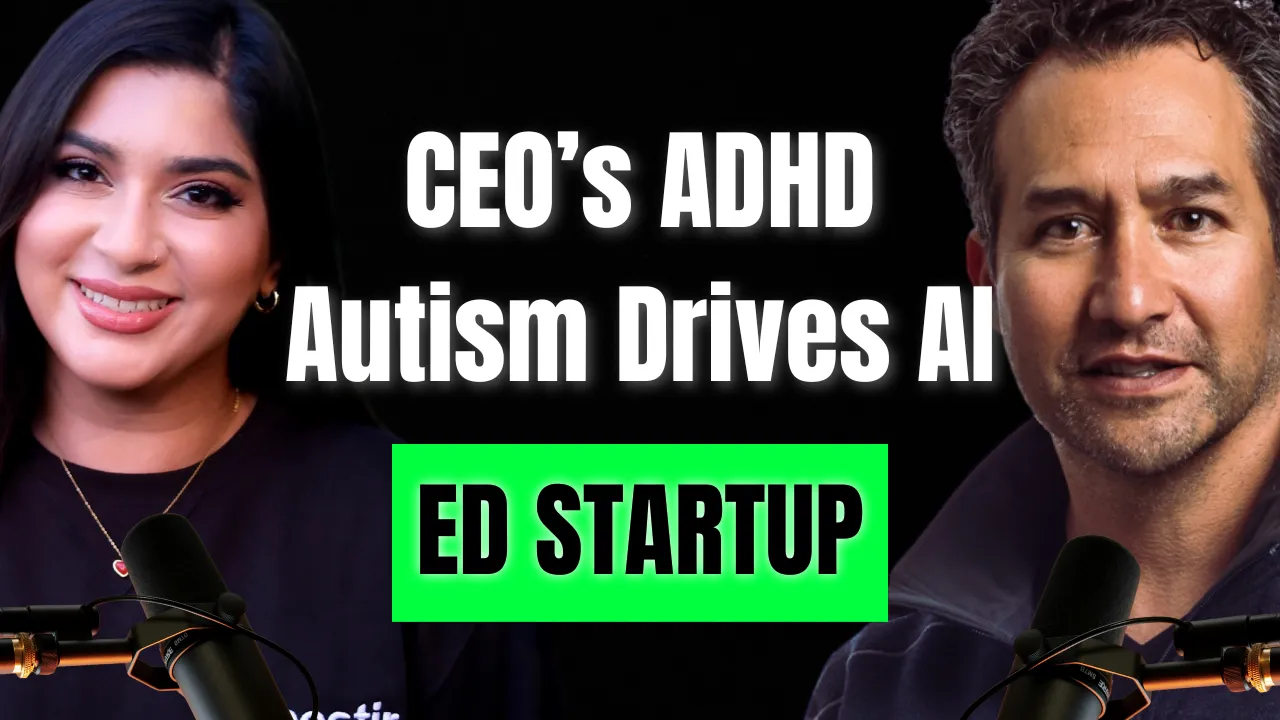
Jake Aaron Villarreal: I'm Jake Aaron Villarreal, born and raised in Silicon Valley. Here to take you behind the scenes to share what it's like to be a startup founder, the journey they're on, the problems they face, the products they build in an effort to make our lives better. I'm excited to have with us today, co-founder and CEO of Aiode, Idan. Idan, welcome to the show.
Idan Dobrecki: Thanks, Jake. Lovely to be here.
Jake Aaron Villarreal: Well, thanks for joining. Before we jump in here, we talk to founders that are all over the world. Presently, where you located?
Idan Dobrecki: I, I think we've talked about this before, but you should ask me that every other week because I'm bouncing in between. Currently I'm in Europe, scheduled to fly to London in a few days time and then heading to the States in next month. So, I'm probably changing continents and countries every other month.
Jake Aaron Villarreal: When I started this podcast, I had this vision to go behind the scenes to share what it's like to be a startup founder in Silicon Valley, where I'm born and raised. And weekly, we dive deep in the trenches to find the wins, the losses, and the lessons learned with the hopes that it helps you run a better startup. But here's the thing. If you've gotten any value out of these conversations or been inspired at all, hit the subscribe button. And I get it. Your podcast feed's probably overflowing. But to stay up to date what's going on in Silicon Valley, stick with us because at the end of the day, we're all just trying to build something that matters. And we're better when we do it together. So hit that subscribe button and follow us wherever you find your podcasts. Now, let's get back to the show.
Well, that's a sign to me of a true innovator. You're always looking at where the world's going and you're there to make it happen. A little bit more about Idan. He comes from a diverse background that includes advanced physics and mathematics, law, and business administration, all the while not neglecting his love for playing the piano. Aiode is his second venture working on connecting people and creating accessibility through technology. [snorts] Prior to his entrepreneurial career establishment, Idan worked at top law firms with large corporations and startups, focusing mainly on tech and capital markets.
Idan, we're going to talk about you and your product and what it's solving and where the market is. But before we do that, let's, let's jump into your background a little bit. What were some of the experiences that helped shape you into doing what you do today and becoming an entrepreneur?
Idan Dobrecki: Yeah, it's a good question. I think I started studying math and physics when I was quite young. So we're talking like 15, 16 years old. And I sort of drifted and found myself falling in love with everything math related. So I guess, I guess to some extent that, that was the initial foundation for me becoming an entrepreneur at some point. But then later on I actually fancied learning the business aspects of starting a business and how that might come to be. So I went back to uni, this time studying law and business administration, like you've mentioned yourself. And I think, very modestly saying it, but I think having both of these disciplines, knowing both the, the technological side, studying math, as well as having a business understanding of how fundraising works, how establishing a company actually works in real life and not just by listening to others do it. I think it gave me a solid foundation to actually start my own venture.
Jake Aaron Villarreal: Yeah, you know, it's always, it takes a little courage to start your own venture and you just... the fundamentals of the paperwork you have to put in place and a corporation and finding the right people and the right partners. And maybe you're a solo founder or you have multiple co-founders. This is your second venture and we're going to jump into it. What was the first one?
Idan Dobrecki: First one was actually, I would say half a venture just because we didn't follow the conventional I would say VC route. It was a venture that I've started with a friend while studying law and it was primarily focused on helping law students reduce the prices for the books required for the education and the bar exams. We just came up with a solution to a problem we've experienced firsthand, which is essentially the fact that law students are always and constantly be required to buy the books each year. Even more so when the bar exams are, are next right, right up, the next thing that they're about to do. And these books are highly expensive. And we were looking at it thinking, how come there's no secondhand, specifically for like a secondhand store, specifically for law students? So we set up our own little shop or website rather. And that website ended up generating quite a lot of traffic in terms of law students you know changing their own books around. So that was a small little venture that we had during I would say my, my studies. And Aiode is my second, more traditional I would say, startup.
Jake Aaron Villarreal: Yeah, that's great. You know, you, you, you take lessons that you've learned from any opportunity or operation you build and you take that into your next venture. You talked a little bit about when we had our prep call for this podcast of, you know, your love for music. And, you know, you played the piano when you were younger. And talk a little bit about that aspect of not necessarily your career, but like what was it that drew you to music?
Idan Dobrecki: So, I co-founded Aiode together with my cousin and my cousin's also a musician and a music producer and we come from a very musical family. So part of our, I would say growing up or part of the way that our parents saw our, our, our, the way that they raised us always had music incorporated in it. What I mean by that is that every single one of us had to study or learn how to play a musical instrument. You could have chosen multiple ones but you had to play at least one. For me it was like you've mentioned the piano, but music is deeply rooted within our family. We have a lot of musicians and music creators within the family. So it was quite intuitive for me to try to solve problems that are in the music industry and space and joining forces with my cousin who comes again from the same family made it even easier.
Jake Aaron Villarreal: Yeah. Well, you shared that your co-founder is your cousin Blue.
Idan Dobrecki: I love the name by the way. It's a weird name, but it's a great icebreaker.
Jake Aaron Villarreal: Yeah. I mean, absolutely. It's a great icebreaker. I'd love to have Blue on the show, too, and understand what, what, how that, how that's broken the ice in multiple conversations throughout his life. But his dad is a two-time Grammy winner. Take us inside the family dinner where you two decided to build Aiode. What did, what did your Grammy uncle think about replacing or not replacing, but think about AI and how it supports the industry?
Idan Dobrecki: Yeah, so maybe just starting off with what Aiode does and how it came to be. Blue and I were thinking of the problems that we are experiencing as music creators ourselves. So the problem is that in order to produce a high quality song and this is true for any purpose. You can be a music producer working on the next song for a commercial, a movie, an album, you might even produce music for like the gaming industry that consumes a lot of music, automobile, and so on and so forth. When you want to produce a high quality song, you're met with a very tedious, time consuming, costly process. Now, as creators ourselves, we love the process. We enjoy it. But you can't ignore the fact that it's still very time consuming. It's very restrictive because it's... the barriers to become a music producer given the legacy technologies that are out there are quite high. Music production software or softwares rather are quite complicated. And the inaccessibility to talent is another problem.
So when we talked between ourselves, we were thinking, how awesome would it be if I can always create music with the best musicians for my project at any given time, which we view as the ultimate way to produce music. When you have a talented musician with you in the recording studio... if I have Jake, who's a guitar player, with me, we can just jam together. We can talk. We can come up with amazing solutions and ideas within the blink of, of a second. Because if you're with me in the recording studio and I have you listen to the track that I'm working on and you give me that guitar riff, I get an instant version of what a guitar can sound like on my song.
The problem is that the vast majority of music creators can't work with a real musician. Between the studio time and, and, and cost and the equipment and the fact that if Jake's currently in the US and I'm in Europe, the likelihood of us collaborating is very slim. So we were thinking how can we actually offer the ability to work with the best musicians anywhere anytime. And we came up with the solution that is Aiode, which is our own proprietary foundational AI model that's capable of taking recordings from musicians playing their instruments and then mapping their unique characteristics and sound signatures, creating virtual versions that are based off of these real musicians that we upload and offer through the platform to music creators anywhere around the network.
And the entire platform is ethically and legally trained. Meaning we only work with the consent of the musicians and whenever someone uses Jake's virtual version, Aiode actually allocates a portion of the revenues back to the hands of that real Jake. So Aiode is essentially a solution to a problem that we've experienced firsthand that we would love to solve, which I guess as the cliche goes, good startups are always the solution for a problem that you experience firsthand.
Jake Aaron Villarreal: Yeah. Well, you shared it to me firsthand and I have to say I was very impressed and we're gonna show... and the listeners... view... you can view it, but you can also listen to exactly how it works. If I'm a musician, then you're telling me that you're going to be able to give me an opportunity to take my skills and to be able to get more value through your platform where you might use whatever I create and I'm going to get paid.
Idan Dobrecki: Yeah, precisely. That's the idea. Monetize the asset of musicians, which is their careers. You can think about even expanding that. Imagine musicians that succumb to age limitations. For instance, you can still perform using your virtual version and still monetize off of it.
Jake Aaron Villarreal: Yeah. And there's so many musicians out there that are probably just, they've already had successes or maybe they haven't yet, but they're really good. Like, what's the distribution channel for them to get their content or their music or their skills out in the market? So you're able to bring their, their skills and their, their ability into your platform that then creators can take and use and build songs or create whatever themes they want within the platform. Is that correct?
Idan Dobrecki: Yeah, I think that's exactly correct. And I think part of the idea here was to democratize the ability to work with musicians. By the way, in a world where two-thirds of musicians can't make ends meet, and that's an actual number, we feel like we offer a new route for monetization to these musicians. Like, traditionally, what's called session musicians, musicians who actually come to a session in a professional recording studio, play the entire day, get paid. That's their main livelihood. And oftentimes, as I've mentioned, they just can't make ends meet. And suddenly we tell them, listen, keep on taking the jobs or gigs that you want to take in real life, but allow your virtual version to be deployed in a thousand different places, different countries, different continents, and just earn an additional revenue stream from that.
Jake Aaron Villarreal: There's so much content out there that you can put on YouTube and you can [clears throat] bring in different songs, but it's... there's copyright infringements and there's issues that come up. But like for example, as a podcast host and producer myself, I'm always looking for like good music that I can add to the podcast or the channel, but I also don't want to get in trouble with the law because I've taken someone else's music. If I was to go onto your platform and create music based on what... and I'm not a music producer, but just uh fiddle around and pull some instruments together and some musicians together and produce that. When I actually post that, is that actually then, if I'm paying your service for your platform, do I have to pay additional services and using that song anywhere I deploy it?
Idan Dobrecki: It's a great question. I'll split my answer into two: the platform itself and the way copyright law currently addresses AI generated materials. So in terms of, of Aiode itself and the platform that we've created, we thought of this early on and we feel like we went with a trend that the industry is used, is used to with AI, which is you as the creator working with Aiode's virtual musicians get the generated materials royalty-free. Meaning you can use them for any purpose, commercial or not as you deem fitting and then you can do everything royalty-free. By the way, oftentimes musicians relinquish their royalties for content that they create for a, an increased hourly pay. So that's something musicians are used to.
On the copyright question, it's very complicated. There is no definitive precedent yet set in any Supreme Court around the world, as far as I know, regarding whether or not AI generated materials can be copyrighted. There is a recent US Court of Appeal case that established, and I'm paraphrasing here, but what they said is that a human had, has to be thoroughly within the creation process in order for the final outcome to be copyrightable. And we feel like we've positioned Aiode exactly to meet these criterias or demands, because with our platform, you don't just write a text prompt and an entire song is being created. You're actually in the driver's seat and the AI is there to accompany you. Meaning, you instruct the musicians precisely where, what, how you'd like them to play. You can even upload the tracks that you've worked on and have the virtual musicians accompany them. Meaning, you've created the core essential of the track or production and our musicians are simply there to follow your vision. So, it is a tricky ground, AI and copyrights, but I feel like again, we thought of this early on and we, we've tried to create the tech to meet what, what we've anticipated would be the ultimate results in terms of the legal precedences.
Jake Aaron Villarreal: Idan, you seem like you have the perfect background for this company. [laughter] You've got the legal, you've got the corporate, you've got the music, and you also have the partner. How's it been working with your cousin? Like, you know, the biggest breakdown with, with companies, what we see is the partnership doesn't always flow well and it doesn't work. But, you know, you're talking family, you're talking, you know, friends and, you know, founders. So, what's that been like for you?
Idan Dobrecki: I, for, for me personally, it's been amazing. So, first of all, we're very close. We have a very close family. We were friends long before we became business partners. And Blue and I, first of all, Blue's the brains and I'm, I'm the looks, as you can see. So, perfect match for us. But we share the same values. We have the same, I would say, mentality in terms of how to run the company, how to treat employees, and we, we were brought up the same. So we always try, I know it sounds like a cliche, but we always try to be good people before we're anything else. So before we're good entrepreneurs, before we're good employers and whatnot, we try to just be good people. And if you have that mentality in mind, we personally believe that everything else will just follow and you, you'll be on the right path if you just follow the, the basics of being a good human being.
Jake Aaron Villarreal: Yeah, I love that. Well, you know, you're the 20th company ever accepted into Abbey Road's music tech program, the studio where the Beatles recorded. What happened in that room when you pitched to Abbey Road? What, what did they see that made them bet on you over thousands of other tech startups?
Idan Dobrecki: First of all, shout out to Abbey Road Studios and particularly Abbey Road Red, any music tech startup out there. I can't recommend the program enough. So, maybe two sentences about the program itself. It's a tailored program for each startup that gets accepted. That's why the selection process is so I would say thorough. And as you rightfully mentioned, they get a lot of applicants and only select a handful of startups. But I, I feel like the amount of value that they bring to the table, being one of the, the most known names in music production is just tremendous.
For us specifically, I think they, they fancied or fell in love in two different areas of the startup. First of all, the fact that we had proprietary technology that was groundbreaking. And secondly, our ethical approach. Unlike some companies out there that favor go-to-market speed, which I can understand from a business standpoint, we opted to do things ethically and legally. We thought it would both serve the business, but it's also for us the right way to go. So, I think like they, they saw a potential in what we're trying to build. They believe in doing things the ethical way. They're home to the most prolific artists since the 1940s or whatnot. So, I feel like the, the combination of the unique technology and the right approach for the industry itself is what drew them to us.
Jake Aaron Villarreal: Yeah. Well, that's, that's phenomenal. You know, I'm not a coder. I'm not an engineer, but I want to understand a little bit more about the technology. Explain to me, like I'm five years old, what makes this so impossibly hard what you're building, you know, and you look at OpenAI and Google and Meta and they haven't been able to crack this code yet. What are you doing that others aren't?
Idan Dobrecki: First of all, let me be modest for a second and say that I don't think we're the only ones out there that can build something like this. I think we just have the intent, the passion and the desire to do this. There are other brilliant minds out there that if they put enough resources and commit enough time to this, they might be able to do the same. But for us, it, it was a passion project before anything else. And the team that we have in Aiode are also very passionate about music. So they're all like AI developers with some musical background. They can be drummers, pianists, they can be music producers or, or previously played in a band. But everyone has to have some sort of passion towards the music industry and that's what we've had. So, but, but let me put that aside for a second and also be very practical. I think when you're approaching such a drastic endeavor or you take upon yourself such a big mission of, of trying to actually develop a foundational model, you have to build a good foundation. No pun intended there, but you have to build a really solid foundation to how you're going to develop the tech.
So that started off with you talking with musicians and music producers and seeing the technologies that are out there at the moment, researching the most I would say advanced research in your domain field. And once you have that initial mapping of where the industry is at and how you should build the tech, then you can actually start diving deeper into the R&D phase, which took a lot of time. Again, talking between us, I can, I can't even recall the amount of, of nights that I woke up at the middle of the night sweaty thinking we won't be able to do it just because it's so hard and we had a small team, limited resources. And with AI, I think the, the best like recommendation is just keep on believing. You're going to make so many mistakes. It's, it's going to not work, not work, not work, and then all of a sudden one day it's going to start working and then you're going to see results. And from then on you just keep on improving it. But it takes time. It takes, it takes a lot of effort. We, we constantly, we work constantly. So it was I guess a mixture of passion and hard work.
Jake Aaron Villarreal: Yeah. Talk a little bit about the business model. So you're having content creators or musicians really help music producers create music. Who are you selling to? Who cares most about your product today?
Idan Dobrecki: Mhm. I think, I think the idea is quite simple even if the tech is not. We sell the option of producing music using our virtual musicians to music creators worldwide. That can range from the 16-year-old kid, bedroom producer, as we call them, producing music from home all the way up to an Abbey Road Studios music producer. Even small production studios, labels and so on can benefit from the technology itself. And it works in the old familiar SaaS model where you pay a monthly subscription for the option to produce music using Aiode's tech and you get what we like to call Muse tokens which are essentially the in-platform currency with which you pay the virtual musicians. So you can imagine that being the currency that you use to pay for virtual hours or virtual session time by our virtual musicians.
Jake Aaron Villarreal: Got it. Really cool. Talk a little bit about the company. Have you gone out and raised capital? How big are you? How long you been in business?
Idan Dobrecki: Yeah, so the company we've raised money just because if you want to start your own startup, build a team around you and have the best developers and, and, and resources out there... Sadly, when talking about foundation models, I, I, I can't imagine someone doing it without funding. I oftentimes speak with founders about bootstrapping a startup which is a very interesting concept and, and a lot of times it works for the benefit of the founders themselves. But when you want to start a company that's, that's missioned or revolves around foundational models, I, I feel like you have to have an initial capital. So that's what we've done. We've raised money from both angels and VC investors primarily located in the States. We've set up our own team and maybe one tip for anyone when listening out there is the first 10 employees that you bring to the company ha- has got to be the A-list employees. They're going to be the core, the core team that's working on the model. If they do a mistake, that just creates a ripple effect that lingers on for years to follow. So, if you can bring A-listers as the core team, the first 10, 20, 50 employees, that's not always possible, but you should aspire to bring these individuals, and you'll be rewarded. And I feel like we've done, we've done that pretty well. The team's still small. We're about 15 employees, maybe 20 if you count like the outsourced developers. But I think a small team sometimes creates a lack of resources that forces you to be, or, or create ingenuity in terms of the technology itself.
Jake Aaron Villarreal: Yeah, that's great. It sounds like you're in a great spot as the AI continues to really provide value in almost every sector from what we're seeing. It's really crazy how, how quickly things have evolved and you know I worked at Oracle so I was you know back in the day when Oracle was building databases and applications and today you know they're building the infrastructure for AI and it's been incredible to see this transformation happen. But at the end of the day it's really two things companies live off of. It's, you know, innovation, building a product where there's a problem they can be, they can solve, and then marketing that can get the, the, the brand or the product in front of people. What's worked for you in terms of getting the, the word, the name out, the product out, visibility to your market?
Idan Dobrecki: It's actually a great, like a great question. [clears throat] Because the best tech doesn't always win the game. We all know that, like, marketing, product-market fit, and the way that you actually build even simple things like UI/UX experience for the end users make all the difference in the world. So for us, catering for an artistic community, we had a few ideas in mind. First of all, we had to get a few badges of approval I would say. So having the guys from Abbey Road Studios, for example, supporting the tech, I, I think it goes a long way with our end users because they know there's a recognized brand out there supporting our, our tech, supporting the mission, the idea, and everything. Secondly, being an ethically trained company that also serves a purpose, specifically within the, the artistic worlds and, and particularly even more so music or music creation. I think it, it goes a long way with the end users to be an ethically trained company. And then lastly, something I'll give like a scoop about is the fact that we've just recently signed off on a partnership deal to distribute the tech with one of the more recognized music tech companies out there. So, we're essentially tapping into an existing user base with a recognized brand name in order to deliver the tech to the masses. I think for any like early-stage startup out there, that's a great idea of, of utilizing an existing brand to distribute your technology instead of spending years building your own. Not to say that we're not building our own. We're doing both things simultaneously.
Jake Aaron Villarreal: Yeah. Yeah. I think, you know, there's always good options to look at collaboration and partnerships that can get you into better distribution channels that can help build and grow and scale the company. And we've heard so many times where you start off, you build a product and you go to market and you have a sales team and then you're pounding the pavement and pounding the doors and you know, you look to the left and look to the right, you decide to partner with a company that's got a large user base that all of a sudden things get a lot better and these companies get acquired, they grow, they scale. It's been amazing from what we've seen. But behind all of this are people, right? Like you talked about, your people are incredibly important. Getting the first five, 10, 20 right, you know, can make all the difference in the world. What's worked for you? You're talking about AI engineers that also have music backgrounds. Being able to go out and find them, recruit them, pitch them, sell them, get them engaged. What are some things you could share that other founders can learn from in terms of how it's worked for you to, to find and build the right team?
Idan Dobrecki: I think one of the, the tips or things that I've learned early on is that hiring the wrong person costs more than prolonging the hiring process in order to find the right person. So, I've met a lot of founders who are hesitant about firing someone. And firing an employee is not a, a bad word. I mean an employee that does not fit either the company's culture or the KPIs that we want to meet or is just not the right person at this stage of the company or at this point in time. Cutting these employees as soon as possible will only work for the benefit of the company and the benefit of the employee, by the way, because oftentimes the employees themselves are being frustrated or are getting frustrated because they don't understand why they're underappreciated in their view, in their eyes. Perhaps we overvalue them or overexpect things of them that they just can't meet or will never be able to meet and it creates frustration on both, on both sides. So I would say the number one tip in terms of hiring employees is spend the amount of time that you need to spend to hire the right employees, and then on, just continuously make sure to both compensate them well, but make sure that they're, that they're having a good time. It's not just about the, the money behind or the salaries. It's also actually listening to their needs and desires. It's also making sure that when someone has a, a vacation, you wish them a good vacation. If, if someone has a son being born, make sure to send something their way. Make sure that you actually notice them and say happy birthday and celebrate with a cake or whatnot. It's the, I, I found that it's the small things that create all the difference. In large corporations, I feel like the, the individual employees are sometimes I don't know disregarded. And it's not from any bad intent. It's just, it's just that the, the more you grow as a company, once you have tens of thousands of employees, it's really hard to give each one of them that unique, I don't know, feeling that they're unique.
Jake Aaron Villarreal: Yeah. No, well said. And, you know, we're in the people business. That's what we do. We help companies find the right people and you know my background is in psychology and business is 80% psychology and 20% mechanics and execution. It's the people behind you know the products that are the ones that drive it forward. So to appreciate them is, is absolutely key, to find them is also key. You got to make sure you find the right ones like you said. And you know what we've found is, and we've worked with hundreds and hundreds of companies, is that the ones that do really well really ask two questions. The first question is, who do I need to take our company to another level in any department? And who do I need to let go? And what you talked about in terms of, you know, making decisions quickly, if they're the, if they're not the right fit, you move on. Recruiting oftentimes is, is necessary within a company, but oftentimes it's very reactive. It's like you hire when you know someone's leaving or you hire when the triggers hit that the person's not doing their job and you're not generating the revenue you thought. Or maybe you have a lot of demands for your product and those features need to be built and so now it's time to add more engineers. Or on the sales side, the demand is so high you don't have people to support it. Or you don't have enough sales, you got to hire people to go do it. But it's, it seems to be from what we've seen are plans put in place to grow and to hire maybe at the beginning of the year before you start the year. But as a year goes on, you know, you stay focused on your plan, but oftentimes there's a lot of reactive moments that happen that trigger you to hire. What, what's, when it comes to growing and hiring, what's sort of the strategy that's worked for you in terms of, of executing around building with great people?
Idan Dobrecki: By the way, completely agree with all of your previous comments. And to your question, maybe two tips that I've learned along the way. So, you should start hiring or at least start the process of hiring way before you actually want to hire someone. So that means you can engage with employees much like you engage with investors or partners, that these types of relationships start early on and they mature as, as they move forward. So right now I, I think it was last week that I've met a, a developer for coffee even though I don't have any position open, but I really like that developer. I think he has a great mentality. He's going to be a perfect fit for the company and once we start expanding again, he's the first guy that's going to get an offer from me. So, I feel like getting these relationships very early on is, is highly fruitful and beneficial for any company.
And then also doing a really thorough analysis of the profile of, of employee that you're looking for. So, if you're not well versed within marketing, you shouldn't be the one establishing what the, the next marketeer's profile is going to be like. And if this is the first time you're hiring a marketing individual, then pay someone that has 25 years of experience in the marketing realms to help you define that individual or sit with you in the actual interviews and give you his take or impression of the candidate. Don't do everything on yourselves. I, I think we oftentimes overvalue the way, the, or our ability to judge a candidate, whereas we don't have all, all the knowledge in the world. So don't be afraid to make use of others' knowledge in order to better assess the candidates that you're interviewing.
Jake Aaron Villarreal: Yeah, that's great. And we've seen companies do that. What I really like what you shared is your proactive approach when it comes to, even if you don't have a role that's open today. You're taking a call. You're sitting down for coffee. You're building that relationship for when the time is right. It's not a cold outreach. It's a "hey, let's get together again. By the way, you know, we have an opportunity I think could be a good fit." We rolled a service like that out a long time ago. We called it, it's a metaphor to baseball. It's like building a bullpen or building a bench. And so what we do on the behalf of our customers is we proactively reach out based on kind of what they think they're going to want. What's the exact profile in 6, 12, 18 months that they want. We start to build that bench or that, that bullpen for them. And when the time is ready, those interactions have already started with our customer and that person, so that when the time is right for them to sit down and say, "Hey, here's what we're looking for and we think you'd be a great fit," the probabilities are significantly higher because you've already got that relationship started. They already know what you're building and they are excited to hear more about what the future could hold for them and for you. So, it just, it seems to have worked out really well. But the fact that you're bringing it up, you're probably in the 1% of companies that actually do that. So, hats off to you for taking that strategy. Now I can understand why you've got the team you have and the blending of musicians with AI and building a platform that I think is incredible. In fact, for the listeners, you're going to actually hear exactly what it's like to create a song orchestrated by musicians in their platform. And I think it's going to blow you away because from when I started listening to the songs created and what you can actually do with the platform, it's amazing. Sign me up for the platform because I know we're going to need it. You know, as you look into 2026, which is just around the corner, what are you excited about with the company and the platform today?
Idan Dobrecki: It took us a lot of time to create the foundation model and the tech. So, it's sort of, it's, it's a, an advantage and a disadvantage. The advantage is obviously you have a technological moat and it's going to be harder to mimic what you do. Uh the disadvantage of it is that deep technologies take a lot of time to develop. That comes with a price. The price being you're a bit late to market. So when you launch your product, you're probably going to be facing two years of research and development time where you didn't launch, you didn't accumulate any revenues. And that's something I think you should, by the way, clearly uh state, indicate, and make sure your investors are aligned with. That might be saying the obvious, but I've seen startups struggle there where investors didn't truly understand how long the R&D phase is going to be. So for us, it took a lot of time, but now that we're actually out there and the product's usable and we have paying users using it, the most exciting thing for me for next year, I would say, is just seeing the platform expand, seeing more musicians on the platform, seeing more creators releasing songs with Aiode's generated materials. I can't tell you how lucky I am and how fulfilling it is to actually listen to songs created with our platform for any creator out there. I think that's the, the ultimate dream of seeing users enjoy the platform, using it, seeing positive feedback. And not all feedback is going to be positive, but I'm trying to only look at the glass half full and seeing those producers who are using it releasing songs with it, telling us how amazing the technology is or how, how drastically it's changed the way that they have accessibility to talent, to new artistic possibilities. That fills me up and it just makes it so that I want to wake up the next day just to continue on building.
Jake Aaron Villarreal: Yeah. Well, you know, there's two sides to the story. One side is innovation, growth, and opportunity, and the other side is change. And there's a lot of fear with change, especially in AI. You know, we talked earlier before this, and I know that anytime you're making change that impacts, you know, a beautiful art like music, there's going to be others on the other side that are opposed to it or feel like it might be ruining the industry or changing, you know, how you create it. Walk us through one experience of what that was like and, and kind of how that turned because I think that it's one thing to have an opinion, but it's also one thing to share an opinion that starts one direction and ends in a different direction in a positive way. Walk us through the story you shared with me.
Idan Dobrecki: Yeah, so we were talking about the fact that early on we had a lot of, of users or, or people that have heard about the idea that raised concerns. The concerns ranged from, "Can an AI ever generate something that's as good as, as an actual musician or as good as current legacy technologies?" all the way down to, "Are you replacing musicians?" So we completely got it. We understood where these concerns come from and we've had backlash from some users writing negative posts on Facebook, for instance, about the company. And, and we've managed to turn the vast majority of them around. So it was, I think it was rooted in two different things. First of all, we've created our own community, a community of followers, endorsers, advocates of the vision and idea that actually took the time to listen to the vision. That Aiode is not here to replace musicians, but rather enhance them. If, if [snorts] we talked about two-thirds of musicians can't make ends meet, the platform is there to enhance their overall accessibility, to enhance their, their revenues or revenue streams rather. And what we try to say is we're not trying to replace musicians. What we do is we tell musicians or music creators, continue working with real musicians. We are all up and for working with real musicians. Nothing can replace the, I would say, human element and the joy of having a real musician with you in the recording studio. What we're trying to say is 90% of the music that you're currently listening to does not have a real musician recorded in it. Just because of all of these problems that we've spoken about before, the monetary constraints, the inaccessibility of talent, and so on and so forth. So, we're trying to drive that 90% of music production back in the hands of real musicians.
And I'll try to answer your, your question, Jake, with an actual example. So, my uncle, like you, you mentioned, is a two-time Grammy award-winning percussion player. And during the 1980s and 1990s, loops and samples started becoming a thing. So loops and samples, for those not familiar with the industry, are just short audio clips, examples of, of tracks like you can, it can be just 5 seconds of, of someone playing the drums to half a minute and so on and so forth. My uncle early on was offered to record these loops and samples to be later on sold and he refused because he was concerned that recording himself on his drums and then selling that would mean less work for him or replacing him. Fast forwarding 40 years into the future, we now know that loops and samples did not replace real musicians. It only enhanced them because someone heard my uncle playing a certain loop and then actually called the, the real musician behind that loop to play in a session environment. So new technologies are always something that are going to raise concerns, especially with AI. We try to do our best to communicate that we're here to be the AI that's the, the assistant. We're trying to make sure that our end users understand Aiode is a tool in your hand, the creator. You're in the driver's seat, the AI is in the shotgun seat, not the other way around where the AI is here to replace.
Jake Aaron Villarreal: Yeah. Well, I like how you wrap that up and I'm excited to, to see what the future holds here. You know, it's been such a pleasure to hear your story in a space around art and music that I think just brings happiness to the world. And why not have more of that where you can get it. So really excited to have met you and excited to see where things go in the future. If anybody wants to find you or find your company, Aiode, where do they go?
Idan Dobrecki: You can just log on to our website aiode.com, spelled a-i-o-d-e.com. Feel free to browse the website and even sign up to the actual product.
Jake Aaron Villarreal: Great. All right. Well, I'll be signing up right after we get off this podcast. And again, I want to thank you and I also want to thank the listeners for listening. It means a lot to me. You spent your time with us today. I'm your host, Jake Villarreal, signing off for now, but can't wait to catch up with you all in the next episode. Until then, Idan, the world, take care. If you like what we're doing, don't forget to subscribe, leave a review on Apple Podcast or wherever you listen, and follow us on YouTube where we go behind the scenes to learn what it takes to be a startup founder.















.jpg)









.webp)

.webp)
.webp)
.webp)