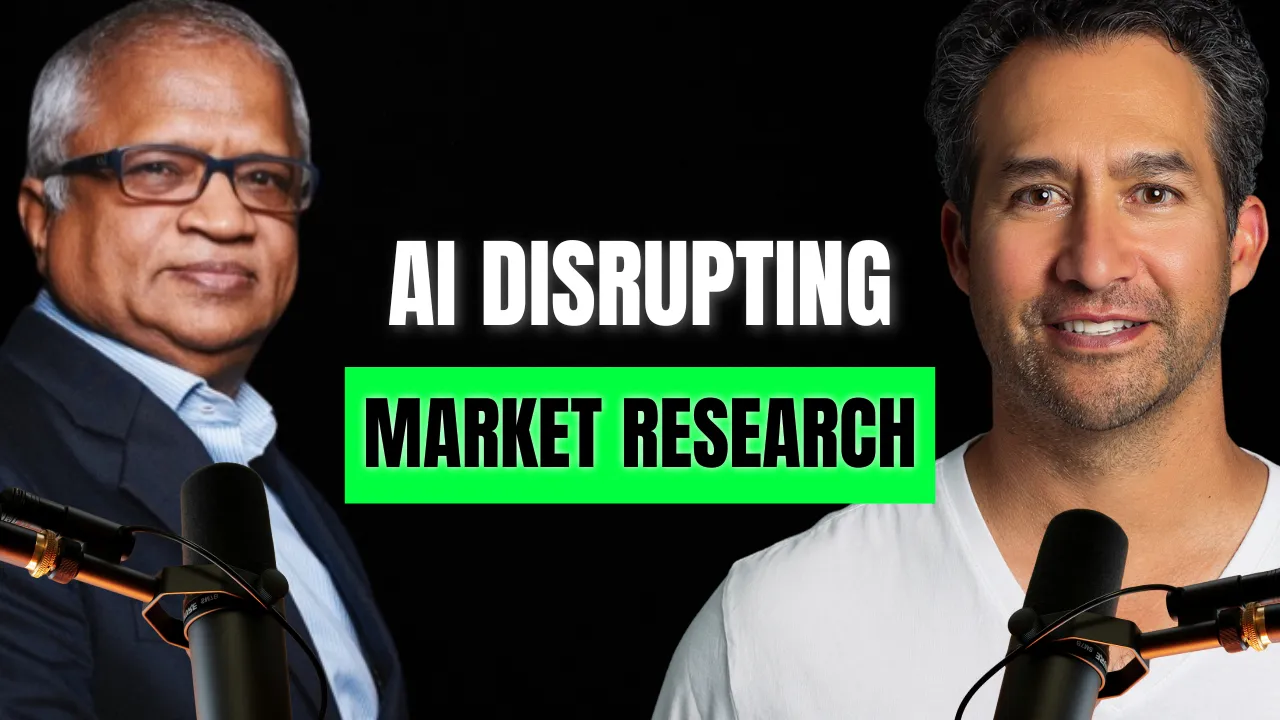
Jake Aaron Villarreal: I'm Jake Aaron Villarreal, born and raised in Silicon Valley, and here to take you behind the scenes to show what it's like to be a startup founder, the journey they're on, the problems they face, and the products they build in an effort to make our lives better. I'm excited to have with us today Puneet Shivam, co-founder and CEO of RightSkale. Puneet, welcome to the show.
Puneet Shivam: Thank you, Jake. Look forward to it.
Jake Aaron Villarreal: Well, excited to have you on here. Where are you joining us from today?
Puneet Shivam: I'm joining you from the Big Apple. I'm in New York City, Manhattan, and we are across the shores, I guess.
Jake Aaron Villarreal: Yeah, coast to coast. I like it. I used to live in the city and love that. It's one of my favorite towns. There's a lot going on, a lot of innovation happening, and has been for a long time. We'll jump into RightSkale, your company, and really more about your journey and what you're doing there today.
A little bit more for the listeners: RightSkale is an AI-first data and cloud services firm. An entrepreneur and former investment banker, Puneet led over four billion in technology transactions and was previously a board member and analytics leader at Inductis. He also serves as a board member and invests with founders at the intersection of strategy, capital, and scale to build durable, category-defining companies. So, we'll dive into your company and the problems you're solving and the market in general. Before we do that, Puneet, walk us through your background a bit here. What were some of the early experiences that shaped the path you're on today?
Puneet Shivam: Very interesting question, Jake. So, I started my career in strategy consulting in New York just before the dot-com boom and bust. It was a company called Mitchell Madison Group. We were a top strategy consulting firm, and like many companies around '99 or so, we bet big time on e-commerce. So we started taking stock instead of fees, and of all the stocks that one can now only remember, pet.com and others, and also went public under the brand MarchFirst. That's when I first realized how entrepreneurship and capitalism works.
During the dot-com bust, which was in 2001, we actually went bankrupt from providing TV ads. We used to advertise on TV, which a B2B company should not, I guess, but we did, and we went bankrupt. That was my first rub with really seeing how things go up and down, especially in the technology world. But we were lucky, and we were kind of, call it astute enough, or maybe audacious enough, to use that opportunity to break away a group of people from Mitchell Madison, the company I was with, to start my first venture. I started it with a founder, and we built what was probably the first data services company. So we kind of—it's almost like from the ashes of the dot-com bust, we started literally I think in 2001 or so. We built it to be a very, very strong data analytics company. At that time, "big data" and "AI" were not the words people used, but it was a big data analytics company. Today it would be called an AI or big data company.
We exited that company and then, together with our acquirer, went public in late 2000s. Then I decided to switch vantage points. Staying close to technology, but changing the vantage point from an operator to building a capital side of the business. I started the US subsidiary of a bank which eventually was acquired by KKR and just now it's public news it's being acquired by a Japanese company called Mizuho. So in that case, I invested both initially only as a company but then as an individual in a number of technology companies. I saw how founders and entrepreneurs take the journey, sometimes with all the roughage. Towards the end of last year, I couldn't wait out of the AI trend—the remarkable impact artificial intelligence is making—so I took a stake in this company, RightSkale, to go back into the trenches. And here we are, building AI-led services now. So I couldn't complain. It has been a journey with ups and downs, but one thing has been consistent: I have met such amazing people that I cannot call myself anything but fortunate. So that has been the short form of the journey.
Jake Aaron Villarreal: Yeah. Well, you've got an interesting perspective because you went through the process of building a company and then selling it to KKR. You know, most entrepreneurs dream of building something that gets acquired, and maybe it puts them on the other side of the fence where you're now looking and assessing companies and founders and deciding where to place bets and where to invest. Leading up to this podcast, you and I had a conversation and discussed part of that experience. Over 15 years of building that company—it wasn't a short stint of creating a product or platform or service company and getting acquired. It took 15 years. And you mentioned that the middle of that was a little bit of a mess. Even though the bookends look great, there are always challenges and tribulations in building something. So, what happened in that messy middle and what was your big break that kind of helped you push through?
Puneet Shivam: That's an extremely astute question, I would say, because in my view, any venture or company that starts goes through a period of what I will call a "family generation" and then it becomes a "sports team." What I mean by that is, in the beginning, it's a small company. You can win in your small space. You work with people who you know personally well, so you can work with a lot of social, personal—which I'm calling "family type"—capital equations between the founders and the team. And you are winning small, so that approach is one approach which many companies start out with.
But there comes a time when you want to institutionalize. You want to really go beyond the initial group of people and manage and work with people who you don't have a personal, close rapport with. That transition from what I now call a family structure to a sports team structure, where everything is measured, nobody has a seat guaranteed at the table, and you have to become very metrics-oriented—that transition, first of all, can never be done right in one go. And there is a bit of letting go of something that you had built. That transition is very difficult. When I think of that middle period, our aspirations grew to be institutionalized, but our culture and behavior remained, you know, the warm and fuzzy little bit. And that transition is the one that I found was very, very tough. You make decisions differently. In fact, a partner of mine said, "It's like driving a car and while the car is running, converting it into a plane without stopping the car." So that's the kind of journey many companies go through, and that was the period which was rough.
The break, I think—and I think it's a systemic thing, it's not just chance with us—is when you go through those transitions and you are willing to take those bad days, something puts you on the map. So I don't want to name the exact transaction, but there was a transaction in which we got a chance to run this small group of people against Goldman Sachs. And the way the decision was made, we actually became joint partners with Goldman Sachs in that particular transaction, and that put us on the cover page of some magazines. That was probably the time when we were institutionalized. It didn't happen in a very, very pre-planned manner, but we just continued hustling, continued believing in the dream, and the break came. After that, one thing led to another, and we couldn't even believe what we had built. At some point we said, "Oh, this is what we have built. Amazing." So that was the middle part I was referring to.
Jake Aaron Villarreal: Yeah, got it. Well, going from that experience and being acquired, you know, the transition is easy. A lot of people would just hang it up, go live on a Caribbean island, and be kind of done with their career. But you jumped to the other side and started investing in companies, too. What was it that you learned being on the other side that you applied moving forward after you jumped back in to RightSkale? I mean, what were some of the things that maybe others can learn from, that you saw consistently when you started investing in companies, where you felt like, "Here are things I would not do if I was to build a company again," or "Here's what I would look out for if I was to decide to avoid problems"? What are some of the learnings there that you learned, and then we'll jump into the company you're building.
Puneet Shivam: So, Jake, I'll answer that question in two parts. One is that a lot of learning that happened during this period was about myself, and some of it was not very comfortable. Because there is a narrative which is considered a cool narrative, I would say, but that narrative is average, and I think none of us are average. We make up the average, but we are not average. We have our own things, and together you do a mathematical thing. So learning and being very clear about what brings the best out in you, and what you don't want to or can't do—even recognizing what I cannot do well, right? Everybody can't do everything. What really brings out the best in me? That was a non-trivial learning. And it's a learning which is your own learning, because nobody can tell you about you. Your mentors and friends will give you signals, and that sometimes is very misleading because depending on the person's personality, either they are being very supportive or they don't want to say no. So it takes time to get to what is your journey. It's said so many times, but it took me years to really figure it out literally. So the first learning was, "What is me?" right?
And the second thing is, then once I figured out what is me, I've tried to think of where I can make sense in investing and advising, but also making sense where I'm unable to advise and really saying, "Guys, I'm very good. Thank you for inviting me. I'm honored, but I will not—I'll screw it up." That clarity makes you feel so cool and so calm. But what is that for me? It's that I am able to give my best in companies where the motivation is not something I have to bring. I know my friends who can go in a sluggish company, nudge, push, shout, and get things done. I had to figure out I work best when I am with motivated people. I don't work best when I have to change it and go through that. That's not my best. So that's one learning. So I look for people who are motivated, excited. That's one thing I look for.
The second thing I look for is where people are pure capitalists. Many times the other fuzziness, passion, all this, it gets—it sometimes in my view becomes an excuse or a deflection from the real honorable thing, which is if you follow capitalism very well, you actually come to great outcomes. When you mush that up, "Okay, we are not doing well, but we are doing this," I don't do very well. I do very well when there's a singularity of purpose of capitalism, which to me is creating real value. You do great things for your clients, prospects, partners, then money comes, right? The capital is a proof. So that's another thing in my investing philosophy. I say, is the group—and even where I become an investor—is the group motivated? Are they really purists in their view that let's create value and participate in the value? If you have to explain value 10 times to someone, "Oh, you don't get it." I'm very good, but you don't get it. I'm not very fit for that. That's the second thing.
And the third thing, I also look for people where the view is actually longer term. I know there are a lot of companies today which make—I'm a big fan of them—many of them that turn quickly, create value quickly. But my experience has been that that cannot be the starting point. If you're lucky, great, but if you are not taking a long game view, your chances of being lucky are very few. And you are probably creating an environment for you and your partners, whether investing partners or management partners or employees, in a wrong way. So I've used these three or four guard rails to narrow down where I can spend time.
Jake Aaron Villarreal: Yeah, that makes a lot of sense to me. And you know, you have your own philosophy. You talked about the motivational aspect. I'm a big believer in that, too. I mean, how we look at it, there's two types of motivation. It's the pull motivation where you're driven to do it because you feel like, you know, it's pulling you to do it. And the push motivation, which is you're having to push yourself up the hill, push the rock up the hill to do the work, but it's really not the path of least resistance. And we kind of talked about this a little bit in our first conversation, about how I'd gone on this big global travel, and as part of that travel, I had to do a big shift mentally, which was, you know, things aren't always going to go your way. It happened to be when I was in India, where I kind of decided at some point to go with the flow instead of trying to work through every little issue and negotiate and get it done my way. You know, just turn around, go with the river, flow with the direction it's going, and you'll kind of find your way and it's just more enjoyable too. But ultimately, I think you end up going where you need to go and getting there the way you should be getting there. So the same is with business. I mean, we've done the same with our own business and kind of taken a path of least resistance, but also navigating it where it's pulling us to wanting to solve problems. So from your perspective, you've been on the build side, you got acquired, you were on the investment side and placing bets with different companies and operators of those organizations, but you decided to jump into a company and really build it and launch it. Talk about RightSkale. What was it you saw in the company that you wanted to take this and really dive into and see what you could do with it?
Puneet Shivam: Yeah. So Jake, you know, one thing as you said, global travels. Even in our first discussion, I believe travelers have a unique mindset which I share, right? It's that the place is not defined by how good it is, but a place is many times defined by how new it is. You are living in Silicon Valley. It's great, but you don't stay there. You go somewhere else, right? I live in New York, it's great, but I go travel. So I believe that traveler mindset transcends into experiential choices of life also, or business in this question you asked. So for me, I was very sure that when it becomes something where it's not new enough or it's not adventurous enough, I want to do something else. It has been actually the trend throughout, right? I have just gravitated initially not being able to articulate it, but when I look back, I say, "Why did you decide that?" And then I could articulate, because many times our actions tell more than what our perception of what we want is, because generally life takes you where you want to go. And in the end you have to say, "Okay, this was by my choices."
So when this previous bank got built and we had great success, it started getting to a point where the institutionalization was really strong. But what that means is that, you know, one analogy one can use is you move from a sailboat to a cruise ship. We discussed it the first time. So when you're on a cruise ship actually you are in a very good position and you can feel tremendous pride in building it, but I'll tell you that doesn't seem that adventurous. Because actually you can go to your cabin and sleep for 2 days, nothing changes. In a sailboat, try doing it for 20 minutes and your direction changes and you are under the weather, right? So I do want to seek my next adventure.
My decision making generally is—you may know of a principle called Ikigai. Some of your audience may know it's a Japanese principle which helps you decide what you want to do in three categories: one, what you are good at; second, what you love doing; and third is what you add value to, right? Which is my capitalistic thing. Where do you really, what you're good at, what you love doing, what you can add value to, and that center of that becomes a simple set of what you choose. So when I started that exercise in this choice, I'm very experienced in the technology ecosystem, where technology is going, technology trends. I know a lot of technology people. And I'm obsessed with the overlap of technology and capital. I mean, those two things I played with and I'm so, so intrigued by that. It just makes me get goosebumps that technology and capital, when they play together, they do very well. So I love that. And third is that, you know, the world does need a way to absorb AI. AI is an emerging philosophy, not even just a technology of doing things differently, and that's what really I got into.
So with this Ikigai, I was sure that this is the space I want to play. AI in a place where there is technology and there is a root play of capital. So when I selected this, it brought up RightSkale as a company. Now I overlaid it with—I told you earlier the way I work best, I work very well with motivated people. So the person who really initially started the company, my partner Mitch, whenever I'll meet him it'll be like, you know, we will just go talk about things. So he was excited, the team was in the right place. So when I thought of RightSkale and the future of RightSkale, we actually call ourselves "Bridge to AI", which is basically we take companies, enterprises, and take them from current technologies to absorb AI with a meaningful impact on their business, very outcome focused. So this seemed like a place which will have a lot of value, to create value, to participate in the value, and a lot of fun while doing it. And I'm back into learning. I'm an engineer by training, but I'm back learning into all the technologies. I have a personal coach who's training me about the new technologies. So that's how I got into this new phase. And right now I'm all in. I have a dream to make this company something great over the next 5 to 10 years, and yeah, I'm blessed with right partners and right space. That's where, Jake, we are.
Jake Aaron Villarreal: Yeah, really cool. Well, you know, it's a big space. There's a lot of service providers, there's a lot of companies trying to figure out what AI can do for their organization. A lot of proof of concepts that are happening. Talk about your service and like, how are you differentiating or where is the wedge you're getting into companies and how are you helping them with AI today?
Puneet Shivam: Jake, very nice timing of this question. Last week I was on the West Coast actually having a discussion on strategy and all these questions that you mentioned in front of us. Jake, the way we are addressing kind of both our differentiator and our place under the sun is that one, like we said, "Bridge to AI." So we are very aware, because there are many companies which are like, "Oh, look at this great thing I do with compliance or something," but only AI-centric. The issue is that companies have a lot of data and technology already installed. It's working very well, quite well. So for them to move towards AI is not like just dropping something new. It's like building on what they already have: data being there, managerial processes, people mindsets. You know, people's mindsets don't change overnight. So one "Bridge to AI" path we are taking, Jake, is that we want to walk with our partners and customers to take them to AI. We are not saying that just tomorrow we'll bring these new things, pull out everything else, put it there. We recognize that there is a buildup. So that is connecting very well with the market.
The second thing, Jake, which is somewhat a buildout on this, is that we go very close to the customer, our prospects and customers' business, and we put execution ability pretty much on top of our list of recommending solutions and building solutions. So we know that, you know, most companies have a business to run. They have a quarterly or annual target to meet, whatever their objectives are, which are business objectives. We want to be incorporating our solution within their business goals. Which is again, I would say, not like just that jazzy new thing, it's basically working with the corporates and clients to get there.
And then the third leg we are betting a lot on is "man plus machine." So while we are on this journey, we keep continuing to build plugins, tools. When we show up, we bring a lot of pre-built things to do, so the time to proof of concept—which is, I think, a little bit overused, good, but the time to see whether this solution will really create value for you or not is short. And we are willing to say, "Okay, it doesn't work, let's move on to the next attempt." Our nimbleness also comes into play now. This is very much possible at our stage of the company because we are not always worried about, "We have, you know, built that for a company," or "We have a thousand people who are working for that. How can I come up with a solution where a thousand will become 500, and what will happen to my revenue?" We have no such burden. So those things are connecting very, very well with the prospects.
Jake Aaron Villarreal: Yeah. So, if you're in the market and you're looking to help companies, you know, implement AI or create some way to, I don't know, automate a business workflow or reduce costs in the organization, whatever it happens to be, whatever the objective is the company's looking for, the customer wants. When you're going to market, what type of companies are a fit for what you're going after in terms of your target audience? And within those organizations, what is the persona that's interested to hear what you have to share?
Puneet Shivam: Yeah, that's pretty diverse. But a few ones that are currently there, and we keep expanding on that. So one is the product companies themselves, whether it's ISVs, SaaS companies. So they are developing their product at a very fast pace and they have to build in AI within their products. So we become their partners in their product development journey because they are trying to do two things. One, use AI to produce faster. So that's like improving their engineering teams' productivity. The second part—actually there are three parts. The second part is their product itself has to become AI ready or AI enabled. So that's the product design part. The efficiency part, which is coding, which includes QA quality assurance, others, how do they run their business. The second is what product they are making, and third is actually these companies also have a lot of information technology, like cloud. I mean, they are companies, they need all the systems companies need. So this is one area we are finding these are not easy challenges for companies. They're doing these three things together. It's like a bank would only deal mostly with one thing, which is improving their IT, you know, the cloud infrastructure. But these companies have to code better, have to design products better, and while doing it, design their companies better. So we are connecting very well there.
We are also, you know, facing the big challenges that our economy and industry faces. One area we are getting good traction—we are about to actually announce just in the beginning of the new year a pro solution—is that you must know everybody, the healthcare systems are very complex. But the financial side of it, which has been on the news lately, that's a very complicated system in a society which is changing both from the economic structure of the society as well as the demographics of the society. So we believe that there is—we have an expert with us working, our head of healthcare vertically—we have figured out a place where we think we can make a meaningful impact into the healthcare financial side of the healthcare commercial system.
And you asked a question about persona, Jake. That's a very, very good question because that's very relevant to us. We connect best with people who are positioned in their organization to use AI, or even tasked by their organizations to use AI to make a change in the organization. It may be a technology organization, a finance organization, a healthcare commercial organization. The people who are empowered to do that are the ones we connect very well with, and we make their life easier because we can do it in an experimentation mode with them. Because nobody really knows that this is a five-year plan. This is a two-year plan. So they are trying five, six things and given our size and nimbleness, we say, "Okay, let's try this thing. No, it's not working. Let's try this thing." But we connect best with people who are empowered to use AI to improve their own divisions or across the board.
Jake Aaron Villarreal: Yeah. Got it. You know, I heard recently that Mark Cuban, you know, the previous owner of the Mavericks NBA basketball team, he was saying, you know, he was asked where should people, you know, be telling their kids to focus on as they get into the market. And he said the best thing they could do is understand AI and the tools and the technology and be able to go to companies and tell them how they can use technology to make their businesses better, and go in there and provide services that helps. That's really coming out of school at a young age with small to medium-sized businesses. But we know that there's enterprise opportunities that are kind of all, you know, front and center.
When you look at organizations today, is it the companies that are building the AI technologies or the SaaS companies that don't quite have AI yet, but they know they need to have AI, that you'll be able to support those organizations and help them get to what they want in terms of their product and their features that is a benefit to what they've already built? Or is it also like you said, banks, like maybe the bigger companies, the enterprise organizations that have it and have systems and have process, but they're being told by their CEOs to "Hey, what do we do with AI, and let's find a firm that can come in and help us understand what it is but help them bridge that gap and implement it"? Like where—it seems like you can go in a lot of different directions, but what I want to have you share is for the listeners out there that might have their own companies, their SaaS products, it could be the big banks, who knows. If they were to hear you talking, where is there the right fit for you?
Puneet Shivam: So you said three categories. I just want to make sure that I got it. So see, one category, just to give an example, is the companies like OpenAI, right? Which is really doing the heart of AI build. Right. Then there are SaaS companies you said, called Workday, whatever, right? So they are the companies which are SaaS companies, ongoing business, solving a business problem but can do better with AI. And I said three elements they can do better: they can code better, they can design products better, or they can run their companies better. These are billion-dollar companies. And the third one is companies which will not traditionally call themselves a technology company but are using technology to deliver something.
So the first one, Jake, we have found is that the people who do that are an extremely proprietary set of thinking. OpenAI, Gemini... I mean, these places are a little less relevant to us, or we are less relevant to them because they are really doing something which they are keeping under wraps. There is a land grab going on. There are only a few such companies, but those companies we do a little less work on.
The middle one you said, the SaaS companies, product companies in all their three pillars, we do a lot of work. We are very relevant to them even at a relatively small size because, in these companies now, not going to too much business jargon, but size is sometimes not directly correlated to the value of these companies because these companies are starting on the revenue journey. So that's why you see ridiculous valuations, which looks ridiculous now, but companies grow into it. So those companies which have a smaller revenue but a lot of modernization around their world, we fit very, very well. We have a lot of clients doing work there because we also become their experimentation partner. We are not looking for, like, "Give us 10 million of revenue in the next works." So among the people who are building those technology companies, have gone through some rounds of funding, are nowhere going public, but we are a very big support to that.
And the third one is really very, very ripe. Like I said, the healthcare market ground for us, especially where in the pockets there where executives and technology leaders are absorbing AI, trying new things to do AI. We are a very, very good fit with that in the medium to large enterprise.
Jake Aaron Villarreal: Got it. Yeah. And the reason I asked that is we've got many companies that we work with that are in that space around SaaS, and they already have maybe you know, thousands of customers, you know, tens of thousands of customers, but they're wanting to roll out AI that could really impact the growth of their own company. And quite frankly, they just don't have AI engineers. They don't have a strategist that knows AI and how they can come in and really begin to implement or build something on the product side that, you know, it's going to take them a lot of learning to get up to speed on. So, even for technology companies, there's, I think, a ton of opportunity to help them, too.
Puneet Shivam: Yeah. And much bigger than you think. They really have to move fast on this, and many of them are moving fast. But like you rightly said, you know, the time to market which was always important is now super important, and they have to move extremely fast to do that. And that's where we come in, right? So we can ramp up extremely fast, actually, because both our own people and our network into the ecosystem is such that we ramp up at a pace—like we have had requests to say, "Can you have a launch, which we are designing in March, can we have a team in place in December?" And you know, and we have been able to do that. So that's one strength we very much pride ourselves on.
Jake Aaron Villarreal: Yeah, you know, you talked—uh, you actually shared in our call leading up to this a quote by Ben Horowitz saying, "People underestimate technology's long-term impact but overestimate it short term." We're 18 months into the ChatGPT moment. What's one AI use case you think will actually transform businesses in 5 years that no one's talking about right now?
Puneet Shivam: It's hard to say no one is talking about because people are talking a lot, so everything is like talked about, but I do think that a few things will change dramatically, right? I think the organization of information within companies, actually in our lives too, but companies in this case, will change dramatically. I think the way information resides today—I'm not only talking documents, I'm saying the information resides, a lot of it resides in people, like middle management, colloquial language, colloquial knowledge, how systems work. I think that will change so dramatically that short run, like I still say Ben Horowitz is right, but five to seven years later people say, "Were there those roles? Like, those roles existed where people did that?" I do think the flow of information within the organization and through the society will be at a different pace and very, very fast. And we are in a knowledge economy. So if the flow of information will change, our economy will be different because most of our economy is a knowledge economy.
And imagine even if that dramatically changes, the change is like, you know—for example, a very practical example would be let's say we do solutioning concept presentations to our prospects saying, "This is how you should do it." Right, Jake, that in our brief one and a half year, let's say two year period, the period has shrunk from 3 weeks to three days. And this is a short period. Now this is not only that. Once we create a solution, even though it may not connect with that prospect, that solution is now forever part of our all future solutions. So this is a compounding effect. And if you know how compounding works, it looks slow, slow, slow, slow, slow, slow, slow, and one day it just grows through the roof. I think how knowledge is organized and managed, it will be. Because I'm seeing it day to day and it's going to be like, I don't think we'll recognize 5 years from now what we saw. So that one change I think is really going to change things.
Jake Aaron Villarreal: Yeah, I love that. I love that answer. You know, technology is one thing, but it's really the people behind the technology that are the innovators. You manage teams, you know, globally, across multiple countries and over 125 people today. From your experience, what has building teams taught you about hiring?
Puneet Shivam: Yeah, by the way, we are about 400 people. What it has taught us, Jake, is this. First of all, you know, there was one thing which is... you know there was this, I think I have been trying to break even in our company and worldwide. There was a world where people used to talk about "years of experience". That seems so irrelevant to me to talk about it. Because if you live the same way for five years of experience given the discontinuity we are at, beyond the limit it is actually a handicap, not a positive. So the way we judge in our system and which I think will extend into the way we evaluate people is so different, and we are still figuring it out both in terms of the objectivity you can bring around it, right? Which is you know, resumes, you can do external checks, all the fibbing can be checked out there, a lot of things you can do improving the process, but I think that's just one simple... that's the knowledge management part.
The people you select for the future are different. The metrics have to change dramatically. Not significant, not minor. And dramatically I mean that the learnability, the curiosity and the ability to forget seniority, experience, all that is the place we need to look for. And the people we will like... you see that like a traveler, right? Let's say you just took a sailboat and you just landed on the shores of a mountain and then you have to start climbing. You cannot take your sailors. I mean, you should maybe as a friend, but the skill that will be needed is not a sailor skill. The skill you will need is a mountaineering skill. And whichever company, I am convinced, whichever company can separate sailors in this example from mountaineers will win. If they say that sailor has been sailing for 20 years and he's a great sailor, I think those guys will lose out.
So I think the human resource, as you said, managing the people is moving from obviously doing the knowledge part but selecting the people who have high hunger, high curiosity, high learnability, high flexibility is the way to go. And then the last part, that's in managing those people also. How do you motivate those people? Like if you have gotten good people, the motivation has to be done in a very, very different way. The typical hierarchy, you will get a new title, some more salary, it's not going to work. I think what will work is people go directly benefit from the value they create because, you know, whatever they create they create great value. And one thing which I'm promoting a lot in my company: work for pride. That you know, you will know when you're doing well. So you know when you feel proud about what you created, you're doing well. So I think many of these metrics would change dramatically. So it's one of the biggest I think changes will be in how people think of their career and how people think of managing other people and how people think of you know, creating value. So those things will change. As you can see passion. I'm like this is a you know, it's a beautiful thing that...
Jake Aaron Villarreal: Yeah, well you know business is 80% psychology and 20% execution or mechanics. So it's people are everything, and being able to find the right ones to nurture, to support, to provide a vision where they can join a company and be excited about it and execute... you know, there's a lot of decisions that have to be made to get the right people.
Puneet Shivam: Yes.
Jake Aaron Villarreal: You mentioned um that within a company or maybe just individually, that excellence isn't a goal, it's a habit. You also referenced the movie Inside Out as shaping your business philosophy. Walk me through how you actually apply that framework with your team. And for those that haven't seen Inside Out, just a quick substance context about that.
Puneet Shivam: So, Inside Out is a movie um, like many movies, like Dr. Seuss books. It's ostensibly targeted at kids, but if you're listening well, you see it speaks to everyone. So, it's one of those movies I actually highly recommend people to watch this movie with this context. It's talking to you. Believe me, it's talking to you. Jake, you remember in the beginning when you asked about my journey, what learning? You remember I said I learned most about myself. That was my first point. So Inside Out is really tying your own or your friends' or your colleagues' behavior and character and intent to what is inside them. And if you can tie it to what's inside them, it becomes the intrinsic motivation or intrinsic drive. If you can help them distill and help yourself distill... because everything we do is actually inside out. You can even go to extremes and say that actually there's nothing out. It's all inside. But that's kind of a philosophical point.
Inside Out is, you know, how do you change those small things which, when they come out, we try to control? Like, you know, think of a projectile. You throw a projectile, it's off like 20 miles away. Trying to control it is very tough. But if you control it at the launch point, you can do very, very great things, right? So Inside Out is basically controlling your motivations, your interests, your intentions at the source, and at times you can, you cannot, but that awareness is very, very good. So very important. So Inside Out is that, that you can isolate, and many times it also goes into managing your leadership behavior. Because if you could know that "I'm feeling mad right now, why?" Many times it seems I'm not mad at the person in front of you. I'm mad because that happened. So that clarity of self-emotions is really... I really believe people in our company, world who are extremely high performers like Warren Buffett or like Musk, I think they are so in touch with... they don't tell us, but they are completely aware of their inside mechanics. So once you know inside mechanics you multiply. So that's the inside out.
And the first question you had raised was about excellence, right? So actually one aha moment of Jake in my life was because I am very well educated, right? So I had read many books and I was thinking that intelligence and when you solve a problem that's the beauty, right? That youthful you know, that "I can solve this problem." And then it occurred to me that so many problems people have solved correctly, but the world has not changed, right? Whether it's war, famine, whatever the big problems, health. So intellectual solutions don't become... like most people know some things are bad to eat or bad to drink, but people do it. So one aha moment for me was that when I realized that actually all that, unless it translates into habit, it's just on paper. It has no meaning. So I believe that everything we do has to translate from a well-intent, like inside out, well-intentioned everything, but really you have to translate into a habit. Habit is the only way to do anything meaningfully and substantially because, again, compounding, right? Compounding can only be done if you have a habit. If you don't have it, you try one thing, you leave one thing, it's great. "I went for a workout from 15th January to 21st January and then I'm off." Unless you translate into a habit.
And I then extended it to saying, can excellence be a habit? And then I looked at people around me who I respect, and I think excellence is actually a habit. Excellence is actually like, you know, the table is kept here. You see that, you fix it a little bit. You write a sentence, you say, "No, that word doesn't make sense." You set up a colleague for feedback, and next time you say, "No, no, that feedback is slightly better." So this excellence, because if you see some of the sportsmen stories, right? Michael Jordan, Tom Brady, you will find that they didn't stop. They just kept going excellent and excellent. So I do think that if a company can make excellence as a habit in their key people, because then it rubs off. It can just do a dramatically different output. And you can see companies which have done great like Amazon. I mean, you see some leader change, like Satya came to Microsoft. You see Steve Jobs' imprint even today on Apple because it became a habit, right? They don't stop. If the slight—if you have seen their iPhone, nothing is out of place. It's like everything has and that's the excellence habit they have. So yes, excellence is absolutely a habit individually. It can be cultivated and organization position needs to be calculated. And that's why you see—one last point I'll make—certain sports teams, every player has changed, but they still win. So it's not the players, it's something about the team, right? So why certain country teams win always, although all players have retired now, right? And maybe some have passed away. Why does Argentina play good soccer? All players change. Why? Because excellence is an institutional habit in that, in that, in that...
Jake Aaron Villarreal: Yeah, it's a really good point. I agree with that. It's those habits are built from leadership that becomes part of the culture, that you understand how to train on it. And then you also look for finding the right people that have the ability to learn that, which is part of the process, the secret sauce. When you interview people, you can start to look for the things that you know are going to help fit into your culture, which could be habits of excellence, and being able to train people on that based on the signals you're seeing from them. You know, I want to kind of, since we're on this topic, and we'll kind of keep it here with a little bit more on the personal side, human side, then we'll kind of close with a few more questions around your company. But you talked about prioritizing your thinking and emotions the same way you prioritize tasks. You know, companies that are startups go up and down. There's ebbs and flows. What's your actual process for managing emotion during those times when things aren't necessarily always great, but you know, you're going through some ups and downs?
Puneet Shivam: Yeah. So, actually, I follow a pretty structured process. I have a three-step process, but I'll tell you some other time. Let it be a surprise. But, uh, the way I manage it is that I am actually a big believer in diversification. So what I do is I have a good set of business and personal friends who are not part of my day-to-day business. They are a continuous part of me for having talks, thinking like this. And so what it does is that the obsession with one single tune, if you can call it a tune, goes away because I'm talking to these people. And I talk to these people across jobs, across initiatives. They are changing, I'm changing. So what happens? They become the key, right? They become the steady part of my life and they change very infrequently. So what it does is that it takes—avoids me from taking my things too seriously, because there's a bigger world, and many of them are, you know, one friend's company is just going public. So what happens is that you see things in a very broad context, right? Because they are dealing with all those, some success, some failure, but the discussion is not on your day-to-day life. And I think just some bit of separation creates a tremendous clarity. Like you know, if you are very close to a painting you don't see it. You just need a little distance and you say, "Oh yeah, that's a painting." So that I use as a very thorough thing to just have a different ecosystem which is where I'm not obsessed with one ecosystem. And that has been very, very good.
And then the other thing which I use, which is a small hack, but it works very well, Jake, for me. And maybe I get very stressed, let's say, someday, right? Whatever. Let's say it's December and I suppose something stresses me. So I ask myself two questions. I say, "Puneet, do you remember 18th of December 2024, what was stressing you?" And if you're like most people, Jake, you will not know it. You will not remember what stressed you unless it was a big event like 9/11 or October 7th. So then you realize things don't last. Feelings don't last. If you couldn't remember one year later, how stressed can you be about the thing? Most likely you will not remember what's happening today one year from now. So if something is so short-term, how much stress can you do? In fact, many times I've tried to look at my calendar what stressed me, and I sometimes can make out, but obviously the feeling has dissipated completely. So by putting in that hack, it's a very, very practical hack. You tell me Jake, what stressed you on 18th December in 2024? If you're like most people, you don't know. You don't.
Jake Aaron Villarreal: So imagine you don't remember. I, I like that hack. Yeah.
Puneet Shivam: So it's so easy to do, and you can do it with friends and others. If your friend is stressed, you say, "Okay, what were you stressed about then?" And they draw, and then it brings a sense of humor and things get off track. I use that very systematically. Now a few things do stick, right? I'm saying 9/11, I was in New York or it was like, you know, October 7th in Israel. A few things do stick. But they are—then you realize the bigness of those things. Whatever you're worried about you say, "Oh, this will not stick. That was like a world-changing event, and this thing..." So I think that hack, that hack I use to do. And then the other thing, Jake, that plays out is given my previous experience, I have been in, like I told you, disaster situations. Now you can say twice have been there. And you know, we'll deal through it. So that experience also gives you the perspective and that wisdom really of knowing that things don't last forever and you know, emotions don't last forever.
Jake Aaron Villarreal: So it's challenging I think maybe for earlier startup founders who haven't really gone through it, where I'm talking like real stress where you're at the look into the abyss, where your company doesn't have any more money, where you can't make payroll, where you're going to go out of business, where you know you feel like you're going to fail. Real failure. Those are moments that you still need some perspective and some ways to manage through that, and you get through it. I mean, we've heard so many stories of how people do it. One hack that I like to use is really if there's a real critical process that you're trying to navigate and you're just not able to get through it, is just to kind of find some time on your own and just start to think about the things that you're really proud of, or real experiences that you remember that bring you happiness. And it doesn't sound like it would do much, but if you kind of meditate on maybe three to five moments in your life that were incredible, it's hard to feel fear when you're feeling gratification. And then it is just enough to kind of get you out of those moments, and then you can think clearly, and then you go about your day and strategize, and... but in some ways it's somewhat like a meditation. Again, it's a mental thing, but it's worked for me and it's worked for thousands of people too. We've actually seen...
Puneet Shivam: This is something that I learned. A very, very, very good hack, and people have written for centuries about the power of gratitude. It's a version of that. And I think you're absolutely right. If people could just thank for, like you're saying, great moments that happened, great people came in their life, sometimes you realize how transient the current issue is. No, I like that 100%.
Jake Aaron Villarreal: Well, let's go back to your company here and we'll end. Uh, I could talk to you forever. In fact, I need to make some time to, to, to connect with you next time I'm in New York. I think we'd have a lot of fun to talk about. You know, where you're at today as a company. I said 125, I didn't know you're at 400. That's much larger, which is great. A lot of opportunities, a lot of growth there. Fast forward 18 months from now. Where do you see the gaps that you need to close to even further accelerate your business, whether it's operationally, whether it's systems, whether it's people? Talk a little bit about that.
Puneet Shivam: So the gap which I'm most conscious of—there will be many gaps we'll have to fill. We are at a stage where you know, everything needs to be changed quickly, like I told you earlier, right? The one that I'm most sensitive to is people. If like the... I told you hungry, motivated, excited people... if I can get enough of them in, that would be the real, real test of us, right? And test of me. Uh, and the other thing which 18 months may be a little bit of touch and go, but if you put 24, 30 months, is that I also want to challenge our leaders to have a homegrown star in 30, 10 months. Like a guy or a girl who's a star, but when they started they were too young or at least they did not know they are a star. If I can make a star foundry out of RightSkale, Jake, the world is the limit. I mean there's no limit, right? I just have to find a way to go star foundry, to create stars, hone stars. Because that's the, that's the way to really build something which is really big, really huge. Because no one person can do it, no 10 people can do it, no 100 people can do it. But what can happen is if you become like great institutions like Harvard, or great companies like McKinsey or Meta, what they have been able to do is that because they have a promise of making you a star, the most starry-eyed guys or girls join you. So if suppose people applied to me when they were starry-eyed and I could offer them that "We'll make you a star," the momentum that builds is unbeatable. It's very tough to do that, but you ask me the gap, I don't call it a gap, but if I could change that about a company, I think everything else... Capital, etc., when you have a good group of people, capital chases you. Capital is a strange thing. The same amount of capital is very, very fickle in that sense. It chases the same top people. So capital is very polar, bipolar, right? So everybody wants the same thing and nobody wants other things, which I think is a little lopsided. But once you are in that category, capital is at your beck and call. So that's why if I could make that, I would be very happy, and we would have made something great.
Jake Aaron Villarreal: Yeah, really cool. Well, 2026 is right around the corner. What's on the road map for RightSkale? What are you excited about?
Puneet Shivam: So, we have a bunch of... I told you in healthcare we are about to announce something. We have a bunch of initiatives on one, one very well-known SaaS company like we talked about. We are, because they want to dramatically change their efficiency, and we are discussing with them as we speak every week. We have a discussion if we can solve that because that's a dramatic problem. Because efficiency for that, if we can change, and then we can also change for other companies. At the same time, we have gone through a similar, I told you, a similar discussion whereby the management team is totally on board with the habit of excellence and bringing and making the stars, right? So I'm very excited that if I start seeing that journey fold, I'll be very, very happy. And if together we can be committed to excellence just every day, I would be very excited.
And the other thing, which is a little more external, Jake, but it's really, really uh exciting, and we have to play a key role in that: the new technologies that are coming right now, it's in a broad stage, right? So what happens, apart from some key LLMs, every time some new technology comes in, n8n, Lovable, whatever, right? So this will at some point start narrowing down. And at that time we want to be able to partner with the companies which are going to be the, you know... how many companies... depending on vintage, when Amazon, there was a company called Netscape, Yahoo, right? So Google, right? So what happens is that out of that pack, a few companies become mainstays. And I think '26 will start showing signs of who are becoming mainstays, and we want to partner with them. So I'm very excited about picking—it will not be a finite pick, but a portfolio of partners who are the future winners of this AI wave. '26, '27 will be really staying close to the market and making some bets. So I'm very excited about...
Jake Aaron Villarreal: Yeah, really cool. Well, Puneet, if anybody wants to find you, uh, they're going to get a great story because you, you can tell great stories from great experience. Where can they find you online and where can they find RightSkale?
Puneet Shivam: So, RightSkale is rightskale.ai. It's also on LinkedIn, but RightSkale is easy to find. Just RightSkale with a K. It's not with a C. So, R-I-G-H-T and S-K-A-L-E. Um, that's one place to find RightSkale. Slowly, I don't think people... I hope that there will be a time where people don't, will not need to ask how to find RightSkale. The second thing is, personally, I'm very, very much on LinkedIn. As well as, you know, on LinkedIn, if somebody sends me a message, I get it. And uh uh, you know, also if you write to me at my you know, work email, puneet@rightskale.com. I pride myself in responding. Everything except spam I respond to, because you know, I think, Jake, including people who are you know, popular and who have a voice out there, I think we owe that to people who are trying to find us with a good intent. The least we can do is to be available whichever way we can. So I take it very seriously.
Jake Aaron Villarreal: Yeah, well that's good to hear. Uh, I'm excited to see what happens with you and with RightSkale in the coming months and years. So uh, I want to really thank you for joining us today here. And I also want to thank the listeners for listening. It means a lot to me. You've spent your time with us today. I'm your host Jake Aaron Villarreal signing off for now. We can't wait to catch up with you all on the next episode. Until then, Puneet.
Puneet Shivam: Thank you, Jake. Thank you. And thank the listeners, and thank God for being with us today. Take care.
Jake Aaron Villarreal: If you like what we're doing, don't forget to subscribe. Leave a review on Apple Podcasts or wherever you listen and follow us on YouTube where we go behind the scenes to learn what it takes to be a startup founder.








































.webp)





.webp)
.webp)



.webp)