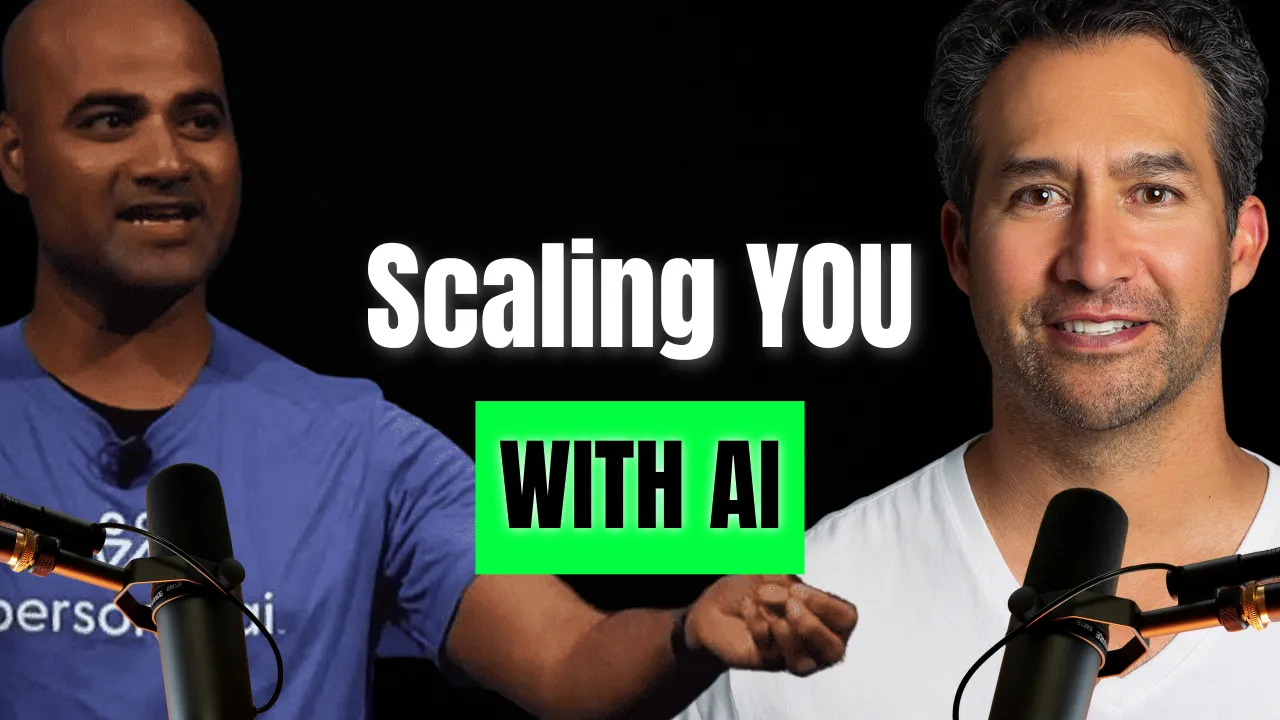
Jake Aaron Villarreal: I'm Jake Aaron Villarreal, born and raised in Silicon Valley and here to take you behind the scenes to share what it's like to be a startup founder, the journey they're on, the problems they face, the products they build in an effort to transform industries. I'm excited to have with us today Vinay Kumar, founder and CEO of Arya.ai. Vinay, welcome to the show.
Vinay Kumar: Thanks, Jake. Pleasure being here.
Jake Aaron Villarreal: Great. A little bit more about Vinay. He is one of the first deep learning startups, or he launched one of the first deep learning startups in Asia. They started Arya.ai in 2013 while in college. He started off building an AI assistant for STEM researchers in 2013 and pivoted to providing the most verticalized AI PaaS, or platform as a service, for financial institutions. He has delivered multiple talks globally on TEDx, GTC, WeWork etc. He is currently focusing on making AI explainable, safe, and aligned.
Well, can't wait to get into the explainable part. And Vinay, um, I guess before we dive into your story, give us a little background of your origin story. How did you get into technology and what was the bug that made you want to at some point start your own company?
Vinay Kumar: Yeah, I mean, um, so I'm an engineering student, which is by design, it's kind of in my genes to think about technology. Willingly or unwilling. So that's how I got into college. So I, I, I was in IIT Bombay, it's one of the most premier institutes in India. So as when, when we go into IIT, right, or or at least in any university, unlike unlike the uh marketing idea of university, you will have a lot of time in your hand you know, as compared to your college or school for example. So my course studies allowed me to think or or spend a lot of time beyond uh academics as well. Uh so that's where I kind of doing a bunch of things. Um you know I I I published a couple of novels because I wanted to publish, you know, I want to become an author in my first year, second year, that was a cool thing. Um at least to get introductions in college, right?
Um so that was there and then when I got into my third year, that's when academics kind of kicked in. Like my CGPA was not that good. Like people started kind of you know creating that FOMO that now is the time you should work on it. Um so that's when I started getting into research as part of my coursework. In third year I did a, a six months research around uh designing a full-fledged uh refrigeration systems. Uh I got an award for that that kind of kick, kicked a positive reinforcement that maybe you know I I I should probably focus more on that as well as when I got into my fifth year. So mine is your, you know, is is a dual degree where I'll do both bachelor's and master's uh within a five-year time, time period, meaning I have a very exhaustive uh academic work uh during those five years. So my fifth year is a research, full-fledged research where I'll have to uh you know uh spend very exhaustive time to think of a topic and then try to come up with uh a novel idea that can lead to a paper and become a part of my thesis.
Um so I think kind of getting into technology is by design as well because of the coursework, because of the excitement or reinforce, reinforced feedback that I got uh I know when when when I did that couple of projects. Um so that's that's how I got into it, but kind of I liked it as as as I started getting into more and more of it, because I was uh I was introduced to deep learning at that point of time. It was a very, very fascinating idea uh that kind of excited a lot to say, "Let's, you know, explore a little bit more about what we could do with this technology." You know this is 11 years back when there was no hype, when there was no you know all such FOMO or fap around deep learning or AI. At that time it was truly an honest effort to solve a problem right? Um so that's, that's pretty much is, is the background in terms of how I got into it.
U but I think the journey is also kind of very much you know ups and downs as well, because when we started we were a, we were a very focused research team in the beginning. We were lucky enough to raise funding in our first year itself when, when we incorporated the entity. The idea was to explore, you know, like any other R&D or tech-driven company, the idea was "okay, we are good at this technology, let's see what we do with that." So but we had a vague idea in terms of building you know some kind of assistant for researchers because that's our pain point, we being researchers as well. Um at that time the thesis was you are as good as the tools that you use and you are not good at anything anymore. These were the two statements that we keep on kind of telling people. Like there is so much amount of knowledge that is coming into the industry which means you're not an expert on anything at the moment right, or at any given point of time. So much is, so much is changing so quickly. That was one. And second is you could probably solve the problem when you have better, smarter tools. Which is what differentiates between let's say a human versus animal, right? Because a, a human is an outcome of the tools that we used during our evolution, for, for example. Uh that's what we believed in. Maybe a better tools, more tools and an assistant of sorts could solve these kind of problems. So that, that excited a lot, excited us a lot you know, it it could actually become a really big thing is what we aimed for. So that's that's how it's kind of we got into it.
Jake Aaron Villarreal: Hundreds of AI startups are launching every month, battling to build their founding teams. As a leader, your job is to get results. When it comes to hiring, that's where it gets tough. So you go out and you try a recruitment firm, but they don't understand your story. They're off target. And when they send you candidates, it's a waste of time. We believe you should never have your time wasted. That's why we launched Match Relevant, because your story is more than just an open role. It's your founder's journey, the problem you're solving, the product you're building, and why it matters. When we work with companies, we make sure we understand your whole story. So, we go out and do a search, we're on target, it's worth their time, they're interested, and more importantly, it's worth yours. And when it comes to hiring engineers, we work to make sure we get it right by deploying a team of seasoned CTOs that have built some of Silicon Valley's best companies. They can collaborate with you in the technical interviewing process. They can be a sounding board, or they can run it for you. When it comes to building teams, there's no time to waste. Let's make it count. If you have a role that needs to be filled, book a time with a hiring guide at matchrelevant.com and learn how we do it.
That's great. Yeah. Usually there's a model or someone you follow to be an entrepreneur, but it sounds like your path was getting into education, learning, getting excited about technology, and then executing on taking a technology and solving a problem with it. Um, what was the initial problem you were trying to solve? You talked about researchers, you talked about tools. What was the initial thesis that you wanted to solve? And then let's talk a little bit about, we'll get into more about what you're doing today.
Vinay Kumar: Oh, sure. In the beginning, uh again it's a, it's an outcome of our uh pain point. So being researchers, the first, the the first step is literature review, right? Which is you go through multiple research papers, try [to see] what others have done in a certain uh topic and see what kind of novel ideas that you can start working on. So this is your six months, seven months of effort that a professor will give you. Uh this is where, you know, that thesis came into play. So we were using tools like Google Scholar at that point of time. Scopus was a paid tool, but these were necessarily a simple keyword search, right? Which means I should know the keyword to find the right paper. But it's, it's, it's, it's kind of, you know, a paradigm, right? Because I don't know what concept I would want to do research on. Then how would I, how would I know what keyword to search for, right? And and and even if I want to read let's say a thousand papers, it will probably take a lot of time for me to process it and then understand what to do next.
So these were the two main things. One, I have a lot of information, but I want to go through that very quickly. And second, I don't know what I'm looking for. That's where the best ideas comes out in, in, in the research world. You have to stumble upon those ideas. One way to do that is you work with a professor and bounce off those ideas, right? But that may not be feasible for everyone to do, nor the professors have that patience to you know, sit with every student to do that. So these are the two things. So we should have something very intellectually superior or or better off where we could bounce off ideas and see what we could learn from it. And second, okay once I localize that concept or area so how could I speed up my information dissemination is what in a way, right? Or distillation for example, information distillation or knowledge distillation. So how do I do these two things in a very, very scalable manner?
So this is where deep learning was interesting. Because if I want to solve this problem you know, if I use traditional NLP it's a very long journey to get there, right? Whereas deep learning at that time was an idea that could work. There was not much of validation at that point of time, so we thought, let's see if that could be a validation. So we used deep learning and started building a, a search called a predictive search where you can type in a broad concept but you can make the system iterate through multiple concepts thereon. For example, let's say you want to do research in deep learning. You actually don't want to do research in deep learning, you probably want to do, do research within deep learning in a very niche area which is futuristic, right? So that's how you would want it. So that's the kind of search that we built by training a very large... in, in current language a large language model. At that point of time we scraped the internet, we, we indexed close to 30 million papers and we built that knowledge system to build the search engine. And then we started building an assistant, which is where the bouncing of ideas comes into play.
But then that's when we hit the wall, right? This is like you know 10 years back, 11 years back, very, very early on in terms of concepts. We were able to solve certain problems, like you know, building a very good contextual search on the snippets which is what the RAG is at the moment, right? So you will do those snippets, but the problem was NLG, which is you know, how do you convert those references into a new language which is what the answer could be, or which is how you can you know direct that system to answer in a manner. So these are the two problems were not solved at that time. So we iterated on multiple ideas as well but it looks like it's a very, very hard problem to solve because architecturally there were not too many ideas. So that's where we hit the wall very, very hard. We, we prototyped whatever we had and we introduced that to certain early users. The first feedback was you know "a re-, a professor can't give me a wrong answer." So imagine ChatGPT giving an answer to a, a professor for example. It's an intellectually very debate right between a professor and and an assistant for example. Uh so that was one of the feedback and second feedback was you know the fluidity of the conver-, conversations. It still was a mechanistic... people were expecting a little bit more fluid answers. There was so much of expectations at that time, but the technology has not caught up. So that's, that's, that's the first uh wall when, when we started productizing the technology. That's when we pivoted. We said this problem we were not able to solve for this, but the technology and the stack that we built can be used to solve any other data or any other use case. So we thought why don't we enable others to do it? Meaning you know, why don't we enable others to build such complex models through tools and everything. That's that, that's that's the main pivot that we have done early on. But initially this is where we kind of get started at that point of time.
Jake Aaron Villarreal: Yeah, that's great. Yeah, it's amazing. I mean you started doing this way before companies were even thinking about deep learning. And really what it could mean today in this market in this world, seems like there's been a fast track and acceleration of technology in AI. And and kind of what you're doing is I think maybe much more advanced than other companies because you've got the track record of actually having been in that space and been building for a while. Um, you know, when we look at problems in the market, we try and figure out what solutions can help solve those problems and that becomes a tool or a business. You pivoted from what you were building into a new market providing a new tool to solve a different type of problem. Walk us through that, what, what, what problem are you trying to solve today?
Vinay Kumar: Yeah. So when we pivoted, as I said, the idea was to enable others to do it. It was also a journey that we kind of you know, said this is what the eventual goal that we want to solve as well, because everything was very, very early right? The data sets were not too matured. The not, you know, the awareness is not that much. It's a very you know, we, we kind of started very, very early on uh in, in the journey for example. So one of the things we realized was the, when we, we, there were a few questions that we were kind of asking continuously. You know, what is the moat? How do we differentiate ourselves? How do we do create that scale such that that can become a truly global kind of scale right? I think a few things were very, very clear. So even though we are building a platform, we were always very, very confident that the verticalization layers... Meaning if I want to deploy AI in financial services versus AI in healthcare, it's a very, very different journey. In, in many of these enterprises, the model is not the end product. Uh once you have the model there are multiple things that you would have to do to ensure you know you have that scalability, you have that, you have that right to usage and easy to realize ROI. All those are realistically large and important problems. So this is where the verticalization plays a major role.
So we, we, we had a big bet on it. Because even from a model perspective you need to have access to data sets which is very, very private in financial services. Nobody shares data sets that's, that easily, which means access to data sets is very tough, which also means access to building models is also going to be tough. And then if you started building those verticalization layers, even if, even though you are a startup, you can defend against a mammoth like uh maybe GCP or AWS for example who always poke around and and try to get into uh these areas from time to time, right? So that's what we kind of uh said this is our goal, which is verticalize the platform the best, in in the best manner that no one else can enable uh deploying AI in the financial services space better than ourselves. Uh which means we have to think multiple layers ahead of the time. Like even two, two, three years ahead of the time as well. Even today we have a product pipeline for the for the next two, three years for example. So we think very, very, very uh uh you know futuristic in terms of what happens, what could go wrong, what can come in. Of course we iterate from time to time with the market, how the market changes and everything. Uh uh but we always try to solve problems that are complex enough such that we always are differentiated in the market. But the focus always has been the verticalization specific to the financial services space. Which means we will become, we are already are one of the best platforms for FSIs if they are thinking of deploying AI on multiple spectrums in terms of uh you know speed, in terms of quality of output, in terms of compliance safety. These are the layers where we kind of get differentiated very, very easily as compared to any other ad hoc model or or some kind of point focused solutions for example.
Jake Aaron Villarreal: Walk us through where your product fits in in the life cycle of adding AI to your company. So you know hypothetically I'm a financial institution. I've got a lot of data. I want to make use of that data. I'm the founder of the company. We've got 20 years of information. I go to my CTO and say, "Look, let's create a model that's going to optimize our business, make it more profitable, make our customer support teams better acquainted with information that could serve our customers, whatever it is. I want to use AI." So, we then go out, bring in a firm, maybe it's internal people, and they, you know, create these LLMs and they put our data into it, and now we're going to see if the output's good and helps us, you know, run our business better. That's like simple terms. Where does your product or tool fit into that equation?
Vinay Kumar: Okay. So, we have two pieces of uh uh the product. Uh one is enablement. Uh second is you know the usage part. Let me start with the usage part first. Uh which is you know so whenever you want to deploy AI on a certain use case particularly in the financial services space uh you could probably you could divide that into two broad buckets again right. One is front-end use cases, second is back office use cases in a very broad spectrum. So front-end use cases, product recommendation or uh pre-underwriting kind of use cases uh or some kind of targeting for example, collections uh which is more where the touch point is exposed towards the customer-facing. Back office is more complicated decisions like underwriting decisions for example, fraud monitoring, auditing. So these are different kind of, there are different kind of functions right. So we have started with the back offices functions first because these are very, very complex uh functions. So let's say somebody wants to deploy AI for underwriting, right? So in in in in today's date it's, it's quite easy to build a model. So that's what I was saying, so your product in enterprise is not the model. Your product in, your AI product in enterprise is multiple layers about that, right?
So for example we were talk, we, we will probably talk about the explainability piece as well. So then you have two dimensions right. So what technique I'm going to use? Uh how applicable, how, how acceptable uh is that technique in my industry? U so currently many of them are at, at the lower end of the uh uh quadrant which is using very simplified algorithms, very simple uh uh ML models because it's hard to get them acceptable, right? Uh they also know that as they use more better techniques, they can increase the scope of the model. They can do much more things much, much faster and advanced, but it's not easy to get them acceptable. So this is where we play very, very fantastic role, right? We are on the top end of the spectrum. We allow them to deploy or we, we have our own models which they can use to deploy something like a deep learning model or an LLM for example, and still make it acceptable. Except making acceptable as in by solving the, the other set of complex problems which is explainability, alignment, the model safety for example. So this is how we, we get differentiated.
So typically we become the AI layer inside that organization where they connect our platform with their data links like Databricks or Snowflake for example, or maybe a certain enterprise software where they are storing all this data. We become the layer where they are using our models or they are building their own models as well. We do both the spectrums. We balance them as well. Uh you know, but our focus is always to enable them to build models such that you know, we, we try, we, we continuously, we continue to solve the more complex problems. But we are, we, we are that layer that sit in between the, the software and the data lake and become the processing layer and, and provide the outputs back to the, the software stack.
Jake Aaron Villarreal: That's great. You know, as a business owner, you always look for solutions that can help solve problems you have internally. Whether you're a small company or a Fortune 500 company, as a product vendor or provider, you have to target the right people to present your product to so they understand your value and then will buy it and implement it. Who are you selling to within a company?
Vinay Kumar: Yeah. Um, so it's kind of debatable, right? So sometimes I'm selling, I'm selling a solution, sometimes I'm selling a platform. Uh the users are very different for both of them. Uh so when I'm selling a solution, it's the business owner uh probably probably the spark. Uh like for example head of operations, which is COO for example. Uh if I'm selling an underwriting solution that's where I'll probably start with. Uh whereas if I'm selling the platform which is enabling them to do ML uh and and ML observability for example, in that case I'll probably start with the CTO or uh Chief Digital Officers, Chief AI Officers for example. So that's where I'll start with. In a way we are both right? I'm, I'm, I'm giving them a solution, at the same time I'm also enabling them, enabling them to do and and use AI. Sometimes it's, it's a conflict. In fact this is one of the question that people typically ask is "How do we say which use case we would build as a solution versus which use case we would enable them to build on the platform?" right. So we don't see that as a, any kind of threat at all because in AI there are multiple opportunities. It's too soon to think there is a monopoly around certain usability at the moment. Like you know we were thinking of foundation models being the monopoly one year back right? But now even the open source have caught up quite, quite quickly. It's too soon to define what, where is the area where you want to create your monopoly. Sometimes the fundamentals play really, really strong. So we are, we, we are very, very confident on certain things which is where we try to play our game really, really well. But otherwise from a, from ICP perspective, it's both uh the CEOs when I'm selling a solution and and if, if I'm selling the platform then it's a CTOs and the CIOs kind of scenario.
Jake Aaron Villarreal: Got it. That's great. Why is this space important to you?
Vinay Kumar: Yeah. Um, no I think from a, from an opportunity point uh standpoint right, so far we are again in an early stages of you would say commercialization or revenue realization at the moment. I believe we have not even started that yet. So revenue realization is matured or at least getting momentum uh when, when the industry start delivering a value of more than 25%. Let's say we assume the market value for this technology is 100 billion for example, or 100 trillion just to, just to keep the spectrum. We are yet to generate as a market less than 25 trillion at the moment. Right? So we are not at that. So which means a lot of a lot of monetization opportunities yet to play and majority of that can happen within the enterprise market. So in, in the consumer market there are certain opportunities which is very different kind of problem to solve. Whereas in enterprises it's, it's, it's quite you know, it's quite hard and as I said the moat is quite you know well defined in the enterprise AI opportunity.
Within the enterprise AI opportunity there is no other vertical which is more matured, more paying capacity than FS right. And more complex as well as compared to healthcare, manufacturing and all those kind of problems. So I think making AI acceptable within FS... when I say AI the industry is the producer of the techniques right, which is you know like OpenAI or Anthropic or these kind of players will come up with new techniques. Players like us make sure these are deployable in the enterprise segment right. So our, our problem statement is always that mak-, making AI acceptable in the FSIs and scalable in the FSIs is going to be very, very interesting problem. And I'm, I'm not just solving a problem for the FSIs, in, in, in the journey of solving FSIs. I'm actually solving much bigger problems which maybe the industry may not be thinking about today yet. As I said, the explainability problem for example, some of these helps me to differentiate but these are very fundamentally complex problems that the entire AI community is trying to solve. Uh so in in in in a way I'm kind of solving very large, very important problems for the entire world. But at the same time I'm, I'm, I'm solving them for my own selfish reasons uh uh you know to create a product differentiation uh around my product.
Jake Aaron Villarreal: Yeah. Let's talk a little bit about explainability because you and I had a conversation about that, you know, a few weeks back and um I think it's really fascinating to know that explainability is such an important part of AI and how applications and data are deployed um and the use cases around it. But I don't think there's been enough attention on exactly what it is and why it's important. Can you talk to that?
Vinay Kumar: Absolutely. Um so we can take a very simple example of having an AI doctor right. It's a very simple, very realistic example. So if what, what's the difference between a human and an AI doctor right? Let's take a virtual medium, not a face-to-face medium. Face-to-face medium it's obvious it's a machine. If you take any virtual medium, meaning an application for example, so how do you, how do you differentiate between whether a doctor was there on the other end versus an AI is there on the other end, right? So that trust factor factor comes in in the ability to able to provide everything in a very transparent manner. Uh in the ability uh or or or the output could always be differentiated, but that's where it comes to, right? That trust factor. If you want to do that at scale, not just for you know a mission critical function, but even a very simpler kind of functions, then we are making AI itself as the acceptable technology currently, right? That's the biggest problem that we are facing. Uh it's not even the hallucination problem. Hallucination problem would always be controllable in a in in a defined space in one way or the other, right? And that errors is always part of our life anyways. That's the risk management right which people are very, very good at at any given point of time or people will get very good at at any given point of time. So the problem with AI is not the hallucination. So then the problem is with the explainability. If we can make them transparent enough for any given technique, then the the questions of what, what could happen is not there anymore. Like the Skynet, the hypothetical Skynet problem for example, or, or not able to do a better risk management. These are the reasons why enterprises are not using something like LLMs to take a decision for example, right? Because these are black box. Not explainable. How do we understand what's happening inside? It is a deceiving because you're only analyzing the outputs not understanding the model right.
So once we solve this problem you actually solving a lot of things for the industry, from regulations to risk management to usability and, and to scale. So that's, that's the end, our end goal of it, right? I believe that's the that's the next inflection point. We would always get to AGI to some extent, some shape and form of AGI very, very soon in a defined problem first and, and an open problem and a general problem as, as as in three stages of evolution for example. But the usability and the acceptability comes in when you have the the transparency factor built in as part of the product, right? Which also helps you to scale the other set of components as well. So that's why explainability is going to be quite fundamentally important for the entire industry. And, and nobody wants a black box. Nobody wants a fully non-transparent kind of models. They want to have some kind of you know, view inside what's happening such that they can, they can improve it and, and they can better, they can make things better and better. So this is the biggest you know, confusion within the regulators as well. How to regulate if they don't know what's happening inside it, right? Which means the regulators either will take a very conservative bet saying that you know you can't use ABCD because it's not explainable, which is what is already happening in certain markets right. Like California AI act for example. It was kind of you know very big chaos, but at least now it's, it's, it's, it's a little bit lesser than what it was earlier. So it, regulators always wants to take you know very calculated bets which, which is uh the easier thing to do is always preventing uh using uh things like this. Uh uh so this, this kind of creates a lot of problems for the industry. Uh so if we solve the explainability then it kind of solves a lot of things uh for the industry and this could help to solve uh the other set of more complex problems like uh risk management and model alignment for example. This, those things can also can also be thought as doable, not an optional outcomes. Uh so yeah, I think we are very, very excited in terms of what we want to solve at least from an explainability standpoint.
Jake Aaron Villarreal: So your product if it does solve the problem of explainability helps companies that are deploying AI based on what the regulators are saying are safe or not safe. And maybe putting them in a position where they're doing stuff with their data that's going to be you know, legal and not... they're not going to be in positions of being sued. So there's a lot of risk that you're helping avert based on the technology platform you're bringing into the market it sounds like. Is that accurate?
Vinay Kumar: Absolutely. So I mean, so people, people thought data was a problem early on. Now the data is not a problem. People thought algorithms was a problem. Now it's not that. People thought compute was a problem one year back. Now compute is also very, very you know optimized or at least it'll get optimized in the next five years. It, it gets very, very cheap. Right? But the next problem is this obviously, which is how do we make them acceptable? How do I, how do everyone openly trust this right? So if we solve the explainability at scale which should be a plug and play to any kind of model. That model could come from anyone, any source right. Now I'm talking a vision of something quite big, which is I have this secret saw or I have this magic potion that works with any kind of uh model uh uh and any kind of technique and anybody could build it, right? Then that's the universe where we could see a lot of exciting things happening. We are very, very excited to achieve that for sure.
Jake Aaron Villarreal: Yeah. I love the fact when a company has an X factor and the X factor is what you can do different than anyone else can do, and you're ahead of the game and you can maximize that value. It also kind of creates a little bit of a moat around and defends around what you're building. So really cool. I know there's other companies that are probably looking to try and solve that problem, but it looks like you've, you're, you're, you're ahead of the game, which is really cool to see. And I know you're, you know, a global company. You're coming into the US. Your customer is already in the US. What, um, what's the biggest challenge for the company currently?
Vinay Kumar: Yeah. Um, I think, uh, there are multiple stages that we have to, you know, solve, right? One is the credibility is one piece. Second is scalability, for example. So I think we always say to ourselves, you know, we always chose the toughest path to get to success. We could have taken things much more easily and and get it done, but we were always like, "No, no, no, that's not probably, you know, our cap, our capabilities are a lot more. Let's try to solve a much more harder problems." Which means you know, even if I, let's say tomorrow if I come back and say that I have solved the explainability problem. Now it's a multiple stages before it gets realized in the market, right? It has to be accepted by the academia, it has to [be] accepted by the developer community, and it has to be accepted by the enterprise community. It's going to be a long journey there. So building that credibility, building those proof points, publishing those outcomes, results, modifications, corrections for example, is what the first big thing that we are going to do.
Second is of course we are not worried about the market scale because as when we do this, we know that the universe is the, the TAM for us, right? Anybody who's using AI is going to be an opportunity for us. Uh we are not worried about the TAM part of it. Uh but the primary thing is actually this, uh, okay, once we get to some stage of solving this problem though, how do we validate it? Uh how do we put the proof points? How do we bring the community into one place saying that this is what the standards are. Standards are, as in, okay, how do we define explainability 100% explainability versus 80% explainability versus 20% explainability? There is no standard today, right? It's, it's not a technical term. So creating that kind of new vertical per se is, is, is, is, is a very challenging thing and and it, it requires a lot of commitment and time and stages to do that. So that's, that's why, you know, US move is going to be important for us because that's, that's a forum where you can you know market to the entire globe as, as well. So that's, that's why we, that's what we are trying to solve in the next coming months.
Jake Aaron Villarreal: Yeah, that's great. You know um Gen AI has come along fairly quickly to the, the layman, to the public, of what it is and how it can help. Um recently Marc Benioff, founder of Salesforce, have an, had an opinion about... he felt, he feels that co-pilots you know across industries um are a good idea, but they really don't solve a major problem and he just, they might be an assistant and might help a little bit here and there. But he believes that agents actually that you can deploy in a company in a system that actually does the work is here now. Um I wanted to get your opinion on your view of GenAI and agents and is it overhyped? What are your thoughts?
Vinay Kumar: Yeah, I mean in a short term it looks like overhyped right. Because you know at least when somebody says AI people assume it's GenAI right now, which is an obvious flag to everyone right. Because it's, it's, it's so much marketed that uh people, when people say "I'm deploying AI" they assume that you know you are deploying something like a chatbot behind the hood for example. Uh from a, from that point of view it is of course hyped. The market was so much... it's, it's, it's an expected outcome any which ways, because it's a new industry that kind of created overnight within, within a span of couple of months. And it's an opportunity that kind of created leaders in the market like Nvidia is now you know one of the most valued companies. So these are like a very huge validations in the market that there is a lot of hype in the industry now. But at the same time the opportunity is also that big right. So we are, we are talking about an entire industry getting created. Um you know something like I, I always get surprised that the entire .com or entire web applications and apps is created in the last 25, 28 years right. Which is, which is very surprising. We are yet to see the you know, we, we, we ourselves know that there are a lot of things that are possible now. AI as an industry we are only seeing for the past 10 years, right? Uh which means even from a perspective of that hype cycle, we are still another 15 years before we see some kind of maturity in the industry and the market.
It is hyped in the short run for sure. But this is where it kind of helped multiple companies as well in terms of marketing the idea, in terms of projecting the ROI for example. But there is always this journey of experiment money, PoC money for example, pre-revenue. Uh that was what it was in the last one and a half years right. People spent a lot of money on research, on PoCs. Now in the next five years it should start giving on positive ROI. It is already happening in certain use cases like the customer care or product assistance, knowledge assistance. It is, you know, it's, it's, it's a multi-year development right. But some of the use cases are very, very new. For example, agents. When people talk about agents, I always think of "Why did RPA fail in the last 10 years?" Right? Because in a way, RPA is exactly the agents with very, very dumb knowledge. It's, it's purely hand-coded kind of stuff. There was a hype cycle for RPA around 2010s right, when UiPath, Automation Anywhere were valued at a very, very massive valuations. But then it kind of stagnated a lot. Why did it fail? It's the same use cases we are again trying to solve with agents. From a use cases standpoint, it's the same use case. You're using an RPA versus an agent now. You could probably expand the use cases to a bit more, but it's, it's kind of that's, that's probably is the 101 of the idea.
I think we are, we, we are yet to solve a lot of things for the agents, agents to scale. The interoperability for example, memory of the agents, the the resource efficiency of the output for example, the feedback optimization of the agents. These are certain problems that people are now just started looking at it. It is a journey. In the short run, all the agents currently are probably a simplified or or or maybe glorified knowledge assistants, which is you know it's, it's doing plus of a question with a simple peripheral at the moment. But when we solve these problems then we can actually see a lot more intelligent agents. Like again 10 years back we had this idea that you would see a personal assistant, professional assistant and knowledge assistant, right? Those three are three different assistant types. Personal assistants, your travel assistant or psychology assistant. Those are the your personal assistants. Professional assistants are a doctor, a an underwriter for example where the, where, where the ability to decide which is a classic prediction problem is probably much better off to position rather using something like an agent for example. And then you have knowledge agents. Knowledge agents, we, I always used to say those are like the baba, like you know the guru of the knowledge. They'll give you a lot of gyan but you are the guys who are going to use it to execute it. Yeah. So net-net, short-term GenAI is probably hyped, but there is enough value to be realized. It will probably happen over time once we solve certain problems from an agent standpoint. So it's, it still is a little bit away from the hype what it was projected to do. But in the short run as I said, there is still an opportunity to scale. There is still a new market to be created out of, out of that in, in a very short run.
Jake Aaron Villarreal: Yeah. Well, I'm excited to see where it goes. I mean, in a world where you can, you know, license bots or agents to do certain parts of a business, um, that helps accelerate how people work, not necessarily replace them, but actually allow them to be more creative or add more value in areas of the company they have to think through and and help innovate. I think is going to be really cool to, to have that. Um, and I think there's a lot of opportunity moving forward to see how it evolves and continues to grow. But yeah, this is, you know, I went through the .com boom. You know, I understood what it was at the moment. I didn't know it was a bubble then. We went through cloud. We went through mobile. But AI we're seeing transform almost every sector that we're in right now. And it's amazing to know that we're just getting started. I mean, opportunities to innovate, opportunities to build, opportunities to really change and transform industries. I think it's an amazing time to be in technology and really excited to see what you've brought to the table, what you're bringing to the table, and really what your journey looks like over the next 6, 12, 18 months in the US as you continue to build and scale your company. What, what are you excited about heading into 2025?
Vinay Kumar: Um yeah, I think so far we have been doing a lot of R&D. Now 2025 is when we start seeing that in, in the market, in the hands of a third person, which is what is going to be exciting for us. As I said I think we are, we have to solve a lot of problems to get there, from bringing the industry to, you know, a lot of problems that I said. So which is now we are taking whatever we have done in our lab and whatever the ideas that we had in our minds into an execution, which is one of the exciting things to be an entrepreneur because there is no guarantee of success there. Which means the guarantee of success is only depends on how quickly you can iterate, right? Uh yeah, so it's, it's, it's a very exciting time for us to see how we are going to scale and establish ourselves in, in the global spectrum. And hopefully we will become one of the key factors of AI becoming one of the big successes going forward.
Jake Aaron Villarreal: Yeah, well really excited to see how it goes and you know if any company wants to find Arya.ai, where do they go?
Vinay Kumar: So they will definitely reach out to through our website and or they can reach out to us directly in LinkedIn. So we are very, very active there. So you can, you can, you can find me at my first name and last name which is Vinay Kumar Sankarapu. So yeah, so you can, you can, you can ping me on LinkedIn at any point of time.
Jake Aaron Villarreal: Great. And just to be clear on your website is it a, y, a . ai or is it... walk us through what the website is so people can find you.
Vinay Kumar: That's correct. It's Arya. A R Y A .ai. Arya is a very known name from Game of Thrones if you don't remember it. Well, so it's a little lady in Game of Thrones. But yes, so you can, you can type in that. .ai is where we are.
Jake Aaron Villarreal: So for all those Game of Thrones fans, it'll be easy for you to find it. And for for everyone else, you've got the you've got the website there, too. Um Vinay, I want to thank you so much for coming on and and joining the show. Really appreciate you taking your time and having the courage to tell your story. I think it's fascinating. I think there's a ton of value there to learn from and continue to see how you um grow in the market. And to all, all of our listeners for listening, means a lot to me. You spent your time with us today. I'm your host Jake Aaron Villarreal signing off for now. I can't wait to catch up with you all in the next episode. Until then, take care. If you like what we're doing, don't forget to subscribe, leave a review on Apple Podcasts or wherever you listen, and follow us on YouTube where we go behind the scenes to learn what it takes to be a startup founder.




















.jpg)











.webp)

.webp)
.webp)
.webp)