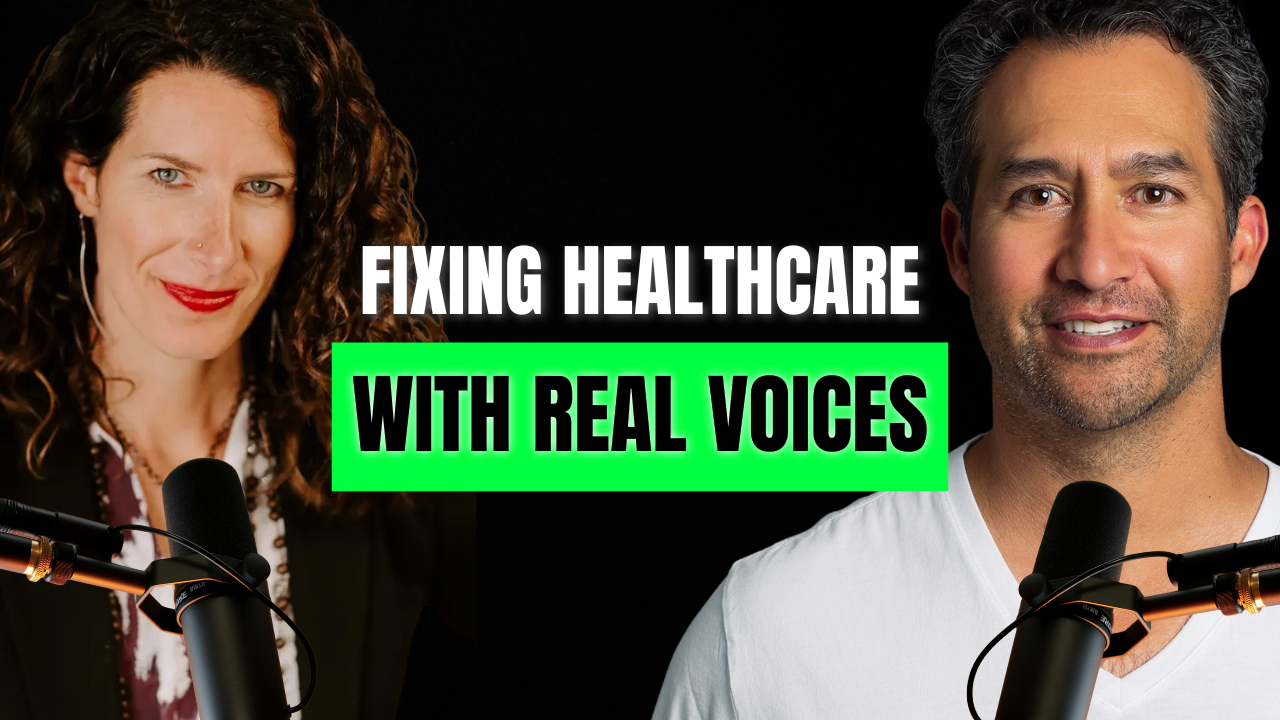
Jake Aaron Villarreal: I'm your host Jake Aaron Villarreal and here with us today we have Erica Barnell, co-founder and Chief Medical and Science Officer of Genoscopy. Erica, welcome to the show.
Erica Barnell: Thank you so much. Pleasure to be here.
Jake Aaron Villarreal: Well, a little bit more about Erica. She's a Cornell graduate and MD/PhD from Washington University. Co-founded Genoscopy, a life sciences company focused on gastrointestinal diagnostics. As Chief Medical and Science Officer, she led the CRC-PREVENT trial that supported Genoscopy's application for FDA approval for ColoSense, an RNA-based at-home colorectal cancer screening test. Dr. Barnell holds four patents, has authored 27 papers, and is a Forbes 30 Under 30 awardee. I love your background, Erica. You've accomplished a lot and I'm excited to learn more about your company, but also a little bit more about you. So, before we dive in here, where are you calling in from today?
Erica Barnell: Yeah. So, I'm calling in from St. Louis, Missouri, where I was born and raised, where I did the vast majority of my training, and where we founded Genoscopy.
Jake Aaron Villarreal: That's great. Well, I love to talk about problems that are being solved with technology. But when it comes to the human and health, it's absolutely more important physically, but also just knowing that there's innovations happening that are helping us live longer, prevent diseases, and things like that. Tell us a little bit about your origin story, some of the experiences that have shaped you to, you know, apply your skills and education, but ultimately into business.
Erica Barnell: Absolutely. So, you know, I kind of happened across the intersection of entrepreneurship within medicine. I've always been a science nerd. I've always been intrigued by research and I've kind of spent a lot of my career dedicated to gastrointestinal research. And as I was going through the process of just learning how to be a scientist as an undergrad, I was working on a really interesting project that was looking at environmental enteropathy, which is non-specific gut inflammation for kids in Africa. And we were trying to look at ways that we could non-invasively diagnose which individuals had this disease that would result in growth faltering.
And as part of my project, we developed a way to pull down human cells from stool samples, just getting the diapers from babies in Africa and diagnosing disease. So as I matriculated to the MD/PhD program here in St. Louis, I started seeing other diseases beyond what I was studying in the lab. I was seeing colorectal cancer in the clinic and IBD and IBS and celiac. And I kind of thought to myself, you know, why don't we leverage this really cool technology that we're building in the lab and apply it to some of these things I was seeing in the clinic? And so that was really the impetus for the company and the idea behind the company. And so during my first year of medical school, I pulled the technology out of the university and founded Genoscopy to see what we could do to address those diseases.
Jake Aaron Villarreal: That's amazing. I love kind of where you started there. When you look at, I guess, the company and the problem you're solving here, you know, there's a lot that goes into the idea, the vision, and then really bringing that into the market. You know, there's some confidence that you need to have, and as all entrepreneurs do, they take risks. What was your sort of thought process prior to launching a startup? I think you shared earlier that this was your first startup. So, what were some of the risks that you were thinking about prior to doing it, and what gave you the confidence to think that, "I think we could do this"?
Erica Barnell: Yeah, I think one of the biggest benefits of being a first-time founder is that you're not burdened with those scars and some of the issues that you face as a serial entrepreneur. So, as a first-year medical student, I was very bright-eyed, bushy-tailed, ready to take on the world. And so, I think we just kind of jumped in and hoped for the best and just mentally kept saying, you know, "If we can get funding or if we can advance the research and demonstrate that we're doing really good science, we'll just keep going and see what happens." And again, I think that's just a really big benefit of being young and excited and having a ton of energy.
You know, I think if I were to do it again, I don't know if I would do a healthcare startup and try to go through a PMA and build a CLIA lab. In retrospect, it feels like a lot. And I think a lot of people told me, you know, "This is going to be hard. This is going to be a crazy tough journey." And I was kind of like, "Ah, it'll be fun." So, I definitely think that, you know, some of the best founders are those that are young. And I know that people will tell you that you're too young or too inexperienced, but for us, it was a massive benefit.
Jake Aaron Villarreal: Yeah, I love that. You know, one of the biggest challenges for a lot of companies is finding your co-founder. I understand your brother is your co-founder and there can be some pros and cons to having a sibling as your business partner. Share a little bit about that with us and what are some of the pros and cons of having your brother be there as you guys build this company and you're on the journey together.
Erica Barnell: Yeah, you know, people hear that Andrew and I are co-founders and it's a dichotomous response. Either, "Oh, that would be so great. I would love to work with my sibling," or, "I can't believe you're doing that. That's insane. I would kill my brother if we were working so closely together on a very challenging problem where there is a little bit of volatility." For me, it's obviously been incredible. We have not only complementary skill sets, you know, me being on the science side and him being on the business side, but very complementary personalities as well. I tend to be the, you know, positive, happy, everything's going to be great, we're going to do fine, and he tends to be the person who is really looking for those potholes, keeping me out of the gutters, and making sure we have all our bases covered, making sure we don't run out of capital, things like that.
So, you know, I think having those skill sets that are complementary, having the personality that's complementary, and then having that intrinsic trust. I think when you have a co-founder, when you have a business, you can feel like you're going to have a billion-dollar company in the morning, and at the end of the day, there's so many fires you've had to put out that you don't even know if it's worth it anymore. And being able to ride those highs and lows with somebody that I love and trust and have known my whole life makes some of that a little bit easier.
Jake Aaron Villarreal: Yeah. Incredible. You know, you talked a little bit about what inspired you to really start the company. Talk to me a little bit about what inspired you specifically on the application you're creating today. We mentioned it a little bit earlier, ColoSense. What specifically is that and why did you choose that product? What's it solving and who's it solving it for?
Erica Barnell: Yeah. So, I think I mentioned, you know, we developed a platform technology. So, we're capable of looking at RNA biomarkers in stool samples. It can really be applied to any disease, any indication. And when we went to think about what should our first diagnostic test be, colorectal cancer rose to the top. When I was a first-year medical student, I actually met, unfortunately, a woman who was diagnosed with stage 4 colorectal cancer. And when I talked to her as a medical student—you know, I have a lot of time and I really enjoyed talking to patients and understanding their journey—she really mentioned that she just couldn't get a colonoscopy done 'cause if she had taken time off work, she might not keep her job. And you know, she had two kids at home and it was tough to schedule that time.
And I was just thinking, gosh, you know, we have all this technology, we have ways to look at disease in so many different ways. You know, why are we relying on a colonoscopy which was developed in the 60s and it's invasive and it's time-consuming and it's expensive? Why are we relying on that as our first-line screen? And so colorectal cancer became kind of, you know, my mantra, um, and my hope and dream that it's a disease and indication that we could solve with this technology. So we applied the RNA-based approach to screening average-risk individuals for colorectal cancer so that we could parse out those that didn't necessarily need a colonoscopy because they didn't have colorectal cancer or advanced adenoma lesions that needed to be removed, and they could do this non-invasive testing in a really convenient way by just shipping a stool sample in the mail to our laboratory and feel that they're covered in terms of colorectal cancer screening.
Jake Aaron Villarreal: Yeah, you're talking to someone who just got a colonoscopy a couple months ago and, you know, it was something that I personally put off because I did not want to take time off. I didn't want to go through the process. There's some fear-based in there as well of, you know, you got to go under, what's going to happen? Like, you know, there's a lot of things that you think about psychologically. So I love the fact that there is a non-invasive approach to it. What's the competition look like in this space? I know there's different technologies out there today. What makes yours different and what makes yours better?
Erica Barnell: So I mentioned that colonoscopies have been around since the 60s or 70s. There was a non-invasive test that was developed around that time called a fecal immunochemical test. So it's really just looking for blood in the stool which could indicate that there's a lesion present. And then in 2014, there was a FIT-DNA test that was approved by the FDA for colorectal cancer screening. So, you know, since then, about 10 years ago, there really haven't been many other non-invasive diagnostics that have risen to be able to be, you know, eligible for average risk individuals over the age of 45 for colorectal cancer screening. Our test is specifically aimed at younger individuals.
So, what we hypothesized is that by using RNA biomarkers, we could maintain the accuracy in younger patient populations. So currently, I mentioned that there's a DNA-based approach to look for colorectal cancer screening that actually uses methylation biomarkers that are correlated with age. So they do really well in the older patient populations, but as we go younger and younger, that accuracy tends to be reduced. So for example, in the 50 and up patient population, the advanced adenoma sensitivity was 42%, and that actually dropped to 33% when looking at the 45 to 49 patient population. So I mentioned because we use RNA biomarkers, we don't see that degradation in accuracy in patients 50 and up. We reported a 46% sensitivity for advanced adenomas, and that sensitivity was maintained at 45% in the 45 to 50 patient population. Similarly, on the colorectal cancer side, when we detected 94% of cancers for patients 50 and older, in the younger patient populations we detected actually 100% of colorectal cancers.
Jake Aaron Villarreal: When you talk about numbers, colorectal cancer for example, how much of that is the reason where people are dying from cancer? If you look at all the different cancers, that seems to be one that's pretty well-known. What are stats around that? Do you have those handy?
Erica Barnell: Unfortunately, 150,000 patients every year are diagnosed with colorectal cancer. The vast majority of those diagnoses are in late stage. Despite the fact that colorectal cancer is a pretty indolent disease, it takes up to 10 years for most cancers to go from normal tissue to a malignancy. It's really quiet. You can start developing a small polyp and that polyp grows and grows and grows over the course of 10 years and then transforms into a cancer, and that's when you start to see problems. And that's why non-invasive tests every couple of years or a colonoscopy every 10 years really reduces the chance of a polyp developing into cancer. So our goal is to kind of not just detect colorectal cancer when it's become stage 2, stage three, stage four, but either detect cancer at stage one or earlier. Those precancerous lesions that have high malignant transformation rates like high-grade dysplasia and tubular villous architecture. Our test is really aimed at detecting those lesions to actually prevent cancer development.
Jake Aaron Villarreal: It's amazing. Thanks for doing that. I'm sure there's a lot of people out there that are going to be very thankful that they can, with very easy process, be able to do it from their home and be able to get some results and have some peace of mind really more than anything. I think it's really important to have that. You just don't know if it's too late to test and then you hope that you did it in the right way. So really cool. There's some options out there. If you look at the market, how big of a market do you see this? And I know this is only one application. You can use your platform for multiple other solutions to solve other problems. But when you go out and you raise $100 million like you did and you're looking at, you know, the broader market, your investors want to know, we're investing in you and your company because we see the growth. Talk a little bit about...
Erica Barnell: You know, based on the kind of recommendations, every individual over the age of 45 is recommended to undergo colorectal cancer screening. If they're average risk, so no family history, no ulcerative colitis, no predisposition, that represents about 100 million Americans. We've had colorectal cancer screening implemented since the 70s, you know, colonoscopy, and we've had non-invasive tests like FIT or FIT-DNA for about a decade. Even though we have some of these options, you know, colorectal cancer screening compliance is still relatively low, between 50 and 60%. And then as colorectal cancer incidence has been rising, especially in younger patient populations, they recently added another cohort of individuals, younger patients 45 to 49, to recommend colorectal cancer screening. So there's a ton of people out there that are not screened for colorectal cancer that should be, that are recommended to be. So our goal is to kind of bridge that gap and make it much more convenient for patients to get screened so that we can have a higher number of patients that are screened so we can make sure that those individuals don't develop colorectal cancer or precancerous lesions.
Jake Aaron Villarreal: You know, when you build a company, it's first about taking a vision and then understanding, do you have a product-market fit, and hiring a team, raising capital, executing on your plan, all those things that go into taking an idea and bringing it to market. For you, what's been something you wished you would have heard or learned prior to starting your company and building this business?
Erica Barnell: So much. I think, you know, when you look back on what you did and what you've accomplished, you know, there's so many amazing milestones that we've achieved as a company, but I would say that, you know, doing it for the first time and what I say now to entrepreneurs that ask me is, it's never as good as it seems and I think more importantly it's never as bad as it seems, and just being able to kind of ride those highs and lows and keep a level head and just keep knocking down barriers and keep pushing. Um, you know, when you start seeing press releases from competitors that are citing sensitivity, specificity numbers that you know you're never going to be able to achieve, or you see an individual or a company that can fundraise more money than you're ever going to see in your lifetime and you're really struggling, um, trying to make payroll and all those things, you know, it can get to you. But I always try to remind myself that it's never as bad as it seems and it's never as good as it seems. And that really helps to kind of get through the volatility that is entrepreneurship.
Jake Aaron Villarreal: Yeah. Perspective is the word that comes to mind. We're all in it. We all do it. And we all have to keep reminding ourselves when times are good, they're great. And like you said, when they're bad, they're bad, but they're never really as bad as you think. I think it's important to just see it for what it is and be able to operate in that lens. I think that's really helpful. Looking back, is there a defining moment in the evolution of Genoscopy that stands out to you?
Erica Barnell: I think that is about to come. So, we've kind of submitted this test for FDA approval as a pre-market approval application. So, we did that in January of last year and we've been kind of in discussion with the FDA um, about approval or a decision and we expect that to come in the next couple of weeks. Can you hear me?
Jake Aaron Villarreal: Yeah, I got you.
Erica Barnell: And so, we expect that decision to come in the next couple of weeks if not days. And so I think that for us will be transformative. It will be the culmination of all the research that we've done. It'll be the culmination of our product development life cycle. And it will provide us with the kind of big checkbox that'll allow us to give this diagnostic test to both patients and providers and actually use the technology that we've built as part of clinical healthcare.
Jake Aaron Villarreal: You're not specifically defining what it is. Is that something that you're waiting to get approved or is it specifically? Can you dive in there a little bit?
Erica Barnell: Yeah, so I think the biggest milestone that we're going to achieve as a company is approval for our ColoSense test. So, you know, I think I mentioned, but we submitted that as a pre-market approval application to the FDA and over the last, you know, year and a quarter, they've been digging through that application. And I think getting a decision letter, you know, from them on that diagnostic test would be massive for the company.
Jake Aaron Villarreal: When you look at marketing, it's a different type of process when it comes from medical devices versus selling a consumer product. What works for you? What's been sort of a strategy that you, you know, can share that from a marketing perspective has really helped you get traction where was kind of a trial by error process, but now you feel like you've cracked that code a little bit?
Erica Barnell: Yeah. So, healthcare is a weird industry where the person getting the test, the person paying for the test, and the person prescribing the test are all different entities, right? And so when we're thinking about marketing, we have to kind of choose and think about appeasing all stakeholders, you know, the patients, the providers, and the payers. So when it comes to patients, they want ease of use, right? They want this dropped on their door and they want a button to push on their phone that FedEx can pick it up. And so we've tried to make it as easy as possible and show patients how easy this can be to get the test done.
And then for providers, they care about data, right? All they want to know is data. And I think for us, what we've done is created a really robust prospective pivotal trial that was published in JAMA of last year to demonstrate the high sensitivity and specificity of our diagnostic test. And then for payers, they want to know that it's not going to cost them any more than they're currently paying for colorectal cancer screening. So again, we've tried to create a really robust data package to leverage the accuracy profile we've generated and show the economics behind how much this is going to cost to ensure that patients are screened appropriately.
Jake Aaron Villarreal: That's great. Sounds like an Apple product where it just shows up and it works. And...
Erica Barnell: I think, you know, healthcare is a few years behind. We still use faxes. We still use beepers. It's an industry that's a little resistant to change. And so if we can disrupt that a little bit and bring some technology to our test and to our process at least to make sure that patients are compliant, I think that would be really great.
Jake Aaron Villarreal: Yeah, I like that. You know, most companies have many pivots and some have major pivots in this economy. In the last 24 months, it's been challenging to raise capital, to figure out how to go to a path to profitability with your current company or startup. What's a pivot that you look at or maybe have you gone through that is educational? Because one of the main benefits of a pivot is you come out of it with a lot of new knowledge that either works for you or it doesn't. But can you walk us through any sort of those pivots or breakthroughs that you've gone through over the last eight, nine years? Like maybe choose one or two that you feel like, "Ah, I didn't want to go through that but coming out of that we're a much better company today."
Erica Barnell: Yeah. I think any company that went through COVID had to do something different than they had originally planned. I mentioned there were a couple of other companies that have been on the horizon and were conducting similar clinical trials to us during COVID. So, you know, when you think about the data that we had to generate to get FDA approval, it's a pivotal prospective 10,000-patient clinical trial, that's a huge study that requires a lot of capital. We launched the study right around COVID, right around the time when hospitals were shutting down, right around the time when there was a nursing shortage, right around the time when elective procedures like a colonoscopy were all being cancelled.
And so we had to think about a creative way to get the study done, to enroll patients, to make sure that our test was getting the data was being generated despite the fact that COVID was happening all around us. So to do that we designed and kind of pretty much, you know, invented a completely decentralized clinical trial. So instead of going to clinics and setting up sites like they do in traditional clinical trials, we actually enrolled patients online using social media and then we had our manufacturer drop-ship a collection kit to patients' homes and then we tried to navigate patients to a colonoscopy. So we would try to find endoscopy centers that were open, you know, trying to find endoscopy centers that were within geographical location within their network based on insurance and help patients get a colonoscopy scheduled. I think this allowed us to not only complete our clinical trial on time, but we completed it at about 40% the cost that other companies were doing it at. So it was a really massive change. It was something that we were not anticipating doing it because of the necessity. Because so much change was happening around us, it became necessary and it really helped us as a company to make sure that we were on time and on budget.
Jake Aaron Villarreal: I love that. You know, people are the heartbeat of a company. Without them, you obviously aren't going to have a company that's going to scale, but more importantly, it can really change the growth of the organization. What's been the secret sauce for you and your company in terms of making the right choices when it comes to hiring?
Erica Barnell: Yeah. Oh my gosh, hiring is always a challenge. And I think especially when you're a young company and especially when you're first-time founders where your board and investors and potential investors want to see you being surrounded by experience, making sure that you're hiring the right people and you're spending the little amount of resources you have on the right people can be difficult. I think Andrew and I effectively leveraged consultants for as long as we could so that we could not only conserve resources early on, but make sure that we had time to find the right people for those higher strategic positions. So, for example, before we had a Julie Loraca who's unbelievable and has done everything you could possibly imagine in terms of regulatory and compliance, before we had her, we had a consultant who actually ultimately recommended that individual for the position. And we couldn't be happier with that kind of choice. And I think that the same for, you know, computer software and IT, the same for commercial, the same for market access. We kind of used the network we had, used the consultants and leveraged that to ensure that the people that we were hiring would not only fit in with our culture but would be able to provide inordinate value within their field of expertise.
Jake Aaron Villarreal: It's a good way of going about it, especially on the early end of the company and as you begin to scale really your culture starts to develop. What type of culture did you want to create when you began? Did you really think deeply about your culture before you built the company and what is it like today?
Erica Barnell: Yeah, I think nothing is more important than culture. Culture is not expensive. It's just time consuming. And so you really have to dedicate that time to making sure that your culture is the best because your people are really, like you're describing, the lifeline of the company. Andrew and I both came from cultures in industries that are notoriously difficult. Him being in finance, um, and me being in medicine, you know, there's a hierarchical environment. There's a lot of yelling. There's a lot of blame. And when we started the company, even before we had our first employee, we wanted to make sure that the culture at Genoscopy was a place that people wanted to work and wanted to be and enjoyed working for Genoscopy.
And I think we see that today. We have our head of people, Rachel, who dedicates most of her time to ensuring that people are heard, that people have feedback, that people have opportunities to learn, opportunities to advance, that they feel like what they're doing on a day-to-day is worthwhile, aligned with the company values, and that they understand why they're doing the things that they're doing and feel that they can challenge, you know, anything that's happening at the company without repercussions. I think having that openness and that feedback and communication is instrumental to ensuring that people are happy and that the company that you work at is thriving.
Jake Aaron Villarreal: Yeah, it makes a lot of sense. You know, as you look in the market today and you've touched on what it's like to get FDA approval and the time it takes to get things done. If you're a company that's just starting to get into your space, what's one of the bigger or the biggest challenges in the market to really encounter as you try and build something that you're building?
Erica Barnell: Yeah, I think there's a couple of dynamics that people can struggle with. So, fundraising is always challenging. I think there's a lot of companies that have a lot of resources and then there's a lot of companies, and many more companies, that don't. And being able to conserve your resources and effectively spend in ways that add incremental value to the company are so important. And even after a big fundraise, making sure that you're conservative with that capital so that you don't lose runway is really really important. I think what you were just touching on in terms of hiring the right people and creating culture, people take that for granted. Um, if you can't retain people and if you can't motivate people to kind of believe in the mission, the work that gets done is not adequate and it doesn't achieve purpose. And then the last bit is, you know, while you always want to be raising money from, you know, wherever you can get it, probably making sure that you have a supportive board and that the investors that are in each round are going to add incremental value and be able to provide you with advice not only when times are good, but more importantly when times are bad and make sure that they believe in you and are aligned in your mission so that you can keep that communication open as well during those board meetings, I think is really crucial to ensuring that you're staying on the right path.
Jake Aaron Villarreal: Yeah, that's great. As we wrap up here, as you look at 2023 and get into 2024, you mentioned that you're a few weeks away from getting approvals or getting to this next milestone. What else are you excited about as you look on the road map going forward?
Erica Barnell: So, I mean, as soon as this went to the FDA, I kind of feel like my job is really done. You know, I'm the scientist, I'm the medical professional, there's not much more I can do. And I'd say my worst grades at Cornell were marketing and commercial. So I'm going to leave it up to the experts to kind of do that. I got really excited about our next application. So I think I mentioned that this technology could really be used for all gastrointestinal diseases. And while colorectal cancer screening has been my life for the last 10 years, I'm really excited to get back to my roots in inflammation and see how we can improve the lives of patients with inflammatory bowel disease. So patients with Crohn's disease and ulcerative colitis, I think there's a massive unmet need there in terms of monitoring disease activity and predicting therapeutic response. I think patients go months without a diagnosis. They go years without going into remission. And again, I think our technology can be really useful for patients and providers to kind of navigate those individuals through the disease and make sure that we're making the right clinical decisions.
Jake Aaron Villarreal: That's exciting. Well, I can't wait to see how things go for you here over the next couple weeks and beyond that. In terms of individuals, consumers, doctors, whoever wants to get a hold of you or find Genoscopy, where do they go?
Erica Barnell: Absolutely. So, please visit us on our website or any of our social media platforms. We have a really great team that puts together a lot of amazing content on medicine and patients and lives and people that we're hopefully impacting with our colorectal cancer screening test and our pipeline products.
Jake Aaron Villarreal: That's great. Well, Erica, thanks so much for joining. Really appreciate you sharing your story and having the courage to come on here and to all of our listeners for listening. It means a lot to me that you've spent your time with us today. My name is Jake Aaron Villarreal, the host of the show. Signing off for now, but can't wait to catch up with you all on the next episode. Until then, take care. If you like what we're doing, don't forget to subscribe, leave a review on Apple Podcasts or wherever you listen, and follow us on YouTube where we go behind the scenes to learn what it takes to be a startup founder.













.jpg)









.webp)
.webp)
.webp)
.webp)