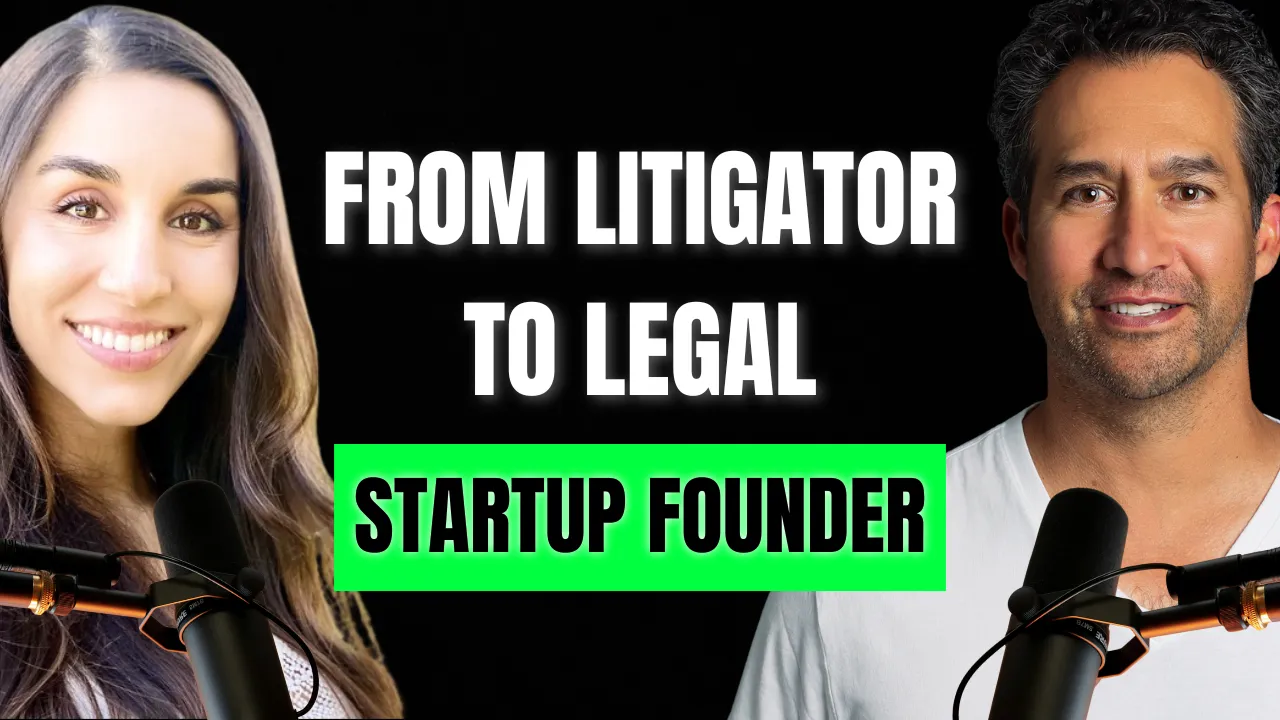
Jake Aaron Villarreal: I'm Jake Aaron Villarreal, born and raised in Silicon Valley, and here to take you behind the scenes and share what it's like to be a startup founder, the journey they're on, the problems they solve, the products they build, an effort to make our lives better. I'm excited to have with us today Dr. Kira Radinsky, co-founder and CEO of Diagnostic Robotics. Kira, welcome to the show.
Kira Radinsky: Thank you.
Jake Aaron Villarreal: So, a little bit more about Dr. Radinsky. Um, she's founded Sales Predict, which was acquired by eBay in 2016, and served as eBay's Chief Scientist. She gained international recognition for her work at the Technion and Microsoft Research for developing predictive algorithms that recognize the early warning signs of globally impactful events such as disease epidemics and political unrests. In 2013, she was named one of MIT Technology Review's 35 Young Innovators Under 35. And in 2015, Forbes included her as a 30 Under 30 Rising Stars in Enterprise Tech.
So, what is Diagnostic Robotics? Uh, it's where the most advanced technologies in the field of artificial intelligence are harnessed to make healthcare better, cheaper, and more widely available. Excited to hear more about you and your story. As we jump in here today, where are you calling in from?
Kira Radinsky: The Bay Area, from Los Gatos.
Jake Aaron Villarreal: When I started this podcast, I had this vision to go behind the scenes to share what it's like to be a startup founder in Silicon Valley, where I'm born and raised. And weekly, we dive deep in the trenches to find the wins, the losses, and the lessons learned with the hopes that it helps you run a better startup. But here's the thing. If you've gotten any value out of these conversations or been inspired at all, hit the subscribe button. And I get it. Your podcast feed's probably overflowing. But to stay up to date what's going on in Silicon Valley, stick with us because at the end of the day, we're all just trying to build something that matters and we're better when we do it together. So, hit that subscribe button and follow us wherever you find your podcasts. Now, let's get back to the show.
I love Los Gatos. Actually, my sister lives there and I grew up in San Jose and we have a house in Los Gatos as well as Capitola right over the hill there in Santa Cruz. So, spend a lot of time in that area. Um, give us a little background of you before we jump in here. When you grew up, where did you start? How did you get into technology?
Kira Radinsky: Right. Um, as you can quickly guess from my accent, I was born in Kiev, Ukraine. We immigrated to Israel when I was very young. For people who never heard about USSR and what it was like to live there in general, imagine a place where you need a visa to leave and not to come in. Where people don't get paid based on what they do, but based on how loyal they are to the Communist Party and in general everybody gets paid the same. A country where it's illegal to be unemployed. In other words, you can actually go to jail. Um, and in in addition to all of that, in '86, the nuclear reactor exploded and they ran out of food. So that's the place where my family used to live.
Um, in general, I can't think about a single person who did not want to leave, but nobody was lucky enough. People were, they knew they're being monitored all the time by the KGB. God forbid they will know that they care about Israel, that they believe in democratic values. The very interesting thing, they even made up a new diagnosis um for people who believed in Western values. It was called um, I'm hoping I'm pronouncing it correctly, it's um "being crazy but slowly." In other words, you don't see the person as crazy, right? But it will slowly mature to being a schizophrenic.
Jake Aaron Villarreal: Right. Wow.
Kira Radinsky: And this is what people who are trying to leave would get as diagnosis in order to go to prison or mental facilities. So in general it was very dangerous to leave. And lucky enough in '89 USSR started falling apart and the Jewish community in the United States started pressing USSR to at least let whoever's Jewish to leave. In general, being Jewish in USSR is also very intriguing because, um, again I can only speak about the Ukrainian area. Of course, every area had it a little bit different, but there were literally schools that would not accept you because you were Jewish. They had a limit to how many Jews they can get every year, unlike you know how you do correctional acceptance. They had a cap. So, for example, in the University of Kiev, one Jew per year.
Jake Aaron Villarreal: Wow.
Kira Radinsky: Um, so literally my parents... so I grew up with parents, I grew up with only women. So, my mom and my aunt, I grew up with them. Although they were like the best in their class, winning competitions in the math Olympics, um, they were not the best Jew in Kiev and therefore could not get accepted. They would never tell you it's because of your nationality. They would call it different nationality. Um, they were told their eyesight is not good enough. "You're not... wow, you have glasses, that's just too bad to get accepted to university."
Anyhow, they started spreading through the USSR empire to try to find a place where the cap was not reached. So after the Jewish community in the United States started requesting USSR to let them go, USSR announced that if you're Jewish, you're allowed to reunite with your family. And they call it, it's not immigration, it's repatriation, which actually means they're coming back from wherever they came from. And a lot of my family spent maybe 2,000 years in the USSR area. Nobody really cared about that.
But the way my mom describes it, she was, she never understood how lucky she was. She was like, "Where does all this sh, the sunshine come on me? I'm super happy, right?" And the reason I started going into machine learning and predictive analytics, my mom was trying to predict when to come to Israel. The United States closed their borders really quickly to immigration. After a million Jews left and came to the United States, the United States closed the borders and the other million and a half came to Israel. Um, Israel was 5 million people and had to absorb almost two million people in less than a year.
Jake Aaron Villarreal: Oh.
Kira Radinsky: And when you leave USSR, you're not allowed to take anything with you. No, very limited amount of luggage. You have to pay a fine for leaving. The thing is you have to quit your job in order to submit for a visa. But remember it's illegal to be unemployed. So it's a very dangerous time. Anyhow, my mom knew there's g... and everybody knew there's going to be the Gulf War. Remember 1990?
Jake Aaron Villarreal: Yeah.
Kira Radinsky: Um, and she was trying to predict at that time when to leave because nobody wants to come to a country when there's huge war going on. And she had to predict almost six months in advance because it takes almost six months to a year to get the visa. Um, so my mom got it almost right. We arrived to Israel two weeks before the war started as opposed to after. So, um, she's almost really good in predictions.
Jake Aaron Villarreal: Yeah.
Kira Radinsky: So, that's pretty much my first memory of of Israel. We arrived at the end of November and we're coming in from a country which is very cold and we wore extra coats, like we tried to wear all of our clothes on us because there's a limited amount of luggage you can take. And it's super hot in Israel. It's like I think it was like 85 Fahrenheit at that day. And we go to the beach. My mom didn't sleep for like three days because you couldn't fly from Kiev. You had to drive to Moscow. It's huge distances. Nobody knew if they're going to be left behind or not. They're pretty sure that the borders will close any moment. She goes to sleep and my aunt and myself... my aunt was like 20. We go to the beach and I was like, "Can I take off my boots?" Anyhow, my first memories of Israel.
But since I can remember myself, I always wanted to be a scientist. I didn't know what type of scientist, but I wanted to be a scientist. And pretty much, although my family did not have any money, um, the way they looked at it, my mom and everybody in our family had like PhDs and master's. And my aunt did not finish her master's which was a huge disgrace because she had to leave because otherwise the border would close, and everybody said "don't work, just go finish your master's." And she had to have a computer because she was doing computer science, specifically computer vision. Because who knew computer vision is going to be a hot topic? But luckily enough, because we had a computer, she taught me how to play different computer games, which were like different math riddles mostly, and then she taught me a little bit how to code because I was bothering her a lot about like how to solve stuff.
So very quickly I understood that if I want to be a scientist, I want to be the type of scientist that automates stuff. I want to automate science. I want to be building... I didn't call it AI, I call it like a system that will replace all scientists. That was pretty much my... when I was 15, I started studying towards my PhD. So I finished school um early, started going to the university, and pretty much I decided that what I want to do... I started hearing about AI at that point. Again, it was like 2002, right? It was nobody talked about that. It's like barely like a search engine. But at that point, I was really interested about like how search engine works, what humanity is writing. I was intrigued by the amount of information there is online. And I started building AI systems to attempt to take everything humanity wrote for the last 150 years and predict future events.
Jake Aaron Villarreal: Wow.
Kira Radinsky: Um, at that point I was doing um, I was working part-time at Microsoft, specifically Microsoft Research. This was actually my first time in the United States to move um to the Bellevue area next to Redmond. And we were trying to figure out two things. One is how to build a search engine, like how do you build an algorithm for a search engine? How do you improve it? It's still crazy to talk about it, right? It seems like a solved problem at this point, but at that point we were still trying to improve it. And the second thing that I was trying is to build the system of predicting events and see how we can deploy it in practice. And I was lucky enough to be introduced by the Chief Scientist to the Gates Foundation. We started collaboration and they asked me, "Like this is all very interesting technology, but please predict malaria, cholera, or something."
So that's what I did. I built a system that predicts the probability of the word "cholera" to appear in the news in a certain area based on historical and social media at some point, etc. And I was able to predict the first cholera outbreak in Cuba in 130 years. So that was a very big thing because we collaborated in sending clean water in time. In general, cholera is a disease that um, it kills like almost 100,000 people every year. But you can [reduce] mortality rates from 50% to less than one if you get clean water in time. All you need to do is send clean water in time. That's it. And we identified a pattern that identifies that if there's a drought two years before and then you have huge floods and storms, the probability of cholera in those locations is very high.
Jake Aaron Villarreal: Okay.
Kira Radinsky: And then I started expanding the system to predicting riots. It predicted the Sudan riots in 2014. It identified a correlation between if you have a subsidized product and you stop subsidizing it and there's a big difference between the rich and the poor, people going to get angry and make riots. Right? Now it makes sense, right? But this is like early days of the Arab Spring. So actually understanding that, you know, all those things was very interesting. And then I said, "Oh, maybe this AI thing works. Who knows? It worked [for] my search engine. We were able to predict stuff and actually send some clean water in time."
And I partnered with one of the product managers that I worked with in Microsoft, and we built a company called Sales Predict, who was attempting to predict economic events. I was like, "I can predict the future of economy," which is a very big wording for predicting churn, sales, conversions. Um, so in general, what we did, we started building an AI system accumulating all the macroeconomy events like reading news articles, and in addition to that we would get access to historical information of companies: who they sold to in the past and who they didn't, and we told them who to focus on, what to tell them. And we were able, with even very large companies, to almost double their conversions. Um, so that company was acquired by eBay. I became their Chief Scientist in Israel. Um, specifically eBay has numerous departments, less than 10. I was in charge of the science in one of the departments called structured data. We were trying to take all of the unstructured data in eBay, structure it to enable a lot of workflows behind it. Um, so we were doing a lot of really intriguing research, especially of trying to predict economic interactions, especially there's also B2B arena for people who don't know, but also trying to generate text for products because we didn't have any kind of doing image-to-text generation. And so a lot of interesting work. It had impact of hundreds of millions of dollars per year.
But then I always had the passion of coming back to where I started from, right? Hey, I wanted to be a scientist, automate myself. I was always excited from healthcare. Um even my boss at Microsoft, he was an MD. He was doing AI to improve decision-making in healthcare. And I felt that it is time to take that risk, right? Um healthcare is very hard. I never recommend it to very young entrepreneurs because it's it's nobody can even perceive what it is from a business perspective. Now we started Diagnostic Robotics with another professor from my university. He IPOed a couple of companies in healthcare. His last one was acquired by Medtronic for almost $2 billion. So he's also convinced it's easy, but we're wrong. And this is Diagnostic Robotics, which I always make the same joke. We do neither diagnostic nor robotics. It's just a really cool name. What we do, we're in the general field of care management. Think about this as nurses, and specifically in the subfield of care coordination. And what we do, we build AI that helps decision making and automation for care coordinators. What do they do? They make phone calls for patients in a usually preventive measures.
So we identify, here's a patient, they're going to deteriorate, you just don't know it yet. For example, maybe they stop taking their medications. Maybe we're starting to see based on their historical claims that they're getting sicker. And then we apply a causal inference algorithm in like 60 billion claims to see what's the best clinical next step. And then we have an AI bot that actually makes the call and tries to convince the patient to do the right thing so they will stay healthy and then everybody's happy, right? Health insurance doesn't pay money. Physicians are happy because patients are happy. Patients are healthy and happy. So we deployed a system for almost 28 million patients in the United States. We have a business in South Africa and Israel. Of course, that's where we started from. With um eventually we're able to reduce by 25% the number of inpatient visits for chronic patients like CHF, COPD, diabetes. Um so that is my biggest pride in Diagnostic Robotics.
Maybe just a last phrase and then I will finalize my very long monologue. Um so from an academic perspective, I'm still a visiting professor. So I still do research and I always try to find where AI still did not make progress. And one of the things I was intrigued is first of all healthcare. This is what got me into healthcare. I started working with HMOs. They started sharing with me their process, because I'm not an MD. I have no idea what I'm doing, right? But what I'm starting to talk to MDs, it was fascinating the way they're working, going into the hospital, understanding the process, understanding how you can actually automate it. And in the last few years of studying, having the same interest in chemistry, I was like, I think it's just amazing. You know, in AI all we do is just like software. I create like Excel files today, large language models that can talk to millions of patients. This is really cool right? But I want to create something real. Creating a material by AI, that's for me kind of the next frontier.
And I partnered with a chemistry professor in my university at a Technion and we were trying to solve a very interesting problem. Remember mRNA from the vaccines? A message that if it gets to the cell, it makes it produce a protein, right? Very interesting. Maybe it can solve many diseases because some people have genetic disorders, right? Um, they not produce the right protein. If only we could get this mRNA to the right cell, because it doesn't help me if the heart produces the protein I need in the brain, right? By the way, this is how you can cure a lot of types of cancers like immunotherapy. What it does, it pretty much takes a white cell outside of the body and creates antibodies for it. So it would identify cancer cells and then the immune system can, think about it like, clean cancer cells. A little bit if everybody heard about Jim Carter, pretty much what's happening with him. Imagine we could get the mRNA only to the cancer cells, make them produce their whatever antibodies. Then you don't need this million to 10 million dollar treatment taking out all the white cells from your body, engineering them outside the body. You just, it just happens with one or two injections.
The problem is how do you do it? How do you create a spaceship for mRNAs and AI to the rescue? The only, the only creature on earth who solved this till today was a virus. I don't know, like I guess a few really good millions of years to try to find their way to the brain. Why? They really wanted to get there. So there's very large companies who take viruses who get to the brain, take out the inside of the virus, put in whatever mRNA you want, that message and send it to the body. What's the problem with this approach? The body doesn't like viruses. It kills itself pretty much. And we were trying to think how you create this from fats, lipid nanoparticles, a big word. And here's AI to the rescue. Learn from viruses and tell me the recipe how to make it in fats. Sounds like sci-fi. When we started it, it was kind of very fun academic project. But when it worked and we managed to get to the lungs, to the um to the brain, to all, a lot of organs in the body including like white cells, T-cells and others, we were shocked and built a company out of it. So a company called MonoBio, which what it does is creates spaceships for mRNA to get the correct locations in the body. Um and I think this is the really cool thing today is that um, I think a lot of the focus today is on AI. How do you print, make it better as text? How you take out knowledge workers? I was like, I want to use AI to create a new world, right? Like literally create like substances. My monologue.
Jake Aaron Villarreal: Yeah. Well, that's a great monologue and there's a lot in there. Um, you know, you've been an entrepreneur and an inventor and in in a lot of ways just an innovator with technology. Um, we're talking about your current company um Diagnostic Robotics, but how did you, how many companies are you running today or building?
Kira Radinsky: Oh no, I'm just building two companies. Academically, I'm interested in many topics including the latest developments. We publish a lot of papers. Um, in general, I think even the definition of safety of AI and large language models is a field we only started touching on. Give you the simplest example. Um, today we're talking only about bias, right? AI model bias against certain people and others because this is the first thing we saw. I think there's much bigger danger is that um, AI develops narratives. I'll explain. If you look at the war between Ukraine and Russia, every event is usually written in the social media based on the narrative of the people who are writing it. Right? So, the Russians had the narrative: they're actually saving Ukraine from the Nazis. This is why they attacked. Ukrainians believe that they were attacked and there is a lot of history behind it, and literally events that cause people to believe that their narrative is correct. I'm interested in whether AI models learn the same narratives. Imagine we can take out the narrative. Does it mean we can create a utopian world where AIs don't have narratives, humans don't have narratives and there's just like the Beatles song, you know, like we're all together?
Jake Aaron Villarreal: Yeah.
Kira Radinsky: All of those studies eventually fuel my companies because narratives you can see this in healthcare. I can see specific bias, if our AI model creates certain materials for certain elements of the body where it's supposed to do otherwise. So the way I look at my journey as entrepreneur, I'm a scientist entrepreneur. I learn science. I like getting very deep into things and then finding their way into real world applications. And I do this all the time because that muscle especially in AI, right, needs to be developed all the time. There's new developments all the time and you need to push the frontiers forward and that will feed maybe open other companies or feed the companies you already have.
Jake Aaron Villarreal: Yeah. I mean the approach you're looking at and taking seems to be much deeper than a lot of other companies that we talk to and work with. And um who knows where they're going to all end up. But a lot of times it's about simplifying and expediting a process in a specific industry. And you know, it takes the labor out of the process from a human perspective. And so that's kind of what we hear. But when you dive deeper, um, what I'm more interested in is the purpose behind what it's doing. So are you actually solving a problem, saving a life, extending a life, making it easier to, I don't know, kill a disease that's going to kill you in five, 10 years. And it seems to be so much innovation in that area, but it also takes a lot of time and effort and people and money. And your current company today, you've raised $70 million. And when you think about what you're doing there, like is it about saving lives or extending life or about reducing the cost or making things cheaper? Um like when you dreamed about doing this, like really at the end what makes you most satisfied about what you're creating today with your current company?
Kira Radinsky: So the thing I wake up every morning is the fact that I know that in less than five years we're going to have almost um four billion people without access to primary care. What that means if they don't have access to primary care is that emergency departments will be swamped. It's like we won't be able to get any normal healthcare service. Even today in a normal country, meaning outside the United States, the number of primary care physicians per patient is around 1 to 2,000. In the United States in certain areas it's 1 to 5,000, like one primary care physician for 5,000. In practice it means they don't have a primary care physician, okay? Now one way is saying, "Oh yeah, we'll just automate primary care, good luck to us," okay, that's um... if you're asking what's the problem is access to healthcare, how do we solve that? And of course it's going to prolong life and I think um many times you focus at least in other endeavors is like "how do I solve Alzheimer's, how do I solve Parkinson's." Most people don't die from those. They don't even get to to like live that long to even develop those diseases. People die from things that can be saved because nobody noticed that they're deteriorating.
So in general the pain I'm trying to touch is around the preventive care. Now why isn't preventive care easy? It's like what's the problem? Outside the United States, Singapore, always like doing preventive care since like literally since we're babies. Like I'm getting emails from my primary care physician with that vaccine, "come visit me, I want to create a relationship." Why, why isn't it as easy? So today the widespread opinion is that you have to have care management to get to really good healthcare service in preventive care, especially in the United States where it's uh, there's no one healthcare system to rule them all. It's all widespread, data is like disconnected and still we need that physician... um very complicated one, human intensive, and indeed there's like 40% turnover. It's really hard to maintain staff post-COVID.
Jake Aaron Villarreal: Right. In addition, right?
Kira Radinsky: Um so eventually the solution is how do we automate and optimize some of their jobs in order to get to preventive care, in order to solve healthcare access. If you ask the day-to-day, it's like I focus on what that perfect care manager is doing and how can I help them be more focused, read all possible medical literature and just do the right thing with the patient in one minute because they don't have time. They have to call like 10,000 patients and how can I automate the simple calls? Because the way it works today, they call the expensive patients, the problematic patients. Who's going to take care of the rest of the world? Like, who's going to call them, right? They don't get the same equality as the sickest ones, the most expensive ones because of the incentive design. Healthcare insurance eventually wants you to focus on the expensive ones because they have an hypothesis that, well, if you treat them in time maybe they're going to be cheaper. How about the ones who are not as expensive but you can still be saved? And this is where a lot of the automation is coming in. Will it save life? Can it prove that what it did saved life? Well, you know, I don't have a parallel universe with exactly the same person. But we do create control groups and we do see that compared to control groups, we do have... this is the number I mentioned before, 25% less inpatient visits. That's incredible, right?
Jake Aaron Villarreal: I mean, you know, it's interesting, as a young man, I never got calls from anybody, but you're right. As you get older, u you start to get those calls from your insurance company, "Hey, have you had your annual checkup yet? You should go in and get it. You know, your doctor might reach out to you." Where, you know, younger it's like, "You're healthy, you're fine." But yeah, oftentimes it's too late when you find that you may have that pain in your abdomen and you go in and it's like, "you know, you're too far, you know, in trouble with cancer, whatever." So, a preventive care um I think is incredibly important. When you're looking at your business model today, it sounds like there's multiple touch points of how to get the product into the market, who's paying for it, like who are you selling to?
Kira Radinsky: So right now we're selling both to health plans and healthcare systems. Both of them have care management and care coordination teams. Think about like almost as virtual nurses. Sometimes they're physical. In other words, they actually come to your house to do the treatment. And of course, nobody can replace... well not yet. We have robotic systems being developed. And although my company is called Diagnostic Robotics, the robotic piece is non-existing. Um, but there's so much in that face-to-face meeting and virtual meeting that can, does not have to happen by a human. For example, we're working with a very large healthcare system and we're trying to automate breast cancer screenings. Um, so what happens is patients are calling, nobody's answering, so they can't even enroll, right? It's usually 45 minutes to obtain all of the information to know if they're urgent or not and to identify her urgently to schedule their appointment. Who's going to make those calls? AI to the rescue. Okay.
So what we did, we built a system that has this conversation, 45 minutes conversation. It's hard to maintain a coherent 45 minutes conversation, integrate to the electronical medical record. And by that we were able to increase by 20% the number of breast cancer patients that are being seen by that clinic, right? So they did have more appointments, but they were not able to treat them. And the coolest thing is most patients call after 5:00 p.m. It's almost a job that should not be done by humans. The human should be where you need the... after the patient's already in treatment, you want the human touch. It has a lot on the psychological. But for data collection, come on. So it's like you don't need a surgeon to collect data from you. You don't need a nurse to spend all our time. It's not the top of license.
Jake Aaron Villarreal: Yeah. Do you think there's... there will be a day where a humanoid will be able to come into your home and sit down with you and talk to you and it'll feel like that human touch is there? So, in other words, you don't have to have actual a whole workforce coming in and sitting down and doing these conversations, but I know you could do it online. You could do it over a phone. But how about like house calls?
Kira Radinsky: Oh, yeah. Um, interesting question. There's a transition period and you know, in certain countries like in China, you know, like they didn't have credit cards and then one day they have electronic payments. That's it. One day, like in one day, they just decided it happened, right? Um, most countries do a transition period and I think we're exactly in this transition. Are you asking eventually will it happen? Yes.
Jake Aaron Villarreal: Yeah.
Kira Radinsky: Right. Um, you know, I've been seeing more and more people using the different large language models as almost like psychologists.
Jake Aaron Villarreal: Yeah, I've seen that. Healthcare or mental health.
Kira Radinsky: Yeah. Well, well, why not? Especially for things that you're ashamed to talk with somebody. The physical element is always hard. Like think about your 3D printer. So, it's like getting it to be aligned. It's not as easy as it sounds. So, there's always like a human involved. This is why a lot in the AI community are talking about knowledge workers being, oh well, disappearing with time and people who are actually doing the physical work reappearing. So coming back to house calls, eventually a human coming in and touching you has other impact, you can call placebo effects right, but it's still a measurable effect that I'm not sure that a robotic system is going to have on humans. I did not still see a study. Okay. Um there's a lot of studies showing that AI is can be as compassionate as as humans, but if you ask the human, "Do you want to talk to AI as opposed to a human?" they prefer a human, right?
Jake Aaron Villarreal: Right. Yeah, you want that human touch.
Kira Radinsky: Yeah. So house calls to just ask you how you doing probably can be automated. House calls that we need to discuss more thorough issues, kind of understanding like where are you putting your medications, why are you not taking them, do you have like other additional issues that we need to be addressing, um that will take time. And in healthcare everything takes 5 to 10 times longer than you expect.
Jake Aaron Villarreal: Yeah. You know, you've done a lot in predicting the future with AI. It sounds like it's something that you're really good at. Um and you built really a career around predictive analytics or algorithms rather, um in your Sales Predict, healthcare. Looking ahead, what do you think AI will predict next that will fundamentally reshape industries?
Kira Radinsky: I'm a big believer that specifically chemistry and I will call it like climate in general. I think that's the next problem we should tackle, right? Um um specifically around climate, kind of understanding where... look at the fires that are happening specifically right now in Los Angeles, right?
Jake Aaron Villarreal: Yeah.
Kira Radinsky: Right. Um there's already many AI models that can help predict where the next spark is going to happen. Right. But I don't see them integrated enough to the insurance business to help you have insurance for your houses, right? Integrated to fire departments to understand. Um although there's AI models predicting where's the next fire um pretty accurate, I have to admit I don't see them still integrated to insurance models and I still don't see them integrated to models for fire departments like where to send the water and integrate them. So there's a huge gap between what AI is capable of and actually integrated into the workflows. Although I I think we should tackle more of the climate side, I think AI is too far advanced as opposed to like integration into real world problems. So in addition to just predicting which materials to create solar energy, being independent, creating the next materials, predicting the next fires, um integrating into the works is so much more important to make it real as opposed to an academic project.
Jake Aaron Villarreal: Yeah. Well, you know, those fires impact not just Southern California but Northern California and these fire seasons have gotten longer. And you know, when you talk about fires versus climate, you know, God, if you could predict, you know, when the fires would come, and I know we're getting better, but you can't always predict it. And with all the technology we have, you would think that you could at least have a little bit more clarity on, you know, where it's at, when it's going to come, and be able to quickly attack it so it doesn't, you know, take a whole city out. It's just, it's crazy to think that that could happen in today's age. It's just not even fathomable in some way, and still, right, um people are optimistic. You don't think the worst thing will happen, and I think most uh machine learning models and or like engineering systems also pressure from the worst as well. So using them in like real world and integrating them leaving less to us humans, I think that will make a huge difference especially in the climate space.
Jake Aaron Villarreal: Yeah. Well, you know, you've learned a lot, I'm sure, as you've built companies and solved problems. Um, your current company today, just kind of take a step back and think about what you're building and who you're helping, like as a leader really understand your business model, hire the right people, um, look at the future, innovate, market, promote, get traction, generate revenue, and continue to grow. What's the biggest challenge you see in today's market with all these AI companies that are popping up everywhere? Like is it impacting you or is it making your world more um focused, more competitive? Like what's the challenge you're seeing today as you continue to grow your company which has raised $70 million?
Kira Radinsky: You know, it's like with every new technology there's a um, the barrier is lower to come into the area, but then you have to raise the bar as well, right? I think the issue is always there's a lot of noise. Customers are getting confused from the noise and then you have to continually prove yourself all the time with really high quality products. And for really high quality products you really, really need high quality people in all the spectrums of the work that you're doing, from engineers to go-to-market. They need, in the go-to-market they need to be much more educated about AI, how it can work, how it can integrate to the different workflows. And engineers need to use the latest tools even to automate themselves. Um, I would call it 10 times thinking. It's like everything I do today, how can I do it 10 times better? Right? And teaching that to people, and it takes time to even learn how to do it because you're going to fail numerous times to get there and kind of creating this DNA that's okay to fail, okay to do it as long as we get to like the next level into a vision. Um, that's a journey and we've been doing this for many years, sometimes successfully.
Jake Aaron Villarreal: Yeah. You know what, with all your knowledge around AI and predictive um capabilities, what's your, what secret sauce can you share about your prediction of making sure you hire the right people? What's the process that you take people through, whether it's interviewing or meeting them or understanding their background, that you could say, "I know I'm going to predict this person is going to succeed based on these things." Is there anything different today with technology that maybe you didn't have 5, 10 years ago that you think is really helpful?
Kira Radinsky: It's a good question. I can think a lot about successes and failures, but there's much more information about people these days online as opposed to historically. And especially when you got a lot of CVs using AI filtering tools to kind of identify more leading members. Um, I have to say that eventually it's the gut feeling. Gut feeling.
Jake Aaron Villarreal: Yeah, eventually it's... I have my own AI model in my head saying this person is similar to other people I met in the past and did a really good job.
Jake Aaron Villarreal: Yeah, I think it's important to really use your mind when it comes to making big decisions. And the gut, I mean, when it's all said and done does really help you survive and prosper if you use it well. Listen to it. It's not always going to be perfect, but yeah, I agree with that. We've made our mistakes. We've also made a lot of happy decisions, but the gut oftentimes is helping you make those decisions, which is good to hear. I mean, AI can't replace the gut, can it?
Kira Radinsky: Eventually it probably can, eventually. That's my AI in my head. Maybe it can train on all my lives and all the interviews I did and do a better job. Um but with people it's still kind of the feeling that you get with them. It's still cues that I'm not sure how to input to AI yet. But we'll get there maybe at one point. But um you ask me at the end and today I don't interview people like for junior positions but more of it to the seniors. Eventually I can interview them many times but I already have this like model trained that gave me the prediction pretty much in the first five minutes.
Jake Aaron Villarreal: Yeah. Got it. You know you've done a lot with academia in in different ways. You've had a lot of success. What advice do you have for researchers who want to turn their breakthroughs into impactful businesses?
Kira Radinsky: So first of all, breakthroughs before businesses. Okay. Um the thing I tell to all my PhDs and I tell it also to entrepreneurs is usually people are frozen from advances because they're afraid to make the step. I usually tell, imagine yourself jumping from a cliff. You'll be surprised how quickly you build your own parachute. So that's what I do with my PhD students. I push them off the cliff. I was like, I really didn't. You have to survive. You have no choice. I try to create similar situations at work because people um when put in extreme situations do get the maximum out of themselves.
Now that's for how to make innovation in extreme situations. How to make it to successful businesses. I think the biggest mistakes academics are doing are focusing on the technological innovation and not on the business innovation. This is what I was giving as an example through predictions of fires. This is amazing we have that, but how is it going to go into the workflow? What is exactly going to be the business model? How all of this is going to sustain itself from a business perspective? Um there's no simple answer. It's like partner with somebody who's been doing this for many years and complement yourself with the qualities that you lack.
Jake Aaron Villarreal: Yeah. Got it. You know, your storied career is great. You're, you know, still young and building what you're creating in many ways. Um but as a leader in technology and AI, you face challenges including biases and setbacks, I'm sure. Can you share a defining moment where you had to push through adversity and what did you learn from it?
Kira Radinsky: I think especially in um corporates you have to first identify what you all agree on. Don't talk about um the how. Talk about like how the vision is going to look like, like what we're all going to achieve. Um I think especially in big organizations people have um, gonna say it nicely, ego. And everybody wants to be part of success. Don't be worried about sharing your success. Um it's, tell them, put the others in the front and push the vision. Eventually you'll get your share. That's what's going to happen. So usually when I'm trying to push an um an idea which is innovative or hard to push, it's about getting the people around me and knowing that they're going to be part of the success. What's in it for them, not what's in it for me.
Jake Aaron Villarreal: Yeah, that's great. I love how you think about that. Um, if there's one thing you could share with the world that maybe you haven't shared yet that um, you think could be helpful for any entrepreneur that's going to start their career, maybe start their first company, that you've learned from starting a few of yours. Maybe you've failed in some and you had success in others. What would it be?
Kira Radinsky: Jump off the cliff. Jump off the cliff. You'll be surprised what you can do, right? Don't do the things which are not risky. If you don't do things which are risky, okay, you're not going to be bringing huge change to the world. And if each and every one of us will do it, we'll move humanity forward by one step, one step at a time.
Jake Aaron Villarreal: That's great. Well, Diagnostic Robotics, um, I love the space you're in and what you're building. I know it's, there's probably challenges in that, but also a lot of opportunity. Um, what's on the road map as you look into this new year 2025? You've been building and you've got revenue and got teams locally and globally. What are you excited about?
Kira Radinsky: Um, in general, I'm looking to how to implement um implement AI because that's my field, but my vision is mostly like how do I move humanity like one step forward and I've been doing this a little bit in healthcare trying to think about like how to increase the healthcare access. I've been doing this a little bit in MonoBio when I was trying to think about like how do you create spaceships for mRNA so we can create drugs that we never could imagine. Um, I think my hope is that I'm thinking big enough, right? And I'm trying to ask myself every day like is the dream big enough?
Jake Aaron Villarreal: Yeah. Well, it sounds like they're huge dreams to me. I love what you're doing. If anybody wants to learn more about Diagnostic Robotics, where do they go? And if they want to connect with you, where do they find you?
Kira Radinsky: Same. diagnosticrobotics.com. And if they want to connect with me, I'm on X. It's very simple. Kira Radinsky.
Jake Aaron Villarreal: That's great. Well, I want to thank you so much for coming on and sharing your story. There's a lot of information in here that I'm sure the listeners will love and also learn from. Thanks for joining and I also want to thank the audience for coming in and listening. It means a lot to me. You spent your time with us today. I'm your host Jake Aaron Villarreal signing off for now but can't wait to catch up with you all in the next episode. Until then, take care. If you like what we're doing, don't forget to subscribe. Leave a review on Apple Podcast or wherever you listen. Follow us on YouTube where we go behind the scenes to learn what it takes to be a startup founder.












.jpg)






.webp)
.webp)
.webp)
.webp)