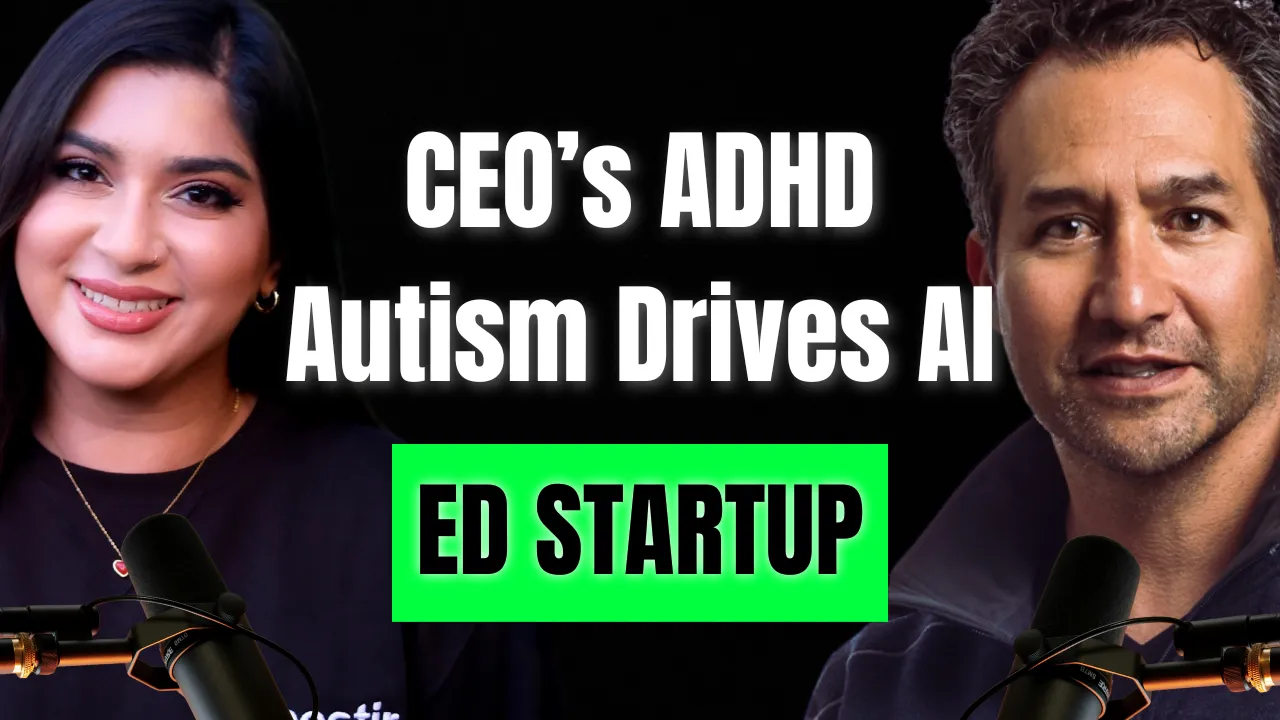
Jake Aaron Villarreal: I'm Jake Aaron Villarreal, born and raised in Silicon Valley, and here to take you behind the scenes to share what it's like to be a startup founder, the journey they're on, the problems they face, and the products they build in the hopes of transforming industries. I'm excited to have with us today Dr. Wardah Inam, the CEO of Overjet. Wardah, welcome to the show.
Wardah Inam: Hi, Jake. Thank you for having me.
Jake Aaron Villarreal: Great. Well, thanks for being here. Um just a little bit more about Dr. Wardah Inam. She completed her PhD at MIT where she developed AI microgrid technology and did her post-doctoral fellowship at the MIT Computer Science and Artificial Intelligence Lab working on biomedical sensing. Dr. Inam has received numerous awards for contributions and is recognized as one of the 32 most influential people in dentistry by Incisal Edge. It's a lot that you've done and a lot of accomplishments there. So excited to really learn more about you and about the company you're, you're building. Before we do that, where are you calling in from today?
Wardah Inam: I'm in Palo Alto.
Jake Aaron Villarreal: Hundreds of AI startups are launching every month, battling to build their founding teams. As a leader, your job is get results. When it comes to hiring, that's where it gets tough. So, you go out and you try a recruitment firm, but they don't understand your story. They're off target. And when they send you candidates, it's a waste of time. We believe you should never have your time wasted. That's why we launched Match Relevant because your story is more than just an open role. It's your founders' journey, the problem you're solving, the product you're building, and why it matters. When we work with companies, we make sure we understand your whole story. So, we go out and do a search, we're on target, it's worth their time, they're interested, and more importantly, it's worth yours. And when it comes to hiring engineers, we work to make sure we get it right by deploying a team of seasoned CTOs that have built some of Silicon Valley's best companies. They can collaborate with you in the technical interviewing process. They can be a sounding board or they can run it for you. When it comes to building teams, there's no time to waste. Let's make it count. If you have a role that needs to be filled, book a time with a hiring guide at matchrelevant.com and learn how we do it.
Great. Are you originally from there?
Wardah Inam: No, I'm originally from Pakistan.
Jake Aaron Villarreal: Great. Yeah, we have a lot of companies we've talked to from all over the world and it's great to understand their, their journey and where it started and where they, how they got here. And I guess for you, um, we'll talk about your company, Overjet, and how it's helping solve problems in the market today. But before we do that, give us a little, little bit of your background, your origin story. How did you get uh into technology and, and how did you end up in the dental industry doing it?
Wardah Inam: So I got into technology because I was very interested in math and science. And I asked my sister, who was in undergrad at that time, what, what I should pursue. And I was thinking whether it's physics, is it math, and is it engineering? And then she connected me with a few of her friends from different disciplines. So somebody doing physics, somebody doing mechanical engineering, somebody doing computer science. And basically through those conversations, I realized that I was more interested in building stuff, and that's how I got into engineering. And, and then studied electrical and computer science too, and graduated with that degree. And that's how you know, got into engineering.
Jake Aaron Villarreal: That's great. You know, a lot of times when you start off and you go to school, you're not really sure what you're going to do when you get out of school. It's a lot of school to go through to get your PhD and you're working a lot of cool stuff. Um, did you have an idea what you wanted to do before you even started school?
Wardah Inam: No. So, I, I think even in school you, you usually ask a last uh year PhD student and they, they have no idea what they're doing afterwards because they're more interested in the project they're doing. I, that's what I feel like it's you know, and for me as well, the project I was doing um while I was in undergrad, that's what was very interesting to me. That I, you know, I found something interesting to do in grad school, and then similarly when I was graduating as well, and these were problems that I've felt that needed to be solved, and I wanted to solve important problems and have an impact, and that's how my, you know, my journey went.
Jake Aaron Villarreal: Yeah, there's a lot of industries to build technology for and some of them that you know intimately and sometimes there's a reason behind it for you. You built technology in the dental industry. Why is that important to you?
Wardah Inam: So I wanted to be in healthcare. Previously I was in clean energy. And I made a conscious decision to move towards healthcare because I wanted to utilize technology to have uh an impact on people's lives. And I felt in healthcare, you know, you could build, build technology and have impact in, at least in my lifetime. And with that, I entered dentistry because I had personal experience. I changed my dentist, got a treatment plan which was very different um than I had received before, and that got me interested in dental diagnosis. So there was a personal reason where I felt that, that not only was it important for me, but also it had an impact on almost every person because every person had, has teeth and uh and gums etc. And a lot of people also get impacted by oral health conditions, and you know, we could have helped solve those. And, and then it seemed like a much more bigger societal problem as well with the, where the industry was headed, with the private equity money coming in, the consolidation happening. And, and there were not enough tools to help ensure the quality of care that was being maintained as well as the right decisions were happening. And that's where Overjet started to come about.
Jake Aaron Villarreal: Well, we're going to talk a little bit about the problem you solve in the dentistry industry and also the product itself. I think one of the big sort of philosophical issues that people can oftentimes have with not just their doctors, but also their dentist, is a trust factor. You go to a dentist, maybe it's a new dentist, and they prescribe some things that you kind of felt like weren't that bad. Do you, do I really have a cavity? Do I really need to get that replaced? How much of your product actually builds trust between the dentist and the patient? Just, I'm just curious.
Wardah Inam: A lot. So I, I would say, you know, and this is not just anecdotal as well. This is actually, you know, factual, where 50% of the ex- the treatments that dentists recommend, patients don't end up doing because of this trust factor that they have with the dentist and other cost factors that might play into, into it as well. However, it is because I, number one, that patients don't understand their oral health. If I asked you how many teeth you have, I don't know if you'll get the number right. And most patients will, will not, you know, is it 32 or you, a few were, you know, taken out, etc. So that's our, that's our understanding of oral health. Although we brush twice a day and, and we know that we need to floss, but if I talk about periodontal disease, a lot of people do not know about it, which is a very common condition or oral condition um impacting the US population.
So I think that's one where um, it's one, one of those things that there is lack of understanding by the patients. There's also, it's a very u- you know, if you look at a dental X-ray, not patients kind of understand what, you know, they haven't like understood dental X-rays as well, and that's how a lot of communication happens, or the, the dentist communicates looking at the X-rays and communicating with the X-rays as well. And that's where, you know, some of the tools like, "okay, take a photograph and show it to a patient" has helped in that communication, the trust building. And, and then you know there also, they are trained professionals who use terminologies that are very um dental depend-, dependent. And because patients don't understand that, such a um you know, "periapical radiolucencies," for example, they, they don't understand what the dentist is saying.
So I think there's like a multiple factors uh with why this ends up as patients not being able to trust the dentist, but this is one where, you know, our technology plays a big role where we are able to... not only we take those X-rays which p- dentists use to communicate, we highlight the important things on that data as well as, and, and we measure things as well. So for example, bone loss is an important met-, metric. Not, you know, the dentist is not telling a patient now there's bone loss or there's no bone loss. The patient can see that the last time they came say they had 3 millimeters of bone loss and now they have four millimeters of bone loss. And that's a, you know, that variation that they are able to see themselves, and that builds more trust. They're able to the, the now see what, where cavities are, those are highlighted. They're able to see other like infections in their mouth, so those things get highlighted, outlined and colored. And then there is no incentive at least for us to be highlighting those if that, that isn't there. And, and, and then the patient, then the dentist can use that to communicate with the patients.
Jake Aaron Villarreal: Yeah, that makes a lot of sense. Let's take a step back now, where I understand the trust factor and that's great. What was the problem you identified when you thought, "You know what, we could do something that's going to change part of the dentist industry or make, make it better." What exactly did you build and how does it work?
Wardah Inam: So we started with sol-, trying to solve the variation of diagnosis problem. So you go to multiple dentists, you're going to get different diagnoses, and which... who's right, who's wrong, you know? And that's, that's what we started uh building for. But we realized that we were solving a much bigger problem. It wasn't just the diagnosis, it was the fact that all this data had never been analyzed before. And if you could analyze it, there's a lot we could do with it. Um but, but in, in that sense um, you know, I, I think for us that, that's where the, the problem stemmed from. And, and then what we built was an ability to analyze this data and be able to not only detect disease but actually quantify disease so that we could come with very objective decisions that could be provided, not just subjective decision-making. And that the objective decision-m- will not only result in better diagnosis, better treatment planning, but also more trust between the dentist and the patient. And then the patient accepting the treatments that the dentist is recommending, and overall better quality of care for the patient.
Jake Aaron Villarreal: When you look at the technology you created, which is in the AI space, artificial intelligence, is it the images that you're taking and, and, and reviewing and having a real clear, maybe better way of diagnosing what the images are saying? Does it help the dentist actually do their job faster? Like, what's the benefit to the dentist too in addition to providing this technology to them?
Wardah Inam: Yeah. First, you know, it is, it provides a comprehensive analysis very, very quickly. And in a dentist's office, dentists do so much. And, you know, providing diagnosis is a part of it, but then there, you know, they, they have very little time to be able to do that. And, and in this case, we are able to you know do that, you know analyze the whole thing very effectively and, and, and help the dentist make a much more comprehensive diagnosis. And when they make a more comprehensive diagnosis, the, uh they um uh do not miss any, any conditions etc., uh as well as uh they are more confident in their diagnosis. And then third, that they can communicate with the patients as well. So, you know, this problem is not just from the patient point of view, but also the dentists have, you know, see this as a problem often uh being able to communicate much better with the patient. So that's how it helps the, the, the dentist as well.
Jake Aaron Villarreal: Yeah. Are there, does it improve misdiagnosis?
Wardah Inam: Oh yeah.
Jake Aaron Villarreal: The potential.
Wardah Inam: Absolutely. Yeah.
Jake Aaron Villarreal: Yes. Yeah. Okay. When you talk about bringing a new product to market or, or your current product and bringing that and to continue to distribute that into the marketplace, who cares most about the solution and who are you selling it to when you go to market, and when you're going to market today?
Wardah Inam: So, we sell to dentists as one persona. We also sell to dental practice owners. So this would be what we call DSOs. So if you have groups of practices. And we also sell to insurance companies. So we have three. And we also sell to schools. So we have multiple personas that we sell to.
Jake Aaron Villarreal: Yeah. Got it. You know, as you, as you bring a new product into market and having a clear message, it's great if you, if there's one problem you solve and you talked about how it helps the dentist and you talked a little bit about as well how it helps the patient building the trust. What's the connection with that and the insurance companies? How does that help them?
Wardah Inam: So the same problem that dentists have, you know, insurance companies have as well, where they're getting significant amount of data and then they have to manually review that data. Um, and they hire dentists to review that data. So helping them analyze that information, um, automate all the administrative tasks such as, you know, looking at is this the right type of X-ray that was sent, is this the right tooth number, etc. And then being able to um route it to the right dentist for review, and then having them review with the annotations and markup so that they are able to make better decisions. So um similar kind of technology or similar technology but different use case. And in that case being used by clinicians as well as administrative reviewers.
Jake Aaron Villarreal: Yeah, I love it when companies have multiple wins in their process. They're helping one side of the marketplace today and another side tomorrow, and ultimately the user who, if it's humanity, that's even sort of the trifecta. So really, really cool to see how technology is really helping everybody universally if it's used. Um is there a way for patients to know that your technology is being used for the dentist they go to, or is it really more a B2B where you wouldn't really know that?
Wardah Inam: No. So the patients see it, you know, the, as the dentist communicates with the patient utilizing the technology, that the, the, the patients see it. And sometimes we see um even Yelp and, and Google reviews with Overjet being mentioned as something that they're very excited about.
Jake Aaron Villarreal: Yeah, that's really cool. Um your company today, talk a little bit about how long you've been in business, how much have you raised, and how big are you as a company?
Wardah Inam: So we've been in business for about six years now. We've raised $130 million and we are about 150 people.
Jake Aaron Villarreal: Good size. What's, what's the current biggest challenge for the company as we speak?
Wardah Inam: Um so for us it is just dealing with the growth. So we're growing very fast and that means you know hiring fast for the folks that are needed. Processes are breaking and new processes are being built. And then being able to just you know, and people are getting um up to be able to handle more responsibility etc. So I, I think it, you know, just the with high growth there's you know, which are good problems, but you know that it brings problems as well.
Jake Aaron Villarreal: Yeah, I understand that. We've been doing what we do for 13 years and it's really in the people business. We help companies grow, scale, and hire. One of the challenges that a lot of founders have told us is that when they're hiring people, especially when they're scaling up, it's a really hard problem to, to solve. Because you have a story, but then you also have to make sure everyone's aligned on the same story that's hiring and in the process. Um there's some challenges there that can come up for you as you grow and you, and you, and you scale and you add people. Um this is a time for you to maybe to talk a little bit about what's great about being at your company. Like if you're somebody that's looking for an opportunity or maybe looking to change from Google to a startup or whatever it might be. Tell us a little about your culture. How do you operate as a company? What do people like about being at your company?
Wardah Inam: So for us, our culture is really focused on high performance, high velocity. And that's something that you'll hear just in general being said again and again. And what that means is, you know, we're more focused on delivering value, getting things out fast. Like being able to build product and get, get it out to the market quickly. Um, and, and that, you know, that's different than some other companies. Everybody wants, you know, would love to do that, but you know, that, that does require a certain kind of um emphasis on, you know, doing things even if they're 90% there and getting it out there, etc., and not perfecting everything. So that, that's where, where I think one of the important um pieces of our culture. Um and um and then you know for us, we were started as the underdogs in this industry, now have grown as the leader in, in the industry. But I think there is still that mentality of every you know opportunity making the most of it, making sure that we um, we, we're always doing our best and, and pushing the boundary there.
Jake Aaron Villarreal: That's great to hear. You know, there's AI that's obviously been brought to life by OpenAI and there's a lot more in-, interest in funding companies in AI. And, but you were there kind of before all the, I guess the knowledge to the, to the layman has been out now and public and been, been building you, there's like three of the big companies, OpenAI and Google and a few others that are really going for the, the data science talent and the machine learning talent. What's been the strategy that's worked for you in terms of hiring? Has it been here in the US? Has it been international? What's been something that's really been something you kind of have looked at? It's been working for you.
Wardah Inam: So for, so we, we hire mostly in the US um and now mostly in the Bay Area, Boston or New York. And um for, for us, you know, getting good people is always hard. The, the best people are, you know, keep, companies are keeping them and, and you have to really find them, you know, find the right fit and be able to then convince them to join. And even if they're, you know, interested, it's, it's one of those things where um there's a lot that, that has to go right for that to happen. So, I, I think for, for us, hiring has always been a key priority for me and, and the company in, in, in general. And, and we do believe in like creating the highest talent density company as well. That means we really do focus on trying to hire the best people. And then we go, you know, we try to go out of our way if we need to um to get them on board and have a really good um seamless experience there as well.
And then, you know, I think what resonates for people is the mission, what we're trying to do, etc. It's something that especially if you're in healthcare um and it, it resonates with you around you know being able to have an impact in your lifetime, being able to really make a difference and see your outputs actually come to life in, and in a, in a very impactful way. You know I think what say, you mentioned like some machine learning science etc. I think what they love is the fact that they're, they're able to work on a very impactful project, get it out into the market and see the impact of it and the customers using it and giving great feedback. And I think that's one where um we've been able to get some really good talent because of it.
Jake Aaron Villarreal: Yeah. Well said. Yeah, I know it's a challenge for a lot of companies to, to get it right. You have to have the right story. You got to fund it. You have the right people on board that's going to attract others to join, and you have to make sure that everyone's aligned in the story you're presenting so that when you get them on site there's a real opportunity to close on them. And if it's the right person, the money makes sense, the compensation ranges and the mission does also make sense. A lot of times there's also the transformational story that companies don't always realize, which is when you bring on the really best people, how is it going to transform their life? Like what are they going to learn? What are they going to do when they get there and where are they going to end up as they continue to grow? And that's a real powerful conversation to have where they can see it, but also you can help them transform into a better person because they're part of your company. So, we've learned this over the years talking and working with a lot of companies that you can, might, you might have the greatest company and good, great products and, but how you're presenting it and how you're transforming people in the process as you grow is very powerful. So cool to, I'm sure you're doing these things already. Just it's, it's, it's great to kind of see where you're at today and, and um the opportunity that lies in front of you.
Every company that starts, you know, it's not like "I'm going to try and get to the North Star and it's a straight line." It's a lot of left and right decisions and shifts and pivots. Um we like to call them shifts. What's been a shift in the company when you started to, to where you had to go left or right that's really had a major breakthrough for the company?
Wardah Inam: I think early on when we were deciding on you know which market to go after etc., and there you know was, it was uh more around "should we do insurance, should we do practices, should we do you know labs for, for example." And then you know deciding on that, like it wouldn't just be practices, it wouldn't be just insurance. And you know the value that we're going to add to the world is being able to look at the, the end-to-end system and being able to optimize that. That was some decision that we made. And, and that led to probably successful outcomes for us. But also it was a difficult decision at that time because you know we were, we were very small and, and you know investors in general want you to focus on one thing. And we were saying, "Hey no, we, we are going to focus on build this out, but while we also build this other piece out." And, and that was you know sort of a pivot that we did and, and, and it turned out to be, had a successful outcome.
Jake Aaron Villarreal: Yeah. Well, it's great to hear that. I know that every company doesn't always have a clear path and you have to experiment and try things and hope for the best and get it right, and if not, you change and go a different direction. It's great to hear that you've done that. Um, in your space, I'm assuming there's competition. What, what's the moat that you're building around your company that will keep you from fending off competitors as we get further and further into AI and companies... there's like 1500 AI companies launching a week right now. So just in terms of um what you're doing to kind of fend off the competition, what's, what, what's your strategy there?
Wardah Inam: I think, you know, we're tackling some of the most difficult challenges which are sometimes not the easiest to tackle and there might [be] other low-hanging fruit. So we keep on tackling the most difficult challenges which usually companies try to ignore. And then also we try to you know build at the system level, and, and that's something that other companies try to ignore as well and, and try to create more point solutions. Um, so I think you know the way we're actually tackling the, the problem and trying to solve it, I don't think there's anybody else doing it. And they might try to copy on us on one thing or the other, but I, I think for us, we are paving the way on how this needs to happen and, and, and treading our own path there. So I, I think that's where we are.
Jake Aaron Villarreal: That's great. You talked a little bit about the shift and pivot of your company. How about you personally as a leader of this company that's growing and scaling and you're leading the path where you're going? What's been a good or a big breakthrough for you that you've realized over the years of running the company so far that you could share?
Wardah Inam: I think for me, every quarter there's a big breakthrough where, where we're just, you know, there's a lot to learn. And every quarter I look back, or six months before I look back, and I'm like "Huh, you know the, that was interesting where you know I'm, I'm learning and figuring out ways of running the company better, but also you know the, the way I'm operating etc is changing and, and improving hopefully." And but I think that's one where, you know, at least for me, if we're not stretching every quarter, you know, then there's something going wrong.
Jake Aaron Villarreal: Yeah, I, I agree with that. What's something you wish you knew before you started the company that someone would have shared that would be helpful for other listeners to hear?
Wardah Inam: I think one thing that I learned a little later was the fact that every successful company is, is different. And what that means is that you know we can have our own way of how we are, or what makes us successful, and doesn't mean you know, even if it's not the way others are doing it, it doesn't mean that it's wrong in any way. And just being able to then really look at everything in a way that you know uh really look at things that are working well and, and keeping them as much as we can, and then um changing the things that are not doing that well. So I think you know I would say earlier I was more of this belief that you know we had to be more like others, or like if they are having this kind of structure, we need to have it similarly etc. And I think the more um I've realized that every company and every leader is very different and, and how we actually build the company, there is no right way of doing it.
Jake Aaron Villarreal: Yeah that makes sense. Well that's really good insight for everyone that's trying to build a company right now. You've done it at a very good level, $130 million in funding and really growing and scaling up. What's on the road map as you look into... we're already heading into 2025 in six months. What are you excited about from a technical perspective?
Wardah Inam: So, we're building new products both on the insurance side and the practice side. So, I'm excited about launching those products into the market.
Jake Aaron Villarreal: That's great. Um well time flies and as we wrap up here I just want to thank you first and foremost for joining the show here today and sharing your story. And also for the listeners for listening, it means a lot to me that you spent your time with us today. If anyone wants to find Overjet or find you, where do they go?
Wardah Inam: So I, they can find me on LinkedIn um and um I think it's my first and last name as the way to get it, but that would be the best place to do it.
Jake Aaron Villarreal: Great. Cool. Well, thanks so much for joining. My name is Jake Aaron Villarreal, the host of the show. Signing off for now. I can't wait to catch up with you all on the next episode. Until then, take care. If you like what we're doing, don't forget to subscribe, leave a review on Apple Podcast or wherever you listen, and follow us on YouTube where we go behind the scenes to learn what it takes to be a startup founder.









.jpg)






.webp)
.webp)
.webp)
.webp)