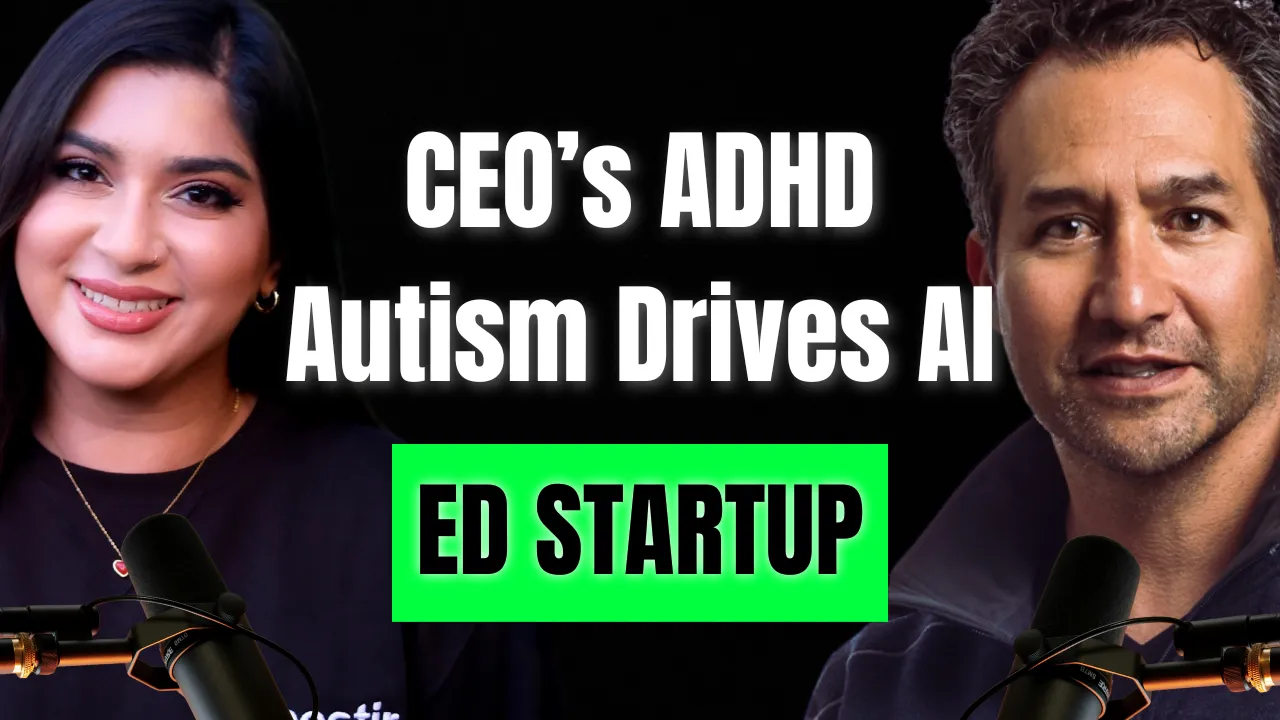
Jake Aaron Villarreal: I'm Jake Aaron Villarreal born and raised in Silicon Valley and here to take you behind the scenes to share what it's like to be a startup founder, the journey they're on, the problems they face, the products they build in an effort to transform industries. I'm excited to have with us today Neha Mittal, co-founder and CEO of Just Words. Neha, welcome to the show.
Neha Mittal: Thank you and thanks for inviting me.
Jake Aaron Villarreal: Well, I'm really excited to have you on the show for a lot of reasons. We'll get into your background and your origin story and the problem you're solving today with your technology company. Uh, a little bit more about Neha so the audience knows. She not only leads the company, but she is backed by Sequoia uh, and their product enables teams to hyper-personalize messaging on emails and push notifications. Prior to founding Just Words, she ran growth for Twitter and Pinterest. Big companies, lots of growth. Excited to hear how you did it. Before we jump in here, uh, where are you joining us from today?
Neha Mittal: Um, I'm in San Francisco.
Jake Aaron Villarreal: Hundreds of AI startups are launching every month, battling to build their founding teams. As a leader, your job is to get results. When it comes to hiring, that's where it gets tough. So, you go out and you try a recruitment firm, but they don't understand your story. They're off target and when they send you candidates, it's a waste of time. We believe you should never have your time wasted. That's why we launch Match Relevant because your story is more than just an open role. It's your founder's journey, the problem you're solving, the product you're building, and why it matters. When we work with companies, we make sure we understand your whole story. So, when we go out and do a search, we're on target. It's worth their time. They're interested, and more importantly, it's worth yours. And when it comes to hiring engineers, we work to make sure we get it right by deploying a team of seasoned CTOs that have built some of Silicon Valley's best companies. They can collaborate with you in the technical interviewing process. They can be a sounding board or they can run it for you. When it comes to building teams, there's no time to waste. Let's make it count. If you have a role that needs to be filled, book a time with a hiring guide at matchrelevant.com and learn how we do it.
Love San Francisco. I'll be there next week. So, very cool. It's the epicenter of technology from my perspective. Born and raised there. Um, want to talk a little bit about your origin story before we jump into your company. Give us a little background of kind of where you where you started, where you came from. Were you an entrepreneurial type of kid? How did you progress? And how did you end up being a startup founder?
Neha Mittal: Yeah. Um, all right. Well, going back to my childhood days, I was definitely not an entrepreneur kid. At least wasn't um raised to be one. Um I was definitely told do the least risky thing and that's what's going to make life successful. My parents had a very different definition of success. Of course, um and so yeah, like I was always trained to be doing things that are easy like pick up engineering so you can find a good software engineering job. And so that's what I did when I went to Singapore for my uh college degree. Except I remember in my second year um I called up my dad and I was like I don't want to be doing this. I think I want to um pick up business and I want to run a business. And he's like where are you getting these ideas from? And I was like oh somebody, one of my friends told me about this thing called technopreneurship where I could use technology in something called entrepreneurship. And I didn't even know what that word means. And then, and he's like, "I don't think that's a good idea. You know, stick to what you're doing." He's like, "All right, cool."
Um, so I I went on to study engineering and um um you know, as I went through college, I did some startup stuff on the side. Um but then I went, I go on to um work with Goldman Sachs again. Um all good stuff, you know, exactly what my parents wanted. Um I am frustrated that in a couple years I'm just like I don't know what I'm doing and I think I want to you know build my own company. Um I didn't have the guts though cuz you know past 20 years it was very much, it was a very different u sort of take that I was used to. So it wasn't easy to change something that was so core or so much ingrained in me as I was growing up. Um so and yet I'm on the tipping point you know in Goldman I'm just like somebody give me a path to get out of this.
Uh so uh it's interesting I I met a friend who was starting a company and I met him for a beer and he's talking about yeah you know this is what I learned from my previous company. We're starting this company uh you know it's only been two weeks and uh like oh this is so exciting. And then next day he calls me. He's like, "Hey, do you want to join us? Um, we're looking for our first founding engineer. We're only like, you know, we're very small company, but we'd like somebody to join us. Um, and we won't be able to pay you the Goldman salary, obviously." Um, and I meet him for a lunch the next day and um, the day after I put in my papers. I take a 50% cut, whatever. Like, you know, the salary didn't matter. It was just like, okay, I got to do this. No matter what, I'm doing this.
Um, that was sort of the first crazyish decision in my life that I took to be going to this startup path, right? Everybody, all my friends were like, "You're going crazy. What is this insane thing?" Um, but within a few months, they're like, "Okay, this was the best decision of your life. You're very happy in whatever you're doing." So that was sort of my first like breakthrough of just getting over the idea like hey I can you know go do something that's out of the ordinary and I can take a risk and it's okay life, life moves on you know. Like I and I'm learning a lot. Like I I think I learned more in the startup than in most of my big company experiences. Um yeah and then um similar things happened um uh so I then moved to the Bay Area. I went to Berkeley you know to pursue my master's and stuff. Um I'm in Twitter now. It's been four years. Uh right and I'm feeling the same um itch like what am I doing? Like this is not what I want to do.
Um and then Elon joins the company uh in the middle of that right. And it's, it's interesting because there's all the stuff that we're hearing in the news. Of course all that is happening. But something that I think he shows and Bay Area has a lot of it is the, is the idea of big visions. Like things that I again don't think I grew up thinking about. Right? He's talking about a vision where he's trying to make Twitter the town square of you know the world. Doesn't matter where Twitter is going or will go, but the idea is like suddenly I'm thinking oh like why why am I not thinking this big? What happened, right? And and this is why I love San Francisco on a side note. But anyway, so now I'm thinking, all right, like, you know, I don't think I'm going to last in this company for very long for various reasons, but why am I not going and pursuing my dreams there? Um, and then anyway, again, you know, hard to get through the, get through things that I was b- like I was trained to believe. So, I'm like going to stick with Twitter, whatever. I joined Pinterest after that. Um, also big company, really good people, great work. Um, but I didn't last very long there, which was a a shock to a lot of people within the company too because everything was pretty perfect on paper. Um, and you know, that was just the time and moment where I was like, if I don't do this, I'm going to regret this for the rest of my life. And so uh I quit Pinterest last December and you know uh start this company um this January and and joined YC and so that was a very long story but that's sort of how uh you know I went through a lot of different breakpoints or breakthroughs in my life.
Jake Aaron Villarreal: Yeah. No, that's really cool. Uh you know I think that as you grow up sometimes you have different perspectives based on how you're raised and limitations are put on you of what you should and shouldn't be doing. It's, it's maybe one of the hardest things to get through and you know you want the approval of your parents but you also have your own internal desires to do stuff. So being able to make those tough choices but also ultimately end up taking the path that's right for you is is, is great to hear. I want to go back to Twitter a little bit because, you know, we all read what was happening at Twitter when it was acquired and you see Elon going in, you know, uh, holding the sink as he's walking in. Guess what, I forget the exact phrase about "guess what the sink brought in" or whatever it was. But anyway, uh, really cool to to to be I'm sure there at that time and yeah, bigger vision creates bigger potentially opportunities. What um, just from an internal perspective, what was the, what was that experience like for you? Um did you feel like a a major shift in in the culture of the company? Was it more fear-based? Was it more "this is an opportunity"? Like how did how, what was it like for you?
Neha Mittal: Yeah. Yeah. Um, I think some, a way to put this is uh put this in perspective is when we were in Twitter, we were in a very um, it was a very uh I'm going to think, think about the right words here. Um Twitter. So when Elon joined, we thought, "All right, like we're used to a very different culture," you know, where it's very bottoms up. Um we we take decisions um very much in a way where everybody's giving their thoughts and comments, right? And it's going to be a little bit of an adjustment to work with how his, his what his style is. Um in a couple weeks, we realized it's not meeting him midway. It's very much resetting the culture. So mostly because of that, it was a little bit of a shock in terms of adjusting to that. Not because anything he was doing was wrong or, you know, like not okay. It's just that the reset took us a little bit of time to get used to that.
Um things that were obviously great or like a very fresh perspective in terms of him joining was um he's not only, he doesn't just have a good vision, he's very good about understanding how to put people behind that vision. So very quickly we were talking about one or two big initiatives and we were not talking about anything else. Uh that was one of the big lessons I learned as you know, as I think about being a good CEO like, how do I bring focus to the company and not try to tell them to do 10 different things at the same time, right? Um he's very good at that. He's also very good at um cutting down um the bureaucracy. There's not, you know, we're not talking to 15 managers. Everybody's focused on doing work, getting things done. That was great. Um I also saw him make really good decisions based on intuition. I think he, it helps that he was a power user of Twitter, but also he's, he's very good about not um thinking five things at the same time, but making a, making a decision based on what he thinks is right. Doesn't mean it's always right, but what people needed in that time was a direction more than whether it's the right direction or not. Um so there was that. But having said that, there were obviously things that we were still struggling with in terms of the culture, uh where uh it was a very people-driven company and it became a very top-down company. So that's something we had to align with and see if that's a good fit for everybody.
Jake Aaron Villarreal: Yeah. Got it. Well, he's certainly an innovator. I'm an investor in you know, some of the companies he's been building and it's great to see him continue to evolve and you know make the world a better place with technology in my opinion. So really cool. When you were at Twitter, just to kind of keep on that topic for a little bit, and we'll talk about your current company here. Um, you were tasked to leading growth. Is that correct?
Neha Mittal: Yeah, that's right.
Jake Aaron Villarreal: And you were there for how many years?
Neha Mittal: Four. About four years.
Jake Aaron Villarreal: Okay. So, when you got there and when you left, what what what did that transition growth look like? Like what did you feel good when you left that you had certain things that you achieved? Because that's a big company, lots of, lots of people are on the platform. You know, how do you measure growth? And specifically when you left, what did you feel like "I really nailed it from the things that I was supposed to be doing there"?
Neha Mittal: Yeah, when I started in the growth team, one of our cultural challenges was to be able to take bigger swings. Again, it was not a very um, it was a very risk-averse company in some ways where it's like, "No, we're not going to try something. We're not even going to put out a tweet to say if we should do X or Y because what are the ramifications of this" or "we're not going to redo our systems because everything is going to take a long time to build." Um so obviously I wasn't doing this at the macro level where Elon was uh you know focused on, but this is something at at least at the growth team's level. This is, this was my mandate that "how do we think out of the box and try to do more zero to one things that we haven't tried before." Um, and so some examples of what that looked like was, um, um, uh, I remember we tried this thing where we said, "Hey, we send a lot of push notifications. People have a love-hate relationship with them. Um, what about web notifications," which in the bubble we live in, we everybody's like, "Well, everybody's going to hate web notifications. Nobody wants to see web notifications." Um, but we enabled them anyway, and we saw massive gains. We saw like half a million more users in, in one experiment. So it was crazy that no, the rest of the world still likes it. A lot of users are on their desktop, right? So there were a bunch of experiments like that that we ran eventually to basically invalidate the idea that um the idea of "hey, we're not going to, we're only going to focus on incremental things and not try things out of the box." Um and the more we did that and the more we optimized on um both using data like machine learning to um effect some of our optimizations, but also going by intuition on what are different things that different markets would need. Um we were looking at driving uh 21% of our DAU um with just our our team's effort. So um that was a very uh it was a very, it was a very nice feeling to see the com- the team that um you know I'm working for is a very massive part of uh Twitter's um overall um even their like um you know stakeholder um earning reports and stuff um would have our team's portfolio as one of the big things there.
Jake Aaron Villarreal: Wow that's cool. You ended up going to Pinterest. What was your role there uh at Pinterest?
Neha Mittal: Yeah. So at Pinterest I was uh leading all of uh retention which involved um um uh retention channels like emails and push notifications, internationalization efforts. So anything to do with localization or expanding into different markets um and performance marketing um so again um looking at "how do we do better performance marketing and understand our LTV gains and so on."
Jake Aaron Villarreal: That's great. What did you see at Pinterest and at Twitter that made you say, "You know, look, I've got an opportunity here to build something on my own. I'm ready to kind of take the leap here"?
Neha Mittal: Yeah. Um, so at Twitter, one of the interesting things that happened was at some point our growth was plateauing and we were looking at what what else can we do to micro-optimize um here. And one of the examples I share is how we changed this push notification from "Elon tweeted" to "Elon just tweeted" and hence the name of the company Just Words. Uh that got us um a million more users in one experiment, which is 10x of what a good experiment looks like. Um wow it was, it was intriguing. Everybody's like "What is going on? What are we missing here?" But our key insights were that only one in 10 experiments would give us these kind of results when it comes to small micro changes. Um and it took us anywhere between 1 to 3 months, a lot of ad hoc messaging changes that we would try um to get to these results, right. So for engineering and product teams this didn't scale. Like it wasn't an exciting project to work on and we couldn't put five engineers just looking at exactly this stuff. Um so that was kind of where we figured "All right, we want to automate some of this. We want to be in a place where we can dynamically refresh content." Um but you know, we left it there. We joked about maybe building a company around it but never did.
When I went to Pinterest um I saw the exact... it was funny because the first project that I had to work on was um or decide how how I want to proceed on was called Copy Tune. I was like this sounds exactly what we were trying to build in Twitter. And then again thanks to Elon, a lot of my colleagues had gone to various different companies by then. So I'm starting to talk to all of them on "hey like how does your company deal with it and how does your company deal with it" and everybody's like "oh yeah localization is still a problem, copy testing gives results, still very manual, um very operationally draining," right? So I'm getting all these insights from different, from talking to different people um and that's when it was obvious that there's something in here. And with the AI unlock we're suddenly not dependent on um the supply of content, we don't need humans to create content for every single thing right. Um so it started making sense in my head and that's why I was like "All right um I got to, I got to give it a shot."
Jake Aaron Villarreal: Yeah. Well, AI certainly is disrupting almost every industry and adding a lot of value to ones that we all are in. What's um talk a little bit about the product itself. So just for the audience, we talk about AI, you talk about not having to create the content, you talk about testing content to see what's going to drive engagement. What, what do they get with your platform?
Neha Mittal: Yeah. So um at a high level we hyper-personalize messaging right on retention channels like emails and push notifications. The way we do that is by letting you test more than 50 variants um within a few weeks for every single campaign or use case you're trying. So you're going from a traditional AB test world where you're testing one piece of content at a time in a sequential manner to now a dynamic world where we're not only testing 50 variations in one experiment, but we're also using signals from the first few experiments to affect what is the next best message to show. So we're creating this flywheel where your content is continuously getting refreshed um based on AI and causal inferences from the experiment.
Jake Aaron Villarreal: And what are some of the companies, if you can share, that are either using your product or you're in discussions with that will use it and they'll, they'll you know, they'll be able to see a benefit from it?
Neha Mittal: Yeah. So some of the companies we work with are Grammarly, Notion, uh BiggerPockets. So lots of different sectors. But really um what they are able to do is to instead of you know um again, again going back to the use cases they use this for, right. So very retention focused in terms of how do we um bring users back to the platform or how do we ask them to now convert from free to paid. Um there's so many different ways why, why a certain user would want to convert to paid. But can we, can we try out different value props and see which one is resonating with users in a short amount of time?
Jake Aaron Villarreal: God, I can imagine those big companies that spend a lot of money and just trying to get their customers, but then keep them. It's a lot easier to keep a company, a comp- a person or a customer than it is to go out and get a new one. So, a lot of value there. Um, what's been the, one of the bigger challenges as you've come into the market? You went through YC. I'm assuming you got some funding, maybe some seed funding, and now you're you're you're building your product. You've got some customers. What's, what's the challenge that you're facing today as a company?
Neha Mittal: Um I think one big challenge is people are still in terms of like the mindset of how they think personalization, right. Personalization is a broad word and broad stroke that so many companies are talking about um, and yet people are still trying to figure out this category which it's almost a new category of things which is right between your um channels like emails and so on, and between segmentation of users that companies like Amplitude is solving for. So you've got your Amplitudes of the world and you've got your HubSpots of the world, right? But in between there's this personalization layer that's still missing that connects users to content. Um so positioning it um that way and having companies see the value of how you want to go from the one-off if-elses that you're used to writing in your journey builders to a world where it's absolutely um automated using machine learning. Uh that's been a little bit of a challenge in just like you know like getting people, getting getting people used to the idea of this, but I'm sure with AI it's definitely going to happen sooner than later.
Jake Aaron Villarreal: Yeah. When you talk about AI you know there's a lot of companies that are starting now that are really we look um we look at them as an AI-first company where they're starting with AI is like the foundation of what they're building and then they're taking their product or service to market. How much of your platform is really built on AI?
Neha Mittal: Yeah, our platform uses AI as an accelerant. It is not, AI is not sort of a dealbreaker if I were to put it differently, right? Um the platform really started from a core problem that we were seeing both in Twitter, Pinterest and many other companies, right? Um however, the platform is not complete if AI is not in the loop. Because the way this works is we test out lots and lots of variations, but we need a machine to be able to generate new variations. Um, so it completes the flywheel, but it's not um uh you know, it's not, it's not that without AI, we wouldn't be building this company.
Jake Aaron Villarreal: Gotcha. How long have you been around now as a company?
Neha Mittal: Uh 10 months.
Jake Aaron Villarreal: Wow. Very, very new. And that's great. You've already got traction with customers. Um, you know, a lot of times you start with an idea and you make shifts and pivots and but with 10 months, my assumption would be is you kind of started with your thesis and you're building that out. Has there been any breakthroughs that you've gone through in this short amount of time that have been like really big aha moments where, "oh, okay, we can do this. It's totally going to change how we build the company or improve it or scale it in terms of the product development." Um, yeah.
Neha Mittal: Yeah, lots of them. Um I guess uh even when we started right at, at some point we're thinking very small again in terms of "hey like let's have YC startups use us." We very quickly figured out that this is an enterprise game and we stuck to that. And that was a difficult decision for us as a startup because we're small. We have to pay the startup tax. Um companies are hesitant to take risks with us early on, right? Um and it's a slower sales cycle. Um u but it was something that you know as we did more and more discovery it was like very obvious, "okay that's the angle we want to go to" and we stuck to that. That was sort of more of a GTM aha moment for us that we stuck to.
Um on the product itself, um I think couple of areas where I was like, like the companies were very excited about, was when they could see very detailed metrics on every single message that we're sending to users and use them to affect their larger product strategy. So something that we were imagining will give them a lot more experimentation speed, but what we hadn't thought through was "all right, some of these insights can be so valuable that you can start predicting new audiences from here." Um uh which is a huge unlock outside of the tool itself. It's helping companies almost like drive product strategy in a more methodical way. Um so that's, that's the exciting next step we want, we are also working on in terms of giving that out of the box to users.
Jake Aaron Villarreal: Yeah that's really exciting. When you sell, when you're out there presenting to companies, I'm assuming it's founder-led. You guys are 10 months old and you're probably in front of the customers. Who are you selling to within the company? Is it the marketing team? Is it the growth team? Who, who cares most about your, the problem you're solving?
Neha Mittal: Yeah, we specifically sell to lifecycle marketing. Um u because they're the most focused on the user journey all the way from activation to retention um and further monetization and upsell. So those are the key users we sell to.
Jake Aaron Villarreal: And getting into the marketing aspect of it. What's been a strategy that's worked for you to get in front of these lifecycle managers?
Neha Mittal: Um yeah, it first it really helps to be somebody who was in this space. So conversations are easier for me where I'm like "I struggled with it" and they're like "we did too." And so uh you know that really helps um because empathy is very easy for me to strike because like yeah I know exactly what you're...
Jake Aaron Villarreal: You've been there. Yeah. Yeah. Yeah.
Neha Mittal: That's that. Um second, um it also helps to stay sector focused. So we're going sector by sector rather than looking at everything at the same time. So if you notice, we're looking at productivity. We're looking at um now real estate, e-commerce, and so on. So um uh that helps because as we build the product, we're building intelligence per sector rather than just going, just doing broad strokes. Um yeah. Um so those things and then eventually honestly the value prop of um how do we set a culture...
Um so sorry, stepping back right. Um as I talk to growth leaders, one of the things that they're constantly talking about is how do we change the culture of experimentation in the company. Everybody wants to be more data driven and tools don't solve for something that's as um uh complicated as you know the culture of the whole company. Um so one of the things that we discuss a lot is how do we bring this tool as a way to bring a culture of continuous experimentation. Um, and that's been an interesting conversation because we step back from "here's the SaaS offering" and we look at the larger world of what do you, what would you like your growth teams to do, right? And they're like "We cannot guess what works in growth. If we could, we wouldn't have a job, right? We don't know what works for our users at scale, right?"
Jake Aaron Villarreal: Right.
Neha Mittal: Like think, I guess elections are here, right? So we didn't know we, in in an election like world, we cannot tell if it's um economics, if it's immigration, if it's a different topic that people care about, right? You have to wait for the results to see what people care for right. Um that's not true um thankfully in um uh B2B companies where you can take small samples and figure out what your users are resonating with, right. Um and so growth leaders are like, "We don't know what works. The only thing we can do is to try a lot of different tests and see what works, right? Can you help us get there?" And that is a big, big win for them if you can. So, and that's sort of the secret sauce of the tool.
Jake Aaron Villarreal: Yeah, I like that secret sauce. You talked about enterprise clients are your focus. You talked about Grammarly and Notion, some big companies, but I know there's a lot of mid-market companies and smaller companies that are also struggling, I'm sure, with that same problem of, you know, what messages should we use? How do we automate it? How do we really drive results out of our marketing initiatives? Um, what do you say to those companies that reach out to you?
Neha Mittal: Yeah. Um there's a couple discovery patterns there. One, micro optimization is not a hair on fire problem for them. They would like to have that, but they're still trying to figure out foundations of what is, what are our core channels? How do we do a multi-channel strategy? And that's intentionally not our game. Like we want to go personalization first, not, we're not building foundational infrastructure. We're building foundational infrastructure for personalization. Um so that's why we're very intentional on starting with enterprises. Um the second reason why enterprises are working out well is because they have the traffic to support quick adaptation. So you know, just how the product is designed, it works better for companies that have more users.
Jake Aaron Villarreal: Really cool. What are you enjoying most about being an entrepreneur right now?
Neha Mittal: Um, what I enjoy the most is I can now be a product manager for 10 companies rather than one company at a time.
Jake Aaron Villarreal: Okay.
Neha Mittal: So, it's it's very exciting to be able to go to Grammarly's office and Notion's office and, you know, another office in Denver and whatnot. Like, all right, I love that, you know, like one day I'm learning a lot about real estate, another day I'm learning about um PLG. I don't know, right? Like there's a lot of different aspects to different companies and I'm always um almost inspired by how, how smart they are. Like each, each company has something to teach me. And so um that's that's been the most exciting part for sure.
Jake Aaron Villarreal: Yeah, that's really cool. For the enterprise companies out there that are hearing this and thinking, "Wow, you know, Neha's been at Twitter, at Pinterest, we're a big company. We could probably use a product like this." Um, for them, what are they getting into when it comes to the business model? Like, is it a price per message? Like, what's the structure of how you, you price out your, your product?
Neha Mittal: Um, yeah, it's a pretty straightforward volume and channel-based pricing. So we try to give all you can eat kind of a buffet where you're not constrained on how many messages you can try. We want you to run more and more experiments. So um um you know it's, it's very much "How big are you? How many use cases do you want to try out?" And based on that we'll we'll price it.
Jake Aaron Villarreal: Cool. Sounds fair. You know, we've all heard the stories about, just going back to Elon, where, you know, during the Tesla days where he's sleeping under his desk and never leaving the factory and doing everything he can to, to make it work and sacrificing really everything to, to prove that he's going to get his product into market and it's going to succeed, and, and it's worked for him. What's, what's one of the biggest sacrifices you've made so far earlier in your startup that you know you think is, you know, a big sacrifice to kind of get your company off the ground here?
Neha Mittal: Yeah. Um it's almost a growth area for me at this point. But um I've forgotten how to disconnect from work. Um which uh you know has its challenges when it comes to having a good personal life, you know, like um uh balancing out other things in life that are more, more, that are equally important um as a startup. Um so that's been a sacrifice uh at the same time a challenge and at the same time something I think a lot about. Because um it's important for me to u not burn out and sustain for the company to continue to go um you know in the right direction. It's it's not a sprint, it's a marathon. So something I am trying to like work on is how do I disconnect. And uh you know while I love to be in founder mode and all of that is true and I can grind a lot, um uh I think one of the sacrifices is there are no weekends, there are no uh uh, there are, there is no separation of work right now from like personal life. Um I don't know if it's a sacrifice or if it's a growth area, but I'll leave it there.
Jake Aaron Villarreal: Lifestyle maybe, I don't know.
Neha Mittal: Yeah.
Jake Aaron Villarreal: Really cool. What's been a breakthrough for you personally, not companywide, but just personally as you're building this company that you've realized, "wow, I've taken another step here in my evolution of growth as a leader."
Neha Mittal: Yeah. Um, I come from a very product and engineering background and I had no visibility into enterprise sales. I I didn't know what what I'm getting into. I didn't even know that I was signing up for it. And an interesting thing I learned was how a lot of it is about relationships. A lot of it it, it, and maybe that was obvious to me as a product leader, but in a very different way where I was still thinking "I built a great product and everybody is just going to use it." Turns out, no. Uh a lot of, a lot of it is psychology. A lot of it is understanding what are people struggling with right now in their personal life, right? Like even though they're working for a company, they probably have a motivation that still ties back to what are they personally looking to improve. Um, and so spending time with them and building that rapport and understanding what is important to each person. And like we're usually, I'm selling to like 50 different people at the same time in the company uh right, like working with them. I think that was a learning that was a very humbling experience personally for me just because I had zero visibility into that side of things. So I have a lot of respect for people who've been doing that. Uh I now look at people who are still trying to sell me, I don't know, T-Mobile on the streets, which I never used to acknowledge. But you know that's, that's, that's a space that I didn't know anything about and um it's been a good learning experience.
Jake Aaron Villarreal: That's great. It's it's good to have empathy for salespeople because as founders and as leaders, you know, everybody's really presenting what their value is and solving problems and selling services and products. So, I think it's a great experience to have and to go through. But that's great. Yeah. It kind of well, makes you more well-rounded in your operation. Um, as you look into 2025, what are you excited about about the product roadmap and about what uh what the new year looks like for you?
Neha Mittal: Yeah. Um it's an interesting time where a lot of companies are starting to look at, you know, what's next in terms of their Q1 roadmap and whatnot. Um it's also a time where they've tried and tested a lot of AI products and now people are starting to build um intuitions and opinions on what works and what doesn't. Um um so next year really excited about repeatability of what we're doing. So you know we have a few customers and we want to see how we can keep producing wins and results for them. Um and at the same time we've been talking about this vision where you know, everybody's going to have their own AI bots, personal bots as well as business bots. Can we like really action on being this orchestration or communication layer for companies where they can truly communicate um with every user at a hyper personalized level. So uh excited to see that come in life as a vision. That's exciting but I want to see how far we go as a company in, in actioning that um for other companies.
Jake Aaron Villarreal: Yeah, that's really cool. Well, I'm excited to see how things go, too. You've got the great background and the foundation and sounds like you got customers in the pipeline that you're working with today. So, really, really good signs. Um, be great to check back with within 6, 12, 18 months and see how things are going. If anybody wants to find you, Neha, where do they go? And if they want to find your company, Just Words, where do they go?
Neha Mittal: Yeah. So, the best place is um LinkedIn um um or our website. It's called justwords.ai. Um and if you want to find time with me um you can literally go to "Contact Us" on justwords.ai that has my direct uh calendar link and you can find time with me there.
Jake Aaron Villarreal: I love that. Very cool. I want to thank you so much for coming on the show and sharing your story and your origin story as well. I think it all ties in real nicely and excited to see where things go for you. I also want to thank the listeners for joining us. It means a lot to me you spent your time with us today. I'm your host Jake Aaron Villarreal signing off for now but can't wait to catch up with you all next... Neha and the world on the next episode. See you. If you like what we're doing, don't forget to subscribe, leave a review on Apple Podcast or wherever you listen, and follow us on YouTube where we go behind the scenes to learn what it takes to be a startup founder.










.jpg)









.webp)
.webp)
.webp)