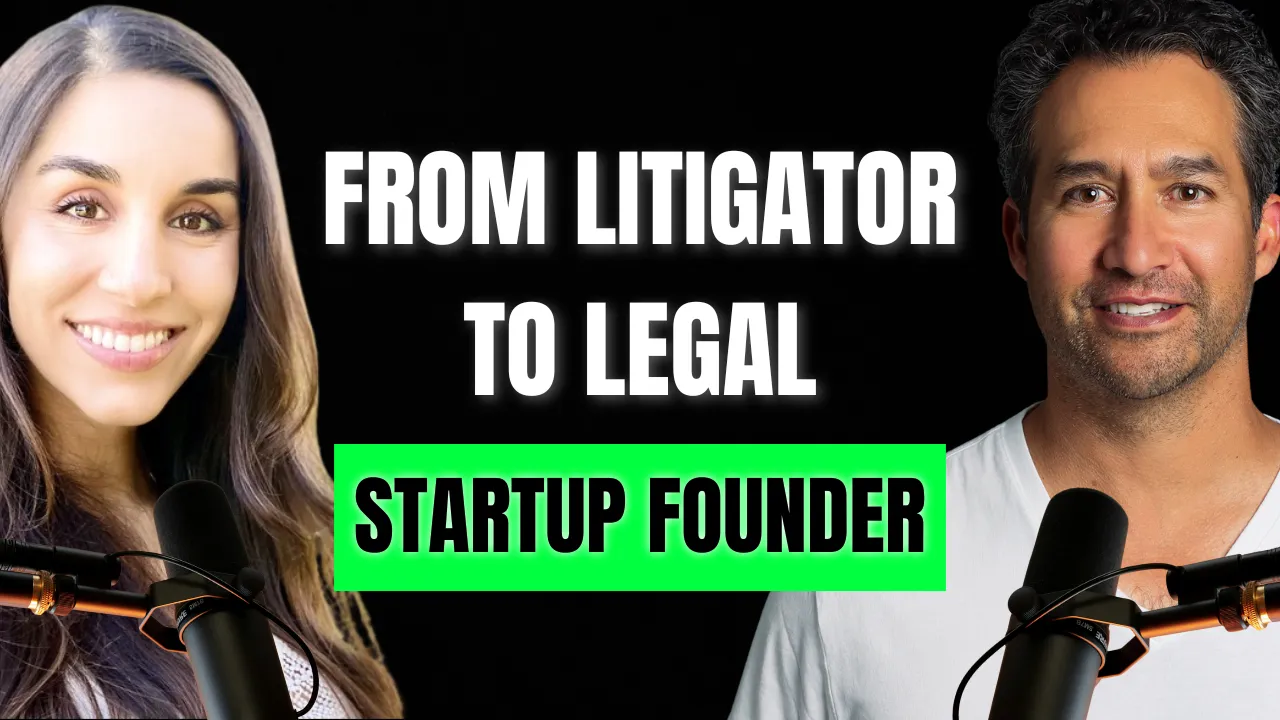
Jake Aaron Villarreal: I'm Jake Aaron Villarreal, born and raised in Silicon Valley, and here to take you behind the scenes to share what it's like to be a startup founder. The journey they're on, the problems they face, the products they build in an effort to make our lives better. I'm excited to have with us today Christina Brady, founder and CEO of Luster AI. Christina, welcome to the show.
Christina Brady: Thank you so much for having me. I'm excited to be here talking about the journey.
Jake Aaron Villarreal: Well, I'm excited to have you here. And I guess before we jump in, where are you... where are you dialing in from today?
Christina Brady: Chicago. Chicago Midwest gal.
Jake Aaron Villarreal: When I started this podcast, I had this vision to go behind the scenes to share what it's like to be a startup founder in Silicon Valley, where I'm born and raised. And weekly, we dive deep in the trenches to find the wins, the losses, and the lessons learned with the hopes that it helps you run a better startup. But here's the thing. If you've gotten any value out of these conversations or been inspired at all, hit the subscribe button. And I get it. Your podcast feed's probably overflowing. But to stay up to date what's going on in Silicon Valley, stick with us because at the end of the day, we're all just trying to build something that matters and we're better when we do it together. So, hit that subscribe button and follow us wherever you find your podcasts. Now, let's get back to the show.
All right. Well, I love Chicago, the windy city. A lot going on out there. Innovation, startups, technology, it's all over. AI in particular seems to be disrupting almost every sector and industry. So, we'll learn a little bit more about your company, Luster. Before we do that, a little bit background on you. You've got 20 years of experience on the sales side leading as a top revenue producer as well as you've worked at companies like Glassdoor, Groupon, Sales Assembly. You've got actually 10,000 sales professionals that you've helped coach and lead on a mission to change how go-to-market teams learn. So really cool background. I myself come from a sales background. I spent a number of years at Oracle and we were always trying to figure out how we could do our job better, how we could be trained or coached that actually had an impact on how we operated. More importantly, being able to learn from our mistakes or if we could figure out how to make our sales process better before we got to those mistakes, that would be the ideal situation. So, let's talk a little bit about you. We'll talk about your product. What inspired you to get into tech and startup and be an entrepreneur? And is this your first startup?
Christina Brady: Yeah, this is my first startup at the helm, but I've spent my career in startups and scale-ups. And like so many people, I did not intentionally... I even hate saying I didn't intentionally fall into tech, but I did. I I fell, like there's a cavern of people and it just grabs you and I fell into the the tech cavern. So I would say that my decision to get into this industry was not necessarily a deliberate one. It was almost accidental and and sort of circumstantial. My decision to stay though has has been kind of more meaningful.
So I, back in 2008-2009, I was looking for a job, wound up applying to be a salesperson, started working in insurance and financial planning services, which is where I learned that I like to sell but I hated what I was selling and I didn't feel responsible enough to be selling those things, and it wasn't a sexy industry. But I figured if I can call people out of the blue in the middle of dinner, remind them of their own mortality, and then ask them for a financial investment that is based on a medical diagnostic, then I could probably sell anything to anybody. And so that's when I applied to Groupon. They were one of the first if not the first tech unicorn in Chicago. Applied to be an account executive there, got the job without realizing that I had just "broken into tech" as they say, and then my career just kind of continued in this industry from there, sort of moving up the ladder. And it's it's it's a small big industry as I call it. It feels all-encompassing when you're in it and you sometimes have to remind yourself that there's an entire world outside of it. But the amount of growth and opportunity that I've had working in in this industry and solving these problems...
Jake Aaron Villarreal: Well, you talk about Groupon. I mean, I remember when that was created, that whole market became just an absolute behemoth. What was that like for you there? And you know, at the beginning, you're one sales rep, but was that a big Groupon growth trajectory that you were on?
Christina Brady: I mean I want to say that I I joined, I was still I was maybe employee 500 at the time and by the time I left Groupon they had like 20,000. I mean like, globally, you know. And so it's, what was it like? You know, it's interesting because it was not my first job out of college by far, I had a little bit of professional experience before then, I was still pretty young, and I just remember going from a different environment. You know, you come from insurance sales and it's a highly regulated industry. Every single email that you send is monitored. You have to watch everything that you say. There's just a lot more kind of red tape. And I'm, you know, going to work every day wearing a suit and, you know, having to kind of, you know, fit in with the... and then I go work at a company like Groupon and I was like, "Is this, is this what work is like as an adult? Is this what people do?" I mean, absolutely wild experiences, different elements of cultures, leadership changes in and out, mass trajectory and growth, doing things that were seemingly uncommon that later on were like, "I don't think that that's what we should have been doing at the time." You know, it's it's the amount of growth that I had there. I honestly look back on those as some of my fondest years. The time that I spent at Groupon and Glassdoor. I I, the amount of growth that you can have by being in an environment like that where somebody says, "I think that we should do this." And they look around to the people in the room and you go, "I guess I'll do this." It doesn't exist everywhere, but it's put me in a position in my life now where I've sat at so many different tables and had the opportunity to build and influence so many different things that were at the time outside of my job scope, but made me a better professional. So I would say overall I would not be where I am if I had not had the opportunity and the incredible people to work with that I have in my career.
Jake Aaron Villarreal: Yeah, I think it's always good to have that big enterprise corporate experience because then you could take that into any smaller company. You could be a consultant. You could really drive value to founders if you're helping them. But you've got your own startup now. So let's talk about what inspired you to want to start your own company.
Christina Brady: Yeah, it's one of those I never thought that that that would be the thing for me. You know, I would watch shows like Shark Tank and I would think, "Man, I don't know that I would have the idea for something like this, but if I had the essence of a good idea, man, I can make it into something really good." There was one Shark Tank idea that I had that somebody told me was a bad idea and then somebody else built it and now they're a millionaire. I digress [laughter] for a later conversation. It was my one idea. But for me it came from... it was pain mixed with opportunity. And what I mean by that is in my last year as an operator sitting in a CRO capacity, I thought back to my entire career, 18 years in go-to-market starting as a frontline seller, 15 years as a trainer and an executive coach trained and certified in seven different methodologies. So always being at the intersection of people performing their best at work.
And I remember sitting and being so frustrated as an operator at my last couple of companies and saying, "How were we still so reactive as a customer-facing go-to-market team? How could we not predict this revenue erosion? How did we not know that that deal wasn't going to close? How could we not have identified that that rep was not prepared to handle that opportunity or run that call? How did we not know that we had these skill gaps?" And we make our customers and our prospects collateral damage to our inability to properly measure the proficiency of our team before the revenue erosion takes place. And when we finally identify that there's something wrong when it's too late, we go backwards and really subjectively try to diagnose what the issue is. Is it one person? Is it, is it the product? What is the problem? And we pay a lot of people a lot of money to go and ask everybody what they think the issue is.
And that's another issue that bothered me is I was like, "So, let me get this straight. We want to do a skill mapping exercise at our organization." Okay, that sounds good. That's super zippy. I like the sound of that. How are we going to go about doing that? "Okay, so we're going to hire someone and we're going to pay them hundreds of thousands of dollars and they're going to come in and they're going to interview our teams. They're going to send them a form and then our teams are going to fill out a self-identification form talking about where they feel like they're proficient and deficient. And then we're just going to take that at face value and put together a lot of programming around that in a hope to fix an issue." And that was crazy to me. I was like, this, this would be like going to the doctor and expressing your symptoms. And the doctor goes, "What do you think you have?" And you go, "I don't... I guess it's this." And they go, "That's great. I'm going to ask every patient that I have today what they think their diagnosis is. And then based on the most popular answer amongst all of you, we'll just treat you all as if you have that. Right? And for the two of you that actually have this issue, you're going to be great. You're going to perform better. I'm going to pat myself on the back. The rest of you are going to spend a lot of time taking a lot of medicine and continuing to get more and more sick." And that's literally how teams operate. And so there was not a tool, process, person that actually fixed this. And outside of Luster, subtle plug, there still isn't. And so that's what prompted me to solve this problem.
Jake Aaron Villarreal: Well, I think it's incredible. There's, when I was getting trained at Oracle, which is where I worked on the sales side, they used to come in with teams that would coach us and train us on strategy on how to take your product and what's the value proposition and then map it, you know, to your customer and all the influencers in the company. And you kind of have... you walk away with, "Okay, this is my product and this is the value prop and this is who I'm selling to and here's the map of who I want to engage with." And that's pretty tactical, right? But it never told you like where you were deficient in your process, whether it was organizational skills or presentation skills or listening skills or following a pattern of what works or like any of that stuff. And this is like a long time ago. So, you know, I'm sure Oracle's gotten way better now because they're killing it in the market, which I love, by the way. But, you know, if you look at individually, you seem to always walk away from these engagements as a sales rep thinking, "Did I really learn any... learn anything I can apply today?" And as a leader for companies that are buying products like this to help improve their own sales teams or go-to-market teams, you know, there's big companies out there that you think already saw this like Gong and other companies, but is that more reactive or proactive?
Christina Brady: Yeah, it's it's reactive and it's also not specific, right? Like I'm not going to dog Gong. I I think that they certainly have their place. But let's just take the name brand out of it and go with recording your calls, right? The concept of recording your customer calls and then giving you feedback after the call. One is you are relying on your teams to step on a landmine to identify that it was there in the first place, right? And that's a really dangerous way to go about uplifting your team is let's have you go on an actual precious customer conversation and make a mistake. But then even let's talk about the mistake because that's another area where these tools just don't do any justice.
The reason why so many sales managers have to spend time tearing through call recordings is because no tool right now is actually giving sales leadership the information on the proficiency of the rep on that call nor their coaching opportunities. Right? It's going to give me a summary of the conversation. It's going to give me a scorecard that gives me inherently useless information like talk time. If I see one more company giving reps feedback on their talk time, I'm going to put my head through the wall. Like that is not a helpful metric in understanding my proficiency as a sales rep is how long I'm talking versus when I am not. And also a lot of those organizations, the feedback rubric that they have is based on their methodology, not your methodology. And it's meant to help you forecast and identify the next steps, right? It's an external tool. But then sales managers have those scorecards and they read through them and what do they have to do? Find the time to go back and manually sit and listen to those calls and then subjectively identify where their teams are making revenue-impacting mistakes, where their teams are lacking proficiency.
So, if I'm a sales manager with 11 direct reports that run around 10 calls per week and they're making five to six different mistakes every single call, when am I supposed to identify all of those? And even when I do, what am I supposed to do then? So, now I have a subjective idea of where my team is failing. But now what? Do I go and take the time I don't have because I'm listening to calls to coach my team? Is it all on me? Do I go to enablement that's underwater and supporting too many people in all roles and tell them they have to retrain my team? Do I fire my team and hire new people? Well, how do I make sure that I'm making the right hires if I can't grade their proficiency before I hire them? And so, what do we do? We catch mistakes here and there and then we say, "You know what, we're just going to train everybody on everything and that will fix it." And it literally never does because people can't consume that much information. If you are not meeting people where they are with their specific gaps and prioritizing where you're upleveling them, you're failing your team and you're wasting time and you're operating with a bunch of hero metrics that aren't going to get you anywhere. So enjoy paying for those expensive tools. They're not going to do anything for you.
Jake Aaron Villarreal: Well, if I'm a founder out there, which I am, and I've got sales teams and others are out there, too. Walk us through how it really works. So I come to you and I say, "You know what, our team is failing in different areas. We have some A players, B and C players. We want to improve the C's and the B's. We want to maybe get rid of the D's, but I think I kind of know my team. I see the numbers at the end of the day, like who's trying hard, who's not, who's succeeding in closing deals, who's not, but they have good attitudes." Like when you talk about the skill mapping and like proficiencies like what what do you actually get? Is it a platform you log into? Do you do testing? Do you measure people? Do you record them? Like give us like the the 20,000 foot view and then dive down.
Christina Brady: Yeah. So 20,000 foot view is we do three things. We diagnose, we predict, we prescribe. So the first step is a comprehensive diagnostic. We build Luster to be an accurate reflection of what good looks like for that organization, that role, their process, their methodology, their hard skills, their soft skills. Every customer of Luster gets a custom-trained diagnostic model. This is different from the traditional call recorders that are out there where basically you can sort of build your own scorecard, but those tools are going to grade your calls based on their algorithm of what good looks like versus yours, right? You're not training those tools from the ground up on your organization. With Luster, you are. So, we first build you the opportunity for a system, an AI powered system to diagnose your team's skill proficiencies and deficiencies.
And so, that's step one is then we're able to measure the team. Now, we can measure the team one of two ways. One, we can digest all of your previous conversations against the diagnostic that we've built for you and instantly spit out your proficiency based on your prior calls. Or we can actually diagnose and proficiency map you within the tool by building AI replicas of customer conversations and diagnosing you by having those practice sessions. But point being, we kick off with a diagnostic right. So for the first time you can objectively see the proficiency of your entire team. So this idea of like A players and B players and C players... we are all identifying those people based on one, their personality and how much of a culture fit they are right, and two, their performance and their output. I promise you that how nice somebody is and their output is not indicative of whether they are an A player. We promote a lot of really bad reps who have gotten really, really lucky. And we fire a lot of amazing reps who never got the same opportunity because they weren't as zippy or they didn't have what they needed to actually succeed. And so let's take the guesswork out of A, B, C, and D in your team and first say, "Here's an objective diagnostic of the team to the atomic skill level." Diagnose.
The next step is the predictive layer. This is also AI powered. Not all skill gaps are created equal. Just because I've uncovered a gap that you may have, if that gap is not going to erode revenue or customer experience, why am I spending time taking you off the floor to uplevel you on that because it feels good to me because I feel like I can give you some great coaching? If it's not actually going to help you close that deal tomorrow, then it's a waste of time right now. And by the time you actually use it, you'll have forgotten it. So the predictive layer says, let's look at the actual customer interactions that you have scheduled on your calendar, cross-reference that with your diagnostic. Based on the metadata of this conversation and your diagnostic, we can now predict where you're about to make a revenue-impacting mistake. We know you're not prepared for that call that you have tomorrow and we know exactly the areas where you're not going to be prepared for that.
So then that brings us then to the prescriptive layer. We can actually now see the landmine where it is before you step on it. It's on a map. It's sitting right there. But we've got to disarm that guy before you go and walk past it. Now we know exactly how to do that. That prescriptive layer is what exactly do you need to get to proficiency guaranteed before that call that you have tomorrow. That could be AI roleplay or AI practice. That is a custom-built simulation of that call that you have tomorrow. Not an agnostic out of the box roleplay. That's, it's it's something that is specifically custom-built for you. Maybe that could be a skill drill focusing on really specific elements of the product or competitive edge or objection handling. It could actually be AI custom-created content, right? Do you need us to build you a one-pager for that call tomorrow? Maybe it's actually suggesting that your manager live coach you in these certain areas. It could even be saying, "Hey, we've tried to get you to proficiency for that call tomorrow. Christina's not ready for that call. So, Christina's manager, hey, tap tap. That's a $100,000 opportunity and Christina is going to make these revenue-impacting mistakes. You should prioritize attending that call with her and leaning in right here." So, it's giving that entire map. So if you heard nothing, we diagnose your deficiencies. We predict where they're about to erode revenue and then we prescribe the solution to prevent that from happening in the first place.
Jake Aaron Villarreal: That's amazing. I think of something like you're talking about as a dashboard or something you log into like a GenAI UI interface that you can just, you know, ask it what you want to see and it kind of brings it back to you and gives you like a plan. But that's just me. I haven't actually seen it. [laughter]
Christina Brady: Even simpler. I'm like, well, you just said that would be cool. It's even simpler, right? So, when you log into the Luster UI, if I'm an admin, for example, the first thing that I can see is my entire team's culminated proficiency. So, of all the skills I need to measure, I can see my entire team and their readiness. And then I can click into every individual to view their individual skill map and the progression of that over time. The second thing that I can do is I can go in and see what actually, what sessions my team has actually completed from a practice standpoint. And I can also review all of the grading of existing customer calls all within the UI. So if my rep had an actual customer call with a big deal yesterday, I can go into Luster and actually view the grading of that call from a proficiency standpoint.
And then we go one level deeper. Every single week, we email all of the sales managers a comprehensive coaching report for every person on their team with examples. And it's all based on what happened last week. So the coaching report is, "Hey, Christina's on your team. Here's where she's showing some proficiencies and here's examples of where that showed up in practice sessions and on actual customer calls. Here's where Christina is showing some deficiencies. Same thing with examples. Here's where you need to live coach her this week to actually get her up to the level of proficiency." So, it's not only log into the UI and actually view all of that data, but it's also being pushed to you as a sales leader and just giving you the information that you need.
Now, as a sales rep, Luster can meet you wherever you are in your flow of work. You can log into Luster and you can practice with the AI simulator. You can view your results, right? You can actually do like a little bit of warm-ups or a boot camp or you can schedule simulations on your calendar. You can practice them on mobile in your car. We can deep link simulations into an LMS so you can train your team on an entire topic and then do a Luster test simulation to actually measure the ingrainment of the training that you just did. So, it's also meant to kind of meet you where you are.
Jake Aaron Villarreal: It's really cool. It sounds like it's a product that helps you become better in sales and also helps your manager become a better manager.
Christina Brady: Correct. Without replacing them, because there's all this now like AI... "like an AI sales coach. It's going to be a sales coach for you." And it's like I don't think anybody wants that, you know, or like I saw one the other day and it was like, "oh, this is an AI sales manager." And I'm like, "No, who wants that? Stop it." Right? And like I get I'm saying a lot of zippy things on this podcast. That's what I do. But but you can have two different deployments of AI. If we consider it running a marathon, you can either build AI that runs the marathon for you. That's no fun. No one's going to shed a tear watching an AI finish the finish line in a marathon. Or you can be a really amazing treadmill and help people get to their best self. And that's the deployment of Luster's AI is how do we help sales reps be the best version of themselves? Because I believe that human beings make the best sellers. How do we help sales managers and coaches be the best version of who they are? Because I believe the best coaches are humans, but there's areas that we can supplement them with data and content to actually help them get out of the weeds of trying to identify what's going wrong and instead know what's going wrong and proactively address it before it erodes your company, your confidence, and your revenue.
Jake Aaron Villarreal: Yeah. Well, you sound like a natural-born seller and you and you've got great, you know, presentation skills. Who are you selling to when you go to an enterprise organization?
Christina Brady: Yeah, we are usually, it's one of two places, and we always want to bring in the other person because I'm also a big believer in making sure that you have alignment internally, otherwise your tool's dead. Like you can find one champion and sell to them and then when people feel like a tool's been plopped on their lap, that's a super cruddy feeling. And that just comes from my history being a salesperson and sales manager, right? And experiencing both of those things. And so the first part of that is we'll go into VP of Sales, CRO, maybe a Chief Customer Officer if we're serving a client success or a customer support, an account management team, but basically the person who is overseeing and holding the bag for that team. And if we if we start to engage with say a CRO, then very very early we say, "Let's bring enablement or training and development into this because this is going to be a tool that is for them and if they don't feel like they're a part of this buying process, we're dead in the water, right?" So then we bring them in. On the flip side, a lot of times it'll be enablement or learning and development that will bring us in. And in which case we say, "Hey, one of the admins and champions who's going to use this data to help you make hiring decisions, scaling decisions, promotion decisions, forecasting decisions, it's going to be that sales leader. So let's get them in here so that they understand this is a tool that serves enablement, sales, and go to market leadership and the individual users who are the customer-facing revenue producers all very differently, but also all in sync." We got to get everybody on.
Jake Aaron Villarreal: Yeah, makes total sense. You know, as a company, talk a little bit about... I'm going to switch gears a little bit here and and talk more about the inception of the company and more importantly, where you're at today. So, have you gone out and raised capital? If you have, how big are you today as an organization? Kind of walk us through that.
Christina Brady: Yeah, we actually just closed our seed round like last week.
Jake Aaron Villarreal: And congratulations.
Christina Brady: Thank you. And we hit our target. So, it's a fairly large seed round that's going to be public in in a little bit, but I can say that the total amount raised for Luster between our pre-seed and our seed round is 5 million and we've closed that. We have 11 employees right now, soon to be 13. We are hiring for our first two account executives. With founder selling, we launched the product in market about a year ago. We have 23 customers. Our revenue is is healthy. I don't know that I necessarily want to dig into it, but healthy enough to to raise and close a seed round. And we're now starting to have our initial customers renewing. The least renewal, the smallest renewal that we've had has been 150% growth in ARR year. And so things are going really well.
And what's been interesting is there's actually a lot of point solutions that launched at the same time that we did. Namely, a lot of different tools that are AI roleplay tools just only, right? Like do an AI role play and we'll give you feedback. And that's created a lot of noise in the market. It's benefited us because we get looped into that of like, "Oh, Luster is an AI roleplay company." And I'm like, "Yeah, totally. We do have an AI roleplay tool, but the way that we deploy that AI roleplay tool is going to be diagnostic based and it's going to be specifically and custom-built. So yeah, we have an AI roleplay tool, but the AI roleplay tool that comes out of the box that's a point solution, you're going to get 12 to 15% monthly active usage because it's not going to feel purpose-built for your teams, but they'll go in and they'll use it every now and then." Luster is getting 85% monthly active use. Describe something to somebody and say, "Christina, here's a here's a practice of the call you have tomorrow, which by the way, here's the mistakes that you're about to make and how much revenue you'll you'll lose." My motivation [snorts] for doing that practice session is much higher than "Hey Christina go practice a random discovery call just because." Right? So the diagnostic is really sort of our our our edge.
Jake Aaron Villarreal: Yeah. Really cool. You know, for a lot of companies out there that are AI based and looking to maybe get into the market, there's a lot to think about in terms of your your business model, the pricing strategy, the infrastructure costs, the use of the of the platform, and you got to make sure it actually is going to be profitable at the end of the day. What's worked for you in figuring that out?
Christina Brady: It's it's not, it's not succumbing to the urge to be everything for everybody and letting your early customers dictate your product growth unless they need to, which sounds like I'm talking out of both sides of my mouth. But the reality is we could be a lot further along in revenue than we are right now. We had customers that wanted to buy, but they wanted to buy for a use case that is not on our road map, right? And they were like, "Hey, we we have a half a million dollar budget for a tool that does this." And we're like, well, if we squint at that, like we could build that. We have a seven-person engineering team, but that's not our roadmap. That's not our ICP. That actually doesn't serve any of our other customers. And so, one, it's making product decisions that keep you on track for the problem that you are trying to solve. That takes a lot of discipline when you are a startup with limited runway and people are trying to throw big checks at you.
The other thing is a lot of people hire sales reps in my opinion too early and it's because a lot of founders don't want to sell and so they sell as much as they need to and then they cannot wait to get sales reps in there. My board has been begging me to hire salespeople for months and I just refuse. But now I'm finally doing it. But part of it one, is I'm a sales girl, right? So like I I do enjoy the process of selling it and I'm selling a product that I'm building that is my brainchild, that is is a culmination of my career. So my my passion for it and bringing it to market is huge. But I think a lot of other founders are like, "Hey, we have some early success. Let's hire salespeople and it'll be gasoline." When you hire sales reps before you have the process for them, the methodology for them, the ICP for them, a way to cut territories, a way for them to get information and contact info, a way for them to outreach. Until you have all of that, you're throwing people into a mess and you're going to spend and burn a lot of money and honestly burn through a lot of account executives before you find the right ones. And so hiring that team too early can also kind of bite you in the butt, which is what we've really resisted is it's been founder-led. I'm the only company in my space that still is exclusively founder led. So won't be for long, right? I'm saying that now, but in a couple months, we'll have salespeople. I've been strongarmed into it.
Jake Aaron Villarreal: Yeah. Well, you know, we're seeing go-to-market teams being hired a lot faster, specifically with AI startups. You know, traditional startups, you know, it's a little bit slower path, product-led or founder-led sales, but we're seeing what you're talking about, which is, you know, "We have product. We just got $20 million in funding. We got to get to market. We got to run as fast as we can to get there to carve out our piece, and therefore, we need more feet on the ground, boots in the street. Let's hire people. Let's get the product in front of customers, and we'll figure it out as we go." But if that model doesn't work the way it should, there's obviously opportunities to come in and either replace people or to really understand where they're not proficient and train them up, coach them up and use a platform like what you're talk, what you're bringing to market. So I could see an opportunity where you're, you know, I don't know where your focus is. I don't know if it's enterprise large scale teams or if it's you know smaller nimble teams. What what's like, what's the ideal persona for you?
Christina Brady: I would say right now we are really smooth, like we can take on smaller customers like that's that actually it's it's very very easy. It's not what we're targeting but we'll take them on. I would say go-to-market teams of 200 to a thousand people is sort of our sweet spot. Like the mass mass enterprise companies we can take them on but they also tend to want a lot more integrations and features and engineering support that at our stage we shouldn't support right now.
Jake Aaron Villarreal: Yeah. Got it. What's the biggest challenge right now for the company?
Christina Brady: Oh my gosh. It's it really, it actually comes down to like that differentiation, you know, like the being able to differentiate. A lot of the people that we compete with for the same dollar are building one product. They're building one product and all of their engineering is going toward one product, which means they're building a lot of features really, really fast and it looks really, really zippy. We're building four different products that all sync together and integrate and operate seamlessly. And so what's difficult is when we're in a feature feature battle with a point solution AI roleplay company, and all they're building is AI roleplay. Whereas we have our team split building not only the AI roleplay feature but the diagnostic and the manager coaching reporting and the AI content creation and the predictive capabilities, right? We just can't build as many features for AI roleplay as fast you know, and so it's tough because we have to really get down to like what is a nice to have versus a need to have. We are starting with need to haves for all of these products, but we are building something that is so much larger and more robust, but it can be difficult and it also interferes with with our with our pipeline.
The other thing that I would say is there's a lot of legacy companies that are building sort of a quick tack-on sort of copypaste [clears throat] of this, right? We had we had one prospect recently. I'm going to try not to name names here, but they basically loved what Luster did, but they said, "Hey, we're using X giant company that is in the LMS CMS space." And they said, "They're actually rolling out like like the option for role play." And while we like the fact that Luster custom creates role plays for an individual and has the diagnostics, they're like, "We actually love all of that but our CEO is like 'hey, if the existing X giant tool that we have is going to have roleplay it'll be good enough, right? It'll be good enough.'" And that interferes with our pipeline. And so what happened with this particular customer is they said, "We have to try the free licenses and if it works great, if it doesn't we'll come back to you." And I was like, "Please go try that because you're going to run into everything we just talked about. It's going to be cool out of the gate, but then it's not going to be prescriptive. It's not going to be purpose-built. It's actually going to feel like a distraction. And I also bet their tech is going to suck because this is harder to build than people... This is not ours is not just a user interface on top of ChatGPT. All of those, that's exactly what they are. You're just you're interacting directly with GPT, right? You don't have a lot of capability to control that." Two months later, they came back. Now, we're contracting for a large sum deal with them. And so that's difficult because as a startup, revenue now is super important and we just have a lot of noise from these quick tech point solutions that wind up in some instances helping us and others it delays our deals, but most of them wind up finding their way back.
Jake Aaron Villarreal: Yeah. Got it. Well, lots of opportunity out there I'm sure right now in the market, there's lots of growth happening. Yourself as a founder and hiring, you know, we're in the business of hiring. You're going to hire two account executives coming up soon. What do you do? What's worked for you in terms of strategy to make sure that you are assessing the right candidates. You're taking them through the right process to get them on board and making sure it's the right fit for your culture.
Christina Brady: You know, I would say what I've learned not to do because I don't know that I can say I I have been very lucky with Luster that every employee I have hired has been sensational. Sensational. A lot like, some of them were folks from my network who I knew and that helps. It can also hurt, but they've been sensational. And I would say that is less... I mean just being honest I could pat myself on the back and be like "it's because of my incredible process." I've gotten very lucky at knowing very very talented people because I've been in this industry for a long time and I actually have a keen talent. So that's not really something that is repeatable for a lot of people. So not helpful but there you go. So I would not say it's been my incredible process.
What I have learned not to do though is simply hire somebody because you have a prior working relationship. And in fact, that can actually make it harder to hire because you're bringing a positive bias into it. Previous success does not indicate future success. And so what I've had to remind myself of: What is the rubric for hiring for this role at this company and these customers versus the experience that this individual has and is what they're bringing to the table? Is the past performance that they've had going to replicate here or not? Because I have also made massive mistakes in the past. I have hired people at previous organizations that I knew, that I trained, that had absolutely kicked butt where they were. And then when I hired them at the company I was at, they failed. And that's not their fault, by the way. It's mine. And that's because I'm hiring people based on "I know them. They're a great seller. We get along great, amazing culture fit." And then I hire them and it's like they don't have the industry experience, they don't have the right process, they don't have the right methodology, they didn't have the right tooling. Right? So I think it goes into that like who are you hiring today and you can use your relationship or their past performance as one of the metrics but certainly not all of them.
Jake Aaron Villarreal: Yeah. And sales is tricky too because you know it's energy, it's presentation skills, it's knowledge, it's persistence, it's attitude. That stuff doesn't come out on a resume. You know like you're not going to find the attitude on the resume. We look at it, we try and simplify it when we hire and we we call it the three C's. It's really the the competency. What do they bring to the table? Like their experience, their knowledge. What's their character, like could we hang out with that person? Do we trust them? Do we see them as somebody we would work for? Like do they actually have that mindset of like building a company, a founder's mindset, but are they a leader? And then lastly, chemistry. Like do they actually get along with our culture? Could we put them in a team and they could get get along well and and make it better? So those three filters for us, it drives a lot of like the intangibles out of that person. That's kind of what we look for. And when we work with companies, we help them hire, but we also help them become better at hiring and we provide like insights that we've seen after like interviewing 25,000 people and all the nuance that goes into making the right choice. But, you know, it's a, it's a fun part of the business. You know, businesses are all about people. So, you got to get that right or else your product's not going to go anywhere. It sounds like you've got the right product and you've got the right leader and you've got great engineers and people. Really fun to see how things go in the future. What's on the road map as you look at 2026, which is right around the corner. What are you excited about?
Christina Brady: We, you know, we recently hired, we we had our initial engineers, but we've recently, you know, tripled the size of that team. And it's it's kicking off and building tech that that I've certainly never seen before and only dreamed of and something that doesn't exist in the market. And when we're able to bring it to market and show people what we have to do, I'm just really excited to see what the result of that is going to be. I'm also thrilled to just be building a company with incredible people and try to do that in a very, very people-first way. I've worked for some incredible leaders. I've also worked for a series of really not great first-time founders and founders and working for those people teaches you a lesson that you don't want to learn, but that's really really important. And so I've seen a lot of what not to do. And so I'm just excited at having the opportunity to do everything I can to build a company in the right way for the people who are taking the time of their lives to work here. So I'm excited to keep growing and scaling this thing. I'm excited to bring a lot of this new tech to market. I'm excited to delight our customers and I'm excited to to invite new people to really experience what Luster can do.
Jake Aaron Villarreal: What are some of the things that are the not to-dos that you mentioned, talked a little bit about? You really didn't dive into the details because I think you know the listeners here on this show they they they want to also understand what can they learn that they don't have to go through from others that would be helpful from what vantage point? Like if you're going to start a company or you've worked for another company and you saw what wasn't the right way to do things or maybe you learned something that you wouldn't do in your own organization because you know these were the outcomes that you saw? Like what's some, what's some insights that you could share?
Christina Brady: Oh god. So like put your ego down. The poor and ineffective founders that I've worked for all have the same exact thing. They have an unbelievably high ego. They believe that their way is the right way. They hire brilliant people and they handcuff them and they want them to be soldiers versus leaders. They make decisions for big deals that don't help the rest of the customer base. They're very, very shortsighted. They tend to build the wrong culture by building accidental hustle culture, meaning "I'm the founder and I work 24/7 and I expect you to come to my company and do the same." Right? It's just there's a lot of this inherent ego that exists there. And that to me is the number one thing to avoid.
As a founder, what I've learned is I have to know what my strengths are and I have to know what my superpowers are. I need to know what my zone is so I can operate there. I also need to know what my zone is not and I need to hire brilliant people and listen to them. I never want to be the smartest person in the room, which is pretty easy for me. Maybe for others not so much, but like [laughter] I never want to be the person that's like, "Man, everyone in here is dumber than me. Thank god they have me." I don't want to be the single point of failure for my company. I get hit by a bus tomorrow, I want Luster to flourish. And that happens by hiring brilliant people and letting them do their job and listening to them. This sounds like basic stuff, but I guarantee you've got people listening to this groaning because they're either working for a leader or a founder right now who is the absolute opposite. And so that's the biggest thing. This is not the job for people with a big ego who are know-it-alls at all. And if you are one of those, you're probably going to fail and you'll you'll blame everybody else for it, but you will fail.
Jake Aaron Villarreal: Yeah. What's one thing you could share before we end here that you wish you would have known before you started your company?
Christina Brady: Oh man, I don't know if there's something that I wish that I would have known before I started my company. I think right now coming off of fundraising as a first-time founder, like fundraising kind of punches you in the face, and coming from having a background in sales and being really good at sales. What everyone told me is that raising venture capital funds, it's just like selling. It's it's just like sales. And it is, except that you get lied to way more. People really, and and not deliberately, but I've I found I I can predict when a deal is going to close or not within maybe a three to five... like I can tell very early on and as the process goes, like like "this one's coming back or this one's not." It's actually one of the things that my board likes the most about me is when I say "No, that deal is coming back," it does. And when I say "we're not going to get that one," I I mean it. It's because I know I can see all of the signals. The signals are very, very different. What VC tends to do is they date you romantically and then they very suddenly break up with you, right? And so you're like, "this is feeling good. I'm getting all of the signals. They're talking to my customers," and it's over, right? Like so I was like I I was trying to align it to, "okay, like it's I'm going to have the same kind of signals as selling a deal," and it's very very different. And the first couple rounds of talking to firms, I really just dumped a lot of information very very early. I was overly eager. I was overly passionate. And I had to learn really quickly on the fly that it is a very, very different game when you are selling VCs versus selling to customers. And so I probably would have approached initially fundraising differently had I known that. I don't know how many first-time founders can understand that. But if I, if there's a seminar that I were to lead right now, it would be if you are a go-to market founder and you know how to sell, you're going to fall on your ass when you are trying to sell to VC because here's the differences that you're not accounting for. That would be the thing that I wish I would have known because it would have just saved, like we got there anyway, but it would have saved me a couple of months.
Jake Aaron Villarreal: Yeah. So, what is it specifically that you would have done differently knowing now what you know about how you would approach that ask when you're looking to raise capital?
Christina Brady: I mean, I would say I was selling to VCs the same way that I would sell to a customer versus selling the vision of the product and selling the team, right? So, it comes down to I'm talking about the product and the features and the use cases and drilling really deep into all the things that we can do versus pulling back and being like, "Here's what we do. This is the problem that we solve. This is the vision of the product. This is..." like you got to go a lot more high level very very initially with VCs versus drilling in really really deep.
Jake Aaron Villarreal: It's almost like you want to talk about the company as if you're a year from now versus being where you are right now.
Christina Brady: Oh, that's a good one. Yeah.
Jake Aaron Villarreal: Yeah. Yeah. We've had a lot of founders on here talk about what worked for them. One of, you know, some of them are very specific of, you know, "I pulled down a list of 2,000 VC firms and investors and I just took this like heads down approach and every day I went out and made the calls, got the meetings and got rejected, got rejected for months, and finally just, you know, said, 'Look, I'm not going to I'm not going to be what they what I think they want to see. I'm actually just going to go in and be who I am.'" And I think it was not just the attitude adjustment, but it was also how you presented yourself and almost like a walk away. Like "Tell me what like what's the, what type of companies are you looking to invest in for your portfolio? Like what's good for you and are we a good fit for what you're looking to to invest in? Because I've got like 10 other companies I'm talking to, too. So, I just want to make sure I'm using your time well as well as ours." And it's a little bit less of "I'm pressing to get you to buy something" versus "tell me first what it is that you're buying and what you like to buy and then I'll tell you if I think we're right fit for you." And so it was kind of just reversing it a little bit changed the conversation and the and the energy of that, which quickly turned into term sheets. So that's just like one example but we've heard a lot of different ways that have been helpful for other founders.
Christina Brady: When I realized there was a thousand of them and one of me, that's when the dynamic shifted.
Jake Aaron Villarreal: Yeah.
Christina Brady: You know, so there's a lot of VCs out there. So if this isn't the opportunity for you, let's not waste any more time, you know.
Jake Aaron Villarreal: So yeah, straight up. I like it. Yeah. Well, very cool. Well, Christina, I want to thank you so much for coming on the show today. I I hope that, you know, the listeners learned a lot. I certainly did. I want to thank the listeners for listening and can't wait to catch up with you, Christina, and everyone else on the next episode. Until then, I'm your host Jake Aaron Villarreal signing off for now. Catch up soon. If you like what we're doing, don't forget to subscribe, leave a review on Apple Podcast or wherever you listen, and follow us on YouTube where we go behind the scenes to learn what it takes to be a startup founder.

























.jpg)














.webp)


.webp)
.webp)


.webp)