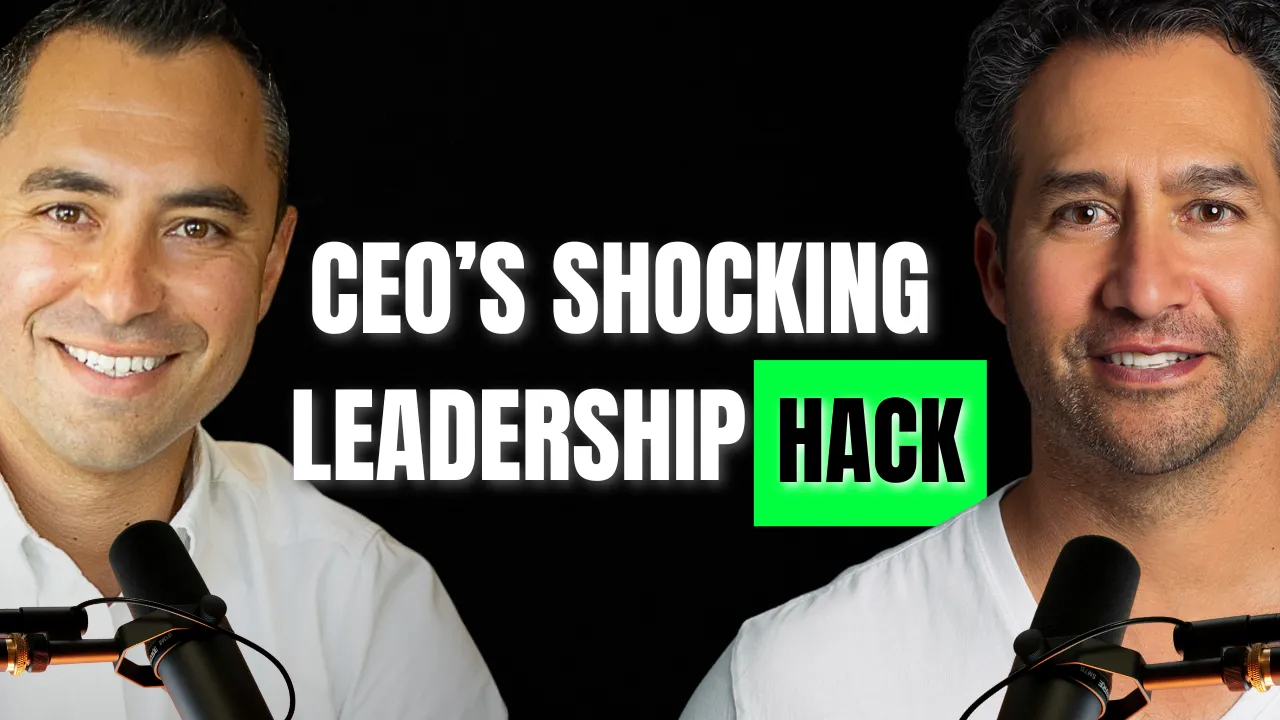
Jake Aaron Villarreal: I'm Jake Aaron Villarreal, born and raised in Silicon Valley here to take you behind the scenes to share what it's like to be a startup founder, the journey they're on, the problems they face, the products they build in an effort to make our lives better. I'm excited to have with us today Ronak Desai, co-founder and CEO of Ciroos. Welcome to the show.
Ronak Desai: Thank you very much, Jake. Thank you for inviting me.
Jake Aaron Villarreal: Well, I'm happy to have you. A little bit more about Ciroos. It's an AI-native company pioneering Agentic AI for site reliability engineering and IT operations. Before founding Ciroos, Ronak served as SVP and General Manager at Cisco where he helped lead AppDynamics and Full-Stack Observability. Earlier, he was a founding engineer at Insieme Networks, which became Cisco Application Centric Infrastructure or ACI, and as SVP helped scale it into a $5 billion data center business unit. Holder of 50 patents, Ronak combines deep technical expertise with business leadership and has a proven record of scaling transformative technologies to serve enterprise customers. Ronak, you got a lot going on there, a great track record. I know Cisco, I kind of have a sense of your background from our previous call, but I want to thank you for joining. Where are you joining us from today?
Ronak Desai: So we have an office in Pleasanton in East Bay, a perfect location for a reverse commute because we are in-person first.
Jake Aaron Villarreal: When I started this podcast, I had this vision to go behind the scenes to share what it's like to be a startup founder in Silicon Valley where I'm born and raised. And weekly, we dive deep in the trenches to find the wins, the losses, and the lessons learned with the hopes that it helps you run a better startup. But here's the thing. If you've gotten any value out of these conversations or been inspired at all, hit the subscribe button. And I get it. Your podcast feed's probably overflowing. But to stay up to date what's going on in Silicon Valley, stick with us because at the end of the day, we're all just trying to build something that matters and we're better when we do it together. So, hit that subscribe button and follow us wherever you find your podcasts. Now, let's get back to the show.
I love that we're seeing a lot of that transition to in-person. There's some real benefits to having people together collectively, solving problems, iterating quickly, and being able to bring products to market faster. Walk us through your origin story, a little bit more about, you know, your earlier experiences that helped shape you to where you're at today.
Ronak Desai: So Jake, fundamentally I believe failure teaches you a lot more than successes. I've had my fair bit of failures and fair bit of successes. So I can consider myself blessed to have that experience. You know this is my fifth startup journey. Uh, I've had two successful exits. The last one was where I was a founding member of the team and I had the privilege to join before the company was even founded and sort of help from a completely whiteboard to scale the business to $5 billion. But I've had my fair bit of failures as well, right? Growing up as well, I mean I've had setbacks, but more importantly, my first startup, which I did, you know, we had raised quite a bit of money, we delivered the product, but there are a lot of things outside of building the product which matter for a successful startup, right? And that lesson learned, as far as we as engineer and product people think about, "build the product and they will come." I think there is a lot more to, uh, how do you sort of go to market? So how do you make sure that you're landing the customers, how do you create that vibe, what you are building it right, and all that matters. So those are sort of super helpful lessons which we are taking in here at Ciroos. Given having said that, like a lot of my founder friends continue to tell me saying, "Ronak, the playbook which worked for you last time, throw it out. Get ready to grind and ready to work and kind of discover your... solve and continue to sort of solve problems." Right? It's all about solving problems everyday morning. And so that's basically what the exciting part about the startup journeys are.
Jake Aaron Villarreal: Yeah, no doubt. Well that's great. You know, for the listeners that don't know about the space you're in, we'll dive into site reliability engineering and observability. And you know, what is the pain you're taking out of the process in the industry you're focused in? You know we see and hear a lot about companies that bring "nice to have" products to market. Others are like "need to haves." We call it the vitamin versus the pain reliever. What is the pain you're relieving in the market for what you're bringing to bear?
Ronak Desai: Yeah. So a great question, right, and we really want to focus on the pain where there is acute pain here with site reliability engineers. And it's I think there are three factors which we kind of think about. Site reliability engineers are the people who have the most stressful job because they are the ones who get called on when there are outages, when there are customer impacting events. And if you have been on one of those calls... I have personally been on those calls for 16 hours where we had an outage on the largest bank.
Jake Aaron Villarreal: Wow.
Ronak Desai: People are not able to do their grocery shopping or fill up the gas. And once you are on that kind of call, you really appreciate how stressful that job is. So I have a huge empathy and appreciation for what our site reliability engineer and operations teams do on a day-to-day basis. The tough part for them is we as a vendor, we created a whole bunch of tools for the right reasons with deep uh capabilities for each domain. So what are those domains? We talk about network, we talk about security, we talk about cloud, we talk about internet, we talk about application stack, we talk about databases, we talk about GPUs now, right? These are all the components which matter for a good outcome, good uh performance for an application. Any of those components has a hiccup, your application is going to see the hiccup. And hopefully not every one of those impacts customer outcomes, but a lot of them do.
So the way we kind of think about it, so that's a big pain point, right? There's a dashboard for each of those domains, right? So now when there's an outage, customers or site reliability engineers have to sort of look at all of those dashboards to make sense of it. And it is extremely painful. I call that click ops, not dashboards. So that's how the operation methodologies are. The second pain point is there is a huge amount of disparity between the application developers or infrastructure engineers combined together with respect to the site reliability engineers. So what we have seen is there are 12 to 15 application developers for one SRE, right. So clearly there is a gap in terms of the bandwidth needed to just handle the things which are coming their way. Right?
And then the third thing which is a recent phenomena where application developers and the builders' productivity is going through the roof. Right? Because likes of Cursor, likes of Codex, right? Cloud Code. They are all helping developers build applications and software at a much faster clip. They're building more applications. So now just put those two things together, right? There are developers building at a faster clip. There's already a gap between what developers are able to produce versus what site reliability engineers support. If you put those together, it is an extremely difficult situation for site reliability engineers. So simply put, we need to build a capability, and think of us as a Cursor for operations teams, right? So we need to build a capability which augments the function, and the augment part is super critical for us, and we'll talk about that, but it augments the function of our site reliability engineer, DevOps engineer, or IT operations. So that's basically where we are focused on it. That's the real pain today our customers or site reliability engineers face. So anything we can do to reduce that toil is real and is super helpful, right? And so our customers are just eating that up when we talk about how we can augment.
Jake Aaron Villarreal: Yeah, that's great. So it seems like the pattern of growth is there's going to be more disparity between application development and being able to support applications and find the root causes of issues that come up. And site reliability engineers are the ones that are on the front lines finding those issues reactively, trying to solve them whether getting calls from customers at banks and whoever else. So the heat's on. So by providing a a different way of supporting this, you're you're helping them personally by reducing their stress by giving them support to do their job, as well as helping the market that has this like high demand and not enough people to do the work.
Ronak Desai: Yeah. Yeah. No, I mean in just the Bay Area and worldwide if you look at the number of openings for SREs and DevOps, it's massive, right?
Jake Aaron Villarreal: Yeah.
Ronak Desai: You can't find enough high-skilled people who can tackle this multi-domain complex deployment of your applications. So building capabilities which are expert level in each of those domains and making that available for any organization would be a great thing to do and would be really helpful for our community.
Jake Aaron Villarreal: Yeah. Well, let's talk about a specific example. So, say you're, I don't know, a bank, maybe a fintech company where it's all online and something goes down and there's a need to have someone figure out what the issue is and you're getting alerts and things are firing on all cylinders about there is a problem here and something's blowing up and you've got site reliability engineers supporting it. Where does your product come in with AI and what, how does it help them? Because it's technology and people, correct?
Ronak Desai: Right. Yeah, 100%. 100%. So, let me take a little bit of a step back in terms of how we sort of think about helping the site reliability engineers. We really think about it like you crawl, walk, run, right? There's an automate, there's an augment part, and I briefly talked about what we mean by augment, and then there's autopilot, right? There's a need for way more like full driverless car in a certain zone. But there is FSD where the driver is in charge referred to as human-in-loop. Augmenting the function is an important aspect of it. And there are places where you would do automations and take care of some of the toil function. That's how we kind of think about it, right?
So now to answer your question, the way we sort of work in enterprises, we integrate and extract the right set of information from your observability tools, whether you have Splunk, you have Datadog, or Dynatrace, or any other observability tools. We extract the right sort of information from them. We connect to your incident management, your PagerDuty, your xMatters, your incident.io. And so we connect to your cloud resources and cloud Kubernetes deployments. We connect to your ServiceNow, right? So think about, we're sort of lending our solution or our teammate the way you would onboard your human teammates, right? It is connecting and getting access to all of those tools which you have, and every enterprise we find, we find tons of tools, right? The goal is to help customers maximize the return on investment for the things which they have already done a lot of work right, and not disturb their observability or incident management. But leverage those tools, leverage all that work which is done the way human does it, but do it with AI. Right?
So think about the case which you talked about. You have... there are two kind of incidents which we typically talk about. There are reactive where something happened. You got an alert. We actually pick up that alert before anybody gets paged and we start the investigation. We as an AI teammate, Ciroos AI teammate, start to investigate it. Looks at the full information which is available, comes up with the root cause, comes up with recommendations, comes up with a change set which broke or potentially caused the impact, and gives all that information before anybody has to get on the call, right? So there is that reactive aspect of it.
But SREs just don't do war room calls. They also do a lot of proactive investigations. They also are sort of trying to figure it out "Are my systems following the best practices?" So we also support proactive ways of investigating your environment. Right? So that's how we kind of think about it, right? And if you look at it from a user base perspective, you will have your NOC people or your operations center people or your L1, L2, they certainly get this super useful tool for them to triage and figure it out what is going on. So they're much more effective in either resolving that alert or redirecting to the right group instead of getting hundreds of people on a war room. Now you're very precise in terms of where the problem is and who needs to be on the call, right? And most of the time you have the root cause as well identified.
But then there are SREs who are really expert, who have a domain-level, multi-domain level expertise, who are the senior people in the staff. They are using these tools to sort of figure out things which could potentially happen in the future and how do they mitigate, how do we make sure that all the deployments are following the correct way of deployment, are there some problems which are hidden which are getting ignored, should be weighing attention. Right? So that's how we kind of help customers from a reactive as well as proactive.
Jake Aaron Villarreal: Well I know there's a lot of tools out there so it's good that they don't have to throw everything out. They could take advantage of their investment but then accelerate it with AI and be able to manage it in a way that it doesn't take more people, it takes, you know, technology, but then the people that are there can utilize it, maximize their own effort, reducing their stress, and hopefully solving more problems. Really cool. Now, talk about the inspiration for your company. How long have you been around? I know the answer, but I want you to talk about it. And then I also want you to kind of give us the quick secret. Maybe it's a long secret, but what was the secret behind being able to raise $21 million in a seed round in 30 days? Because there's a lot of founders out there that have struggled to raise capital and some are doing well and others are learning as they go. But you've got more experience than others. Walk us through your journey there.
Ronak Desai: Yeah, so I kind of always tell we are not your usual founding team, right? This is my fifth startup as we were talking. Amit, who is my VP of Engineering, CTO, another co-founder, I in fact hired him out of college after his master's and he's worked with me for 25 years plus, right? And we've done every project, every startup together. Uh, Ananda, who is our Chief Product Officer and co-founder, Ananda and I have known each other since, again, 20 years plus. Both of these gentlemen worked with me at Cisco. They were running engineering and products for me when I ran the business for FSO. And the other thing is, you know, we've been joined by other founding engineers who have themselves done startups. They're very, very experienced, have deep expertise around infrastructure, Kubernetes, network, AI, right? I mean some of these guys have worked with this team for at least 10 years, right?
So when you now bring this talent together, a lot of people were asking and looked at the progress in six months, to your question, we got started in February. In six months, the amount of things we've done and we are landing customers at this point. People are surprised, right? And the hallmark of this team, Jake, I don't like to beat up my chest, but I'll tell you the hallmark of this team is execution. We innovate. Personally, I have 50 patents, right? Innovation is built into our DNA. But at the end of the day, what's going to matter is execution, right? And and I think shown it in the past, and this was the reason when I went to talk to the venture folks, a lot of them knew my track record and what we had done in our previous lives. So when we went out they were like, not only customers and investors, like "Ronak, I don't know what you're going to be doing, but here is a check, you're going to take the check from me." So we've been blessed to have that level of support from the venture community.
But at the same time, even from a customer base perspective. A lot of my customers who have worked with me have sort of repeatedly told me saying, "Ronak, I want to buy whatever capabilities, solutions you're building because I know how you work with enterprise. You understand deeply and you have the empathy and understand the pain from a customer lens perspective." And I tell a lot of my customers saying, "Look, we are absolutely going to be there with you. We'll build it and we'll be there when you need us the most." Right? It's not about when I need the purchase order. It's I'm going to be with you when you need us. And that level of commitment from the whole team to enterprises matters. Building the solutions for enterprise needs a different kind of mindset than what you would need for consumer-related products. The availability, reliability, the way you work from a compliance perspective, the way you work from a security perspective matters, right? And then these things are sort of built in our DNA. We don't have to think about it. We don't have to sort of... And in fact I was just talking to a customer saying "Ronak, everything you are talking about today is actually something which I continue to ask a lot of startups and they are sort of building and learning as you go. You, out of the park, you built that capability, right." So that was a secret for us to sort of close the round quickly. And the trust we had it, and you know, trust takes a long time to build it and you can break it in a short time. And we've worked very, very hard to make sure that we meet where customers are and take care of what we need.
Jake Aaron Villarreal: Yeah. Well that's incredible and you know if there was a playbook that could be shared I'm sure that would be something would fly off the shelves. When it comes to business, we look at it and it's, you know, 80% psychology, 20% execution or mechanics. So, looks like you got the execution focus down, but psychology really helps build loyalty with your employees, understanding them, understanding how to lead them, understanding their journey, helping support them in their process. You've had multiple companies, and it sounds like you've had multiple people follow you wherever you go. What's your secret there?
Ronak Desai: Yeah. So look, and thank you for that. Like I mean, I've personally been blessed to have some of the smartest people when you get into it across all of this domain. So when I decided to, saying I wanted to pursue the opportunity which has been presented because of GenAI, a lot of the engineers decided saying they would want to join me without we knowing what we were going to do. Right? So that trust again, it's, it's a similar theme if you can see it. Trust with investors, trust with employees, right? I'm a strong believer in "do what you say you will do on time," right? And and and this goes back to the focus on making sure we are delivering on what promises we make.
And then it's true with employees as well, right? They... everybody comes to work and we spend the most amount of time, and at a startup it's 6 days a week, it is 12 hours a day in the office. If you do not enjoy the people who you're working with, you do not sort of resonate with the way we think about it, it's going to be hard. Right. And this people, this everybody in the group here has that intimate understanding of how everybody works, expectations around and what needs to be done to get the job done, right? So that's one thing. And so following through on the trust is one.
Jake Aaron Villarreal: Well, when you find great people, you want to keep them. And when you understand how they work, you want to continue to work with them. So all that makes a ton of sense to me. You know, we look at... we try and really simplify when we hire because we do this for a living and we also do it internally, but we try and simplify it as best we can and we we call it the three C's. And it's really, you know, do they have the competency to do the job? Do they have the right character? Can we trust them in that character? How do they operate as a character in in a company? And then, you know, the culture, do they align with our culture? And everything else kind of fades away. But if you can kind of keep it simple and understand in that area, those three spots, you can really, I think, do a pretty good job in hiring. As your company continues to grow, and I know it's only been since February, now you're, you know, six months into it and you're like seeing a lot of opportunity ahead of yourself and demand. What's the challenge, the priority challenge you have in front of you currently that you're trying to solve?
Ronak Desai: So, so you know, I think the biggest is to make sure we continue to... the AI is moving at a rapid pace, right? The playbook used to be, plan roadmaps for three months, six months, right? And you know, my continued conversation with a lot of other founder friends and the the community at large in the Valley is the road maps evolve on a weekly basis at times because you would see a new model drop and you have to sort of pivot and adjust just to make sure that you are leveraging it. So the pace at which things are moving is definitely very, very interesting. It's, I call it, for people who run like me who are adrenaline junkies, this is a great place to be building companies because we move at a rapid clip. That's where we excel. So that's a fun part about being in this. Clearly there is a lot of noise in the system. Uh, because now the barrier to entry has gone down, right? I mean, creating those demos and kind of showing proof of concept is easy, right? But building the product which can stay and stay available for years in enterprise... the most difficult environment is not a joke, right?
So I see a lot of my peer group talk about things like "vibe coding," "why debugging," right? And I think it's something which we as a community would do a disservice to the SRE domain because when you get woken up at 2:00 in the morning, you're not thinking about vibe coding. You're thinking about, "how do I figure out the problem and fix it and go back to sleep? How do I make sure I don't get woken up next time 2:00 in the morning," right? So that's your focus. That's what you are thinking about. And so if you hear a lot of people who are practitioner SREs, there's a lot of skepticism earlier with AI. But now with the messaging, and this is where I really want to emphasize the concept of "teammate," because you're really not trying to say "we can do everything" because SREs' jobs... and if it was possible we would have done it a long time back. It is extremely difficult and we need to make it easier for them to get to the conclusion in terms of what to fix. Right?
So I think that noise in the system is something which we continue to sort of tackle and educate our customers on what matters. And the people who are serious, people who have been in the business, people who have done this kind of operations, they totally get it. The moment I talk about augmenting, the moment I talk about teammate, they totally understand how it can help, how it can make their operations better and how it can fill the gap they have, whether it's an expertise gap, is the amount of workload they're getting it, how we can sort of bridge that gap. So I feel that's where we as an industry need to stay focused on, rather than getting carried away with the hype.
Jake Aaron Villarreal: Yeah, you know it's a really good point. Yeah, we're we're reading a lot and hearing a lot about vibe coding and you know creating an MVP in a couple hours or over the weekend and then you have something to show someone. But yeah, does it stand up under pressure? Is it enterprise ready? Can you support it in a large environment? And you know, is it scalable? And all those things. So we are seeing that. I mean, we internally have built, you know, our own agents. And you know, we did a lot of research around "should we do vibe coding to see how it could work and what are the workflow automations?" And then, you know, and then we went out and we talked to a lot of the founders, including a lot that have been on our podcast, and we said, "What would you recommend?" And a lot of them just said, "What you want to build, start with Python and just build it. Like, don't, you know, these like, you know, fast and easy ways of coding is is great, but for ideas. But you have to really understand your business and make sure it's going to be, you know, functional and supported and you can find the talent that can, you know, continue to build on it once you've created it." But AI agents are like the talk of the town right now. So if you're building AI agents that are helping, um, it seems to be an easy conversation to have. You're having built it and deploying it with human-in-the-loop or augmented, to me makes a lot of sense. You're not replacing people per se. You're actually helping people do their job more efficiently. Is that accurate?
Ronak Desai: 100%. And so like going back to the comment about the agents or AI, what AI offers from augmenting the functions, right. We are an AI-native company and we start every day, every workflow starts with some AI tools, right? It is phenomenal what it can help you do things, right? And then so there is an opportunity to use these tools in a right context. And so we absolutely use Cloud Code and Cursor and and all of that to build the capability. But to build it, which has... make sure there are no vulnerabilities in there, right? Make sure that it scales. Make sure it is very reliable. Make sure it is able to get to the level of accuracy. Those are the things which comes with the ability to sort of make sure you're using those tools in the correct way, right? So that's basically where I feel we need to have that balance and then need to have that thought process in terms of how you go about it. Right? And and I think with every technology transition sometime we over pivot and then adjust it back, right? And and I feel the promise with what AI can do is phenomenal and we just need to continue to sort of leverage and continue to add capabilities so that we can solve real problems.
Jake Aaron Villarreal: I wanted to also ask you about you. I want to shift gears a little bit here because you've had five companies. You've built a lot of success into those companies and you've had some exits. What did you learn in your first company and how have you evolved to your company now that you could share with first-time starters that would be helpful in whatever area? It might be product. It could be hiring. It could be leadership. It might be firing. Who knows, whatever comes to mind. What are some of the lessons you learned that made you a better leader today?
Ronak Desai: So, first thing I would say is a lot of the product and engineering folks think about "let's build a great product." Don't think about buyer, don't think about users, don't think about how do you sort of lend the product. Don't think about pricing, right? And and those things do matter. Those things are extremely critical. People will give you a try, but for... to close the PO and get to the other side of the puzzle here, I think it matters to think about it. You know, I'm I'm a trained engineer, right? I went to IIT in India and we as engineers think about like "let's build and solve the most complex problem." But a lot of times we forget to think about the rest of the pieces, right? So this was a big lesson for me learned when I did my first startup where we built an amazing product but we sort of had a miss on the other aspect of what would it take to scale the business.
From a leadership perspective, I think the biggest lesson learned out of that first startup is the people who you associate with, people who you work with. Because when it gets tough sometimes, you know, the trust relationships, the character as you were pointing out, matters. And and and I think hiring the people who are somebody who can not only deliver the best possible outcome from engineering, product, go-to-market, but also what their fundamental principles are, what their belief system is, I think matters, right? So so culture matters, right? How they sort of mix it in matters. This principles by which they live their life matter. So that's something which I would tell people who are starting up their leadership journey to really think about it and associate themselves with people who they can not only learn from, but also who they can hang out with even beyond. Because, you know, an enterprise journey is not six months. It takes time to scale the business to a billion dollar business, right? Some of my mentors from my previous startup would tell me that it takes a couple of years to scale that kind of business in the enterprise world. I mean, AI has completely shrunk that timeline now, but but it it is, it is still a lot of grind, right? At the end of the day, look, you also want to enjoy the ride and journey, right? So, so how do we create that culture amongst the team members so that it's not only work, but it's also about relieving that pressure, right? Relieving that stress, right? So, I think I think all of those things matter.
Um, at the end of the day, look, winning customers' hearts and minds is the utmost gratification we get it as the builders, right? Uh, when a customer sees the product and they are seeing a day-to-day benefit where they are ready to get on the stage and talk about your product, that's the ultimate satisfaction you get it. And then that's a great marketing as as some of my current mentors would tell me saying, "Ronak, other customers talking to your other... that level of support if you get it, if that's the level of trust you build it, that's the best sort of marketing you can get it. The best ROI on the marketing dollars." Right. So that's that, some of those things I would say are the ones which have helped me. But as I was telling you, right, every, every venture is a new game. You don't want to sit on your laurels. You want to get back to the work, get back to the grind, stay focused, stay humble and continue to move the ball forward. I think that would be what I would say has helped me.
Jake Aaron Villarreal: Yeah. Well, that's great. Well, on that note, I could talk to you forever. You've got so much insights and knowledge that you know certainly I'm sure the listeners could too. But I want to thank you so much for your time here. I love what you guys are building and the problem you're solving. I have founder friends that I know that have now built enterprises that I'm going to connect you with that I'm sure you guys will have a really good conversation. So thank you and also thank the listeners for listening. It means a lot to me. You've spent your time with us today. I'm your host Jake Aaron Villarreal signing off for now. But before I do that, I want to let Ronak tell you where you can find him and his company if you want to reach out. Ronak, how do we find you?
Ronak Desai: So, company name is Ciroos. Ciroos.ai. Ronak@ciroos.ai. I'm on Twitterland. I spend way too much time on there as well as LinkedIn. So, happy to connect with anybody who wants to chat.
Jake Aaron Villarreal: Very cool. Who can't see his shirt? It's spelled C-I-R-O-O-S. So go there, find it, have fun. Until then, take care. If you like what we're doing, don't forget to subscribe, leave a review on Apple Podcasts or wherever you listen, and follow us on YouTube where we go behind the scenes to learn what it takes to be a startup founder.















.jpg)











.webp)

.webp)
.webp)
.webp)