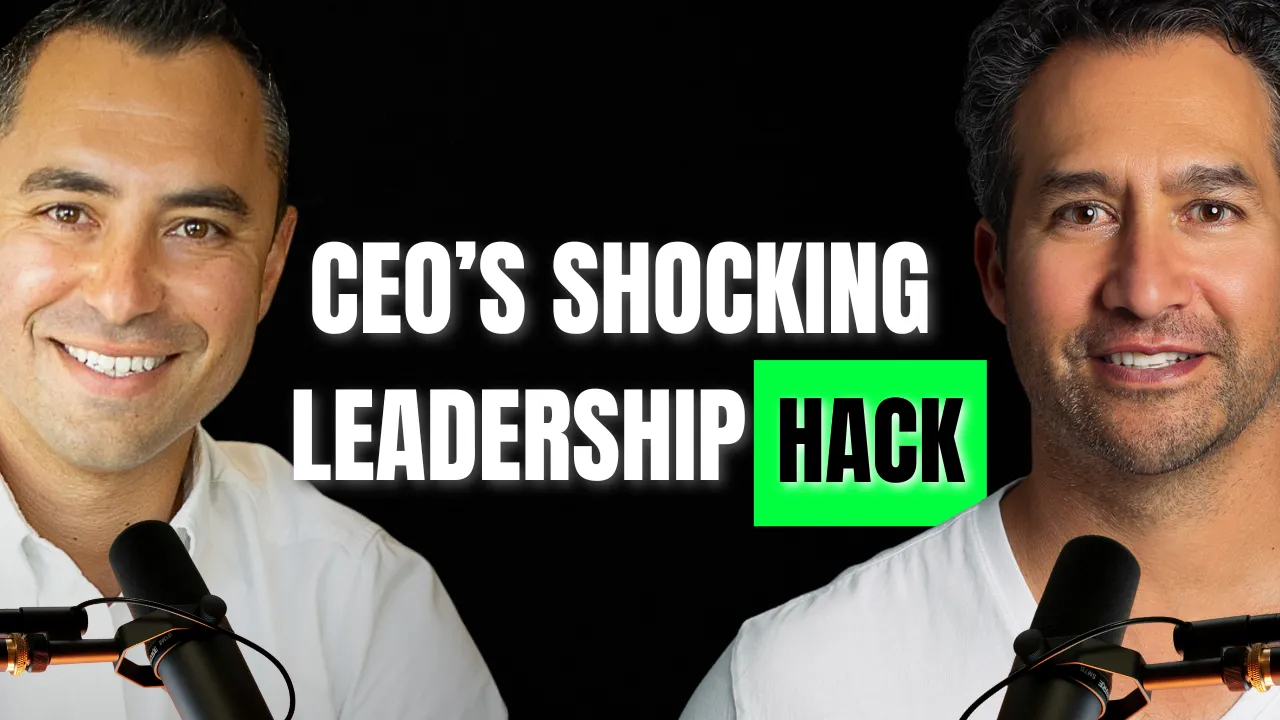
Jake Aaron Villarreal: I'm Jake Aaron Villarreal, born and raised in Silicon Valley, here to take you behind the scenes to share what it's like to be a startup founder. The journey they're on, the problems they face, the product they build in an effort to make our lives better. I'm excited to have with us today James Pham, co-founder and CEO of Opsin. James, welcome to the show.
James Pham: Yeah, pleasure to be here, Jake.
Jake Aaron Villarreal: Well, I'm excited to have you. James leads Opsin, which safeguards enterprise data in Gen AI tools like Microsoft Copilot and Google Gemini. An MIT alum, he taught advanced ML, led AI at Abnormal Security, and explored decentralized AI. Passionate about impactful AI solutions, he brings deep expertise in machine learning and security. So, before we jump in here, James, uh, where are you joining us from today?
James Pham: I'm joining you from San Jose, California. This is where we are based out of.
Jake Aaron Villarreal: Hundreds of AI startups are launching every month, battling to build their founding teams. As a leader, your job is to get results. When it comes to hiring, that's where it gets tough. So, you go out and you try a recruitment firm, but they don't understand your story. They're off target, and when they send you candidates, it's a waste of time. We believe you should never have your time wasted. That's why we launched Match Relevant, 'cuz your story is more than just an open role. It's your founders' journey, the problem you're solving, the product you're building, and why it matters. When we work with companies, we make sure we understand your whole story. So, we go out and do a search, we're on target, it's worth their time, they're interested, and more importantly, it's worth yours. And when it comes to hiring engineers, we work to make sure we get it right by deploying a team of seasoned CTOs that have built some of Silicon Valley's best companies. They can collaborate with you in the technical interviewing process. They can be a sounding board, or they can run it for you. When it comes to building teams, there's no time to waste. Let's make it count. If you have a role that needs to be filled, book a time with a hiring guide at matchrelevant.com and learn how we do it.
Ah, great. Well, I love that area. I'm from San Jose myself and always love to get back there and talk to companies that we work with and just in general the vibe of innovation happening there. Uh, we'll talk a little bit about you before we jump into your company, company. Can you share a little bit about your origin story? Where are you from originally and when did you come to the US and really what inspired you to come here?
James Pham: Yeah, so I'm Viet-, I'm from Vietnam originally. I was actually a chemistry medalist in high school and then after that I went to South Korea for my engineering degree. I finished my degree in three years and then after that I moved to Singapore, worked there in two years. And then you know, at that time I really wanted to work in technology, and there's no better place in the uh, than in the US. So that's where I started applying for graduate school in the US. And uh I went to MIT uh in Boston, stayed there for two years, did my master degree, and moved to Silicon Valley about six years ago. And I've been in you know Silicon Valley ever since. This is the best place to innovate and start a company.
Jake Aaron Villarreal: Yeah, really cool. I want to go back to what you said, "chemistry medalist." What exactly is that?
James Pham: That means that I compete nationally in term of chemistry. I was really good at chemistry and competed provincial level. I was uh first, I was a gold medal in, in provincial level. I was silver medals in national level. So I compete a lot uh in chemistry. So I was very deep in chemistry at that time.
Jake Aaron Villarreal: Wow. And what was the transition from chemistry to technology?
James Pham: So when I first got to, to South Korea at KAIST, which is Korea Advanced Institute of Technology, which is number one engineering school in Korea and probably number two or three in Asia. So when I got there the first year, they allow us to explore different disciplines. And I just, you know, got really hooked with engineering, right? Like uh it's so amazing that you can apply science into like, make it, make things into reality. And that's how I decided to pursue uh engineering degrees instead of chemistry degrees, and one thing lead to another and yeah, I'm working on technology and software engineering my, my full time now. So yeah.
Jake Aaron Villarreal: Really cool. Well, you were at MIT, which obviously is one of the best technology companies globally and certainly in the US. What was your experience like there? And looked like you were teaching, is that correct?
James Pham: Yeah. So my experience there uh was wonderful. I got to interact with some of the smartest people in the world, professors-wise as well as my classmates-wise. And more importantly, they are very humble, right? If you go to MIT you will see the vibe which is very chill. Everyone is so casual and not so polished. And you know that community building is very strong at MIT, even now after like six years after MIT I still hang out with a lot of community event from MIT. So, so that is about experience at MIT. But of course you know there's a lot of stress uh uh around that as well. Just so that you know a lot of my classmate are very successful uh so it's a little bit of peer pressure that I, that you know everyone has on themselves. But other than that, it have been a wonderful experience uh at MIT.
Jake Aaron Villarreal: Yeah. Really cool. Well you know, when we talk uh to our guests here that come on we talk about what problem are you solving in the world today that's using technology, applying to it. AI really everywhere currently and it's being developed, it's being implemented. Walk us through the problem you saw that inspired you to start Opsin.
James Pham: Yeah, so the problem that we're solving is um to enable enterprises to adopt Gen AI uh safely. The most important thing when it come to Gen AI or any machine learning system is around data. The most critical aspect of data uh is around privacy: making sure that the right people get access to the right data. So that's the problem that we are solving. We started with Microsoft Copilot and Google Gemini and making sure that engineering cannot see HR data or it cannot see M&A acquisition and so on and so forth. So that's the number one challenges that prevent enterprise from adopt uh Gen AI safely. In fact, Gartner has a report saying that uh 70% of enterprises are not adopting Gen AI because of data u- security concerns. And that's the problem that we're tackling and probably the other 30% don't know that they have a problem yet, but they will.
Jake Aaron Villarreal: So yeah, I hear you. So just for those that aren't very knowledgeable in Gen AI, walk us through an enterprise. So you have a big company, say healthcare or finance. How would they apply Gen AI in their company? Would it be based on each maybe division or department, and then across the enterprise everyone has access to it but not necessarily always needed to have access to the data? Like try, walk me through a little bit more about specifically how it's solving the problem there and how Gen AI is really implemented in these large enterprises.
James Pham: Yeah. So in a lot of these enterprises there have been a surge in adoption of tools like Microsoft Copilot, for example. Microsoft been pushing it heavily. So one of our healthcare customers for example, they started rolling out about 300 licenses to their team. So what they usually do is they uh, initially they grant some licenses to certain portion of their users to test out the return on investment as well as to understand the data security aspect of it. And then once that's successful... so that's usually phase one. And then phase two they will roll out to maybe 50% of the company uh and then they will gradually roll out to uh broader organizations.
And a lot of time what we see the most important use cases for uh for enterprise customers and employees is around uh having Gen AI to assist knowledge workers in achieving higher productivities. So what that means is that for example in today podcast for example, we could just use a Gen AI like Microsoft Copilot or Google Gemini to help you drop like an agenda, talking points, or it can spin up like entire slide for you or it can edit you know your Excel. So it's more like an assistant for you um rather than you know completely replace the workers. And a lot of people see values in that. The other use case that we see a lot of enterprise are adopting Gen AI is around meeting summarizations as well as uh generating marketing materials for their customers and clients. So, so, so that's the use case, right. So, I talk about uh one is the phases that they go through and then two around the use cases that I see enterprises are using uh Gen AI tools to adopt.
Jake Aaron Villarreal: Got it. That's great. So within a company, you might be in finance and you want to use Gen AI for purposes of your department, but if you're in sales, you might not necessarily need access to the financials. And your... does your product help protect or segment what data is being accessible or viewable amongst uh employees, departments, that kind of deal.
James Pham: Yeah, exactly. So basically you kind of summarize it correctly which is that if you're in sales you probably don't need to see other salespeople commissions, for example.
Jake Aaron Villarreal: Yeah, a very sensitive topic.
James Pham: And if you are in sales probably you should not get access to potential uh merger and acquisition that your company going through. But for example if you're in finance, uh getting access to financial documents is probably required for you to do your job. And let's say if you are in HR uh then you know, seeing people salary is an essential part of it, right? You have to you know promote people uh, raise their salary and stuff like that. So it depend on you know who you are, the information that you get access to will be restricted based on that.
And it's... this is a very fundamental uh uh ask for enterprises in term of like uh in term of the data privacies. The new things with Gen AI is that Gen AI just expose all the data governance issues...
[James Pham's Journey to Technology]
...that enterprises has, right? So this is, data governance is a decade old problem for enterprises. But what Gen AI changed is that now with Gen AI, when you turn it on, it gets access to all of the enterprises' data, and a lot of those are overshared internal permissions. So for example, you might set a document as a public document without knowing it. I get share a document that you don't get access to. So in the past, you need to know uh the right uh location of the file. You need to know the right uh Excel sheet of the file. You need to know the right paragraph to see it. Uh but now with the advent uh invent of Gen AI, you can just ask question about it. Everything just like one question away, right? So... right good analogy from, from one of our customers, that in the past sensitive data is like a needle in a haystack. It take you a long time to find it. But now with Gen AI all the need, all the needle are lined up in a row. So you can just...
Jake Aaron Villarreal: I like how you explained that. Why is this important to you?
James Pham: It is important to me because we can't really adopt Gen AI without respecting privacy and permissions. That's the fundamental request or fundamental uh features of Gen AI that we need to have. Without it, Gen AI cannot survive. Imagine Jake getting access to all the personal information from James and somebody else. That would be a mess in term of you know personal privacy and freedom. And so the way that I see that it is that every new invention of technology, initial roll out will be very rough. But it is progress. It need to get better and better. And this is one of the biggest gap when it come to Gen AI, which is around data privacy, data permission, making sure the right people get access to the right data.
And so from outside, from Opsin, what we are doing here is try to enable the human race to adopt Gen AI securely. And the only way to do that, to increase the adoption of Gen AI and helping uh us human in general, is to make sure that they get a secure uh Gen AI system that they can rely on and uh it can deliver all the benefits that it promised to you. But without security that will not happen. It's the same thing with the cloud as well.
Jake Aaron Villarreal: You know you look at companies like Microsoft and Google, h- they have... have they not built this sort of security or application into their platform already? Or is this something that they haven't focused on quite yet?
James Pham: So the good thing is about Microsoft and Google is that they are basic level of hygiene that they do. As with every cloud providers, they do a little bit of everything. And and they do enough so that they can sell the products. But the issue here is that this problem is not really a Google or Microsoft problems. Because Google and Microsoft does respect the permission on the file. But if the permission on the file on the documents are incorrect in the first place, then even if all the technology in Google and Microsoft can respect that, it's not going to work, right? Because this is more about, more of the end user problems, which is the data governance problem. It's a decades old problem. It's not a Microsoft problem. It's not a Google problem. It's a data governance, end user problem. Uh and so that's what we're solving for uh in term of helping them to be aware of uh what are the issues, how do you remediate the risk, how do you make sure the right people get access to right data and get alerted when something incorrect in term of uh...
[The Problem Opsin Aims to Solve]
...permissions.
Jake Aaron Villarreal: Got it. Who are you selling to? Who cares about this within a company?
James Pham: We are selling to Chief Information Officer and Chief Information Security Officer. So those are two personas that usually care about this. Chief Information Officer because usually they are the one who spearhead in Gen AI initiatives. They would be the one who roll out Microsoft Copilot, Google Gemini and so on. So all the Gen AI tools. But when they roll it out they will find out that there is data governance problem. Like, P- two weeks ago I talked with the customers, they have a payroll data leak. So a sales team member see commission of everyone in that...
Jake Aaron Villarreal: Yeah.
James Pham: ...and that uh uh that was not good. The other customers actually got leaked their upcoming uh M&A company, which is like super sensitive uh informations. So the CIO, because they rolling out that.
And then the other persona we're selling to, Chief Information Security Officers. So the Chief Information Security Officers mostly concerned around data security, and when you know all the Gen AI tools roll out, they you know start seeing a lot of sensitive information being floating around. So that's where you know we come in and help. So those are the two personas that we help.
Jake Aaron Villarreal: Got it. Very cool. You know, as any startup uh coming in to market with a newer product, the challenge is always just getting the conversations going with the buyer. What's been a strategy that's worked for you to get in front of the customer to explore your product, to see a pilot of it, to learn more about it?
James Pham: So, what worked well for me is that I'm very analytical. So, I'm an engineer by training and I still do a lot of coding uh to do data analysis in Python. What work out for me is that I test out different channels. I test out uh LinkedIn, meeting in person, and so on and so forth. And I analyze like who are the person that I'm talking to, uh what is the title, what industry, what's the company size and so on. And I produce like, "Okay this is the target personas that we should be looking at." And what worked out really well for me is based on that result, I narrow down, you know, these are the uh personas that I'm reaching out to. And if I reach out to these exact personas, my conversion rate is about 40%.
Jake Aaron Villarreal: Oh, wow. That's great.
James Pham: Because I know that if they meet these criteria, they are going to have uh problems. So what work out really well for me is just the same way that I approach engineering, which is around like using very data-driven approach and uh optimize for that. And that's how I got a lot of meetings from uh using LinkedIn but also like meeting in person, because analyze a lot of these, these thing and make it a more data-driven approach here.
Jake Aaron Villarreal: Yeah, really cool. You know, how does Opsin approach to data sec- data security differ from traditional data loss prevention or security measures in the context of generative AI?
James Pham: Yeah, the way that we differentiate from uh traditional data loss prevention is we not just look at the file or the content itself, but we also look at what is the prompt that they're using to interact with Copilot or Gen AI system and who are other users. So let's say that check is in, in HR. Like should he get access to financial documents or not? Right? So the way that we differentiate is that we use a lot more uh data than traditional uh data loss prevention to achieve higher accuracies.
And then the second thing is uh which is very unique to Gen AI is that we have a pen testing bot that go and interact with Microsoft Copilot and Google Gemini and to see like what sensitive information that we can extract from. So data refeshing, they're going to scan your entire environment. So let's say if you have like six or 10,000 SharePoint site and you have like let's say uh 50 uh or like 20 terabyte of data, it going to take you like six or seven months to, six to like completely map out everything. And uh it will produce like... probably one of our customers said that they produce like 30 pages of document that you need to go and fix.
Jake Aaron Villarreal: Yeah.
James Pham: Like you're going to need a full-time person just to go and fix these things and then by the time you fix it then new, do more document that got generated. Then that person job is just you know go around and kind of fixing stuff and asking people like "Hey, do you do you really need to make this file public?" and so on. So that how we differentiate in term of: one, higher accuracy, and we f- than you know traditional data loss prevention. Two, we using a pen testing bot to tackle top risk instead of like going through the entire environments uh and like a 30 pages long of things that you need to do, but rather than that you know you just focus on the top risk specifically and you go and tackle these risks instead of like going and do like 30 pages of uh, of reports.
Jake Aaron Villarreal: Wow. You know, if your product is, does what it sounds like it does, which is really cool in terms of data security, what's the implementation of it? Does it take months, weeks, days? Like is it dependent on the size of the company and the enterprise, the data amount? What's a typical implementation look like?
James Pham: It's very easy. So, basically what we need is we need an API key from your Microsoft tenants and that's about it. And for us it take about 20 minutes.
Jake Aaron Villarreal: Wow. That's it.
James Pham: And yeah, that, that's about it. That's what u- you know our customer love about it. Like you just give us the API keys...
[Data Privacy and Governance in Generative AI]
...and be done with it in 20 minutes.
Jake Aaron Villarreal: So within 20 minutes you can implement your product and it's going to segment the data, share with you what's like the high risk probability that you have to look at, make sure that you're taken care of, and basically up, you're up and running.
James Pham: So within 20 minutes you will be up and running. It will take uh a few hours for us to analyze the data. So the initial API connection allow us to get access to your data. So once we have accessed your data, we still need to classify things and generate that risk report, and that will take a couple of hours for to start generating risk assessment for enterprises so that understand like what risk they are facing. But it, it definitely not months like other traditional DLP solution.
Jake Aaron Villarreal: Yeah, you know, we're seeing so many different cultures around the world building technology and AI in particular from, you know, Asia to Europe to South America, Canada, the US. I was reading a report on in Vietnam in particular where there was a lot of early education around AI and getting really students at the high school level or maybe even younger like sort of up and running around AI and training on what it could be and how it could be useful. What did you have any insights about AI before it really hit like it has? And did any of this, did you see any of this while you were also in Vietnam?
James Pham: Do I see any of the culture aspect of the society that prioritize learning technologies?
Jake Aaron Villarreal: Yeah.
James Pham: Yeah. I mean there is a huge emphasis in Asian cultures. I don't know about European cultures, I was there for like couple of uh months and year, but for Asia culture for example, there's a strong emphasis in education in general. And there is a famous saying that if you do not study well you're going to go and be a farmer, maybe you know. In the context of, of Vietnam, it's a very hot life, right? Like it's rain and it's the sun is out there, it's just a metaphor to say that your life going to be tough uh if you don't study well. So there's a strong culture in Asian cultures in general that's emphasized on education.
And uh AI is uh like a kind of one of the new things, but there are many other things. In the past it was IoT uh, and a couple of years ago there was crypto technologies. So Asian culture tend to emphasize on like studying the new technologies. And you could see that the Chinese managed to crack down the deepfake.
Jake Aaron Villarreal: That was amazing.
James Pham: Amazing. Yeah. Very impressive. So, uh there's a strong emphasis in early education like what you said, like they want to train their population as early as possible to adopt latest and greatest technologies. So, that's what I've been seeing so far and I think it's, it working well uh for now. Of course, you know, every culture has its up, upside and downside, right? Like the other side of the coin is that it's u- it's very tough on the kids. So you, the Asian kids is very suffering in term of education.
Jake Aaron Villarreal: So I hear. You know, if you look at your company today, you've raised I think $3 million. Is that correct?
James Pham: Yeah, we raised about three, 3.2.
Jake Aaron Villarreal: Okay. How big is the company today in terms of employees?
James Pham: We have about 10 employees right now that we...
Jake Aaron Villarreal: Yeah. Very cool. And are you uh all local in the US or are you international as well?
James Pham: Yeah, so uh our company is based out of San Jose. We do have uh employees in Europe as well. Uh so it's a bit of mix. So it based on the team really. The back end team, backend engine team is in San Jose because it's just easier to discuss. But the front end team is in Europe uh, and then the UX team is uh Eastern US. So it's all...
Jake Aaron Villarreal: Got it. Different places.
James Pham: Yeah, sounds pretty normal for these days.
Jake Aaron Villarreal: What's uh the biggest challenge as you bring your product into market that you're currently going through?
James Pham: The biggest challenge in the market for us is that Gen AI has a lot of hype and demands. But in, when it come to adoption itself, especially for enterprises that are conservative, a lot of them take a couch approach uh in that they, they uh adopt... let's say if you have 20,000 people company, but you want to you know use maybe u- 30 or like 100 or 200 licenses for Copilot uh and so on. So the biggest challenge for us is to identify the correct customers that are at scale and have the problems. Because if you have like just couple of licenses or couple of people in the company adopting Gen AI, and probably it's not, it's not a big uh problem yet. Uh so that's the biggest challenge for us.
And then the second challenge for us is actually hiring. And we get more customers, there is a need for us to move fastest. And when we hire last time it took us literally six months to get a hire in the Bay Area. And it's very uh acute here in the Bay Area, there's a lot of AI startup, there's a lot of uh money floating around to attract people. Uh so the competition in the Bay is a little bit crazy when it come to hiring. But like when you expand a little bit outside of the Bay Area, things got a little bit easier, especially if you expand internationally, uh that's a lot easier and then cheaper as well. So I would say that the second challenge for us, right? Uh which is you know hiring, right? Like as a startup we want way, like five customers build a team to deliver to that, and these are the two constant thing that we have to do.
Jake Aaron Villarreal: Yeah, it's a fine balance there. You got to know your pitch too really well so you can get people excited about what you're doing, and it's easy to understand and they see the vision and the journey they want to be a part of. So, there's a lot of storytelling that goes into hiring anybody, but sounds like you're on the, on a good path here. As you look into 2025, what uh, what's on the roadmap? What are you excited about?
James Pham: As we look ahead to the toward the end of this year, I look forward to increasing the size of the teams as well as uh onboarding more customers. There's a lot of exciting things that we're building. Uh we're building the pentesting bots, we are building the detection engines, we're building all of that. But it will be very exciting for us to uh make this a lot better and we can support more tools. So, so right now we support Microsoft Copilot, Google Gemini. We would want to expect, we would want to support other tools like uh Glean, like there's so many tools like Perplexity want to go into this space. There is more work we want to go to, into this. And everybody have a data uh security problems, we just don't have enough bandwidth to build uh right now. But looking forward toward 2025 I want us as a company to grow up, uh have more people, more customers, and support more products so that we can increase the adoption of Gen AI tools across the enterprises. So that's what I really look for in this year.
Jake Aaron Villarreal: Yeah, really you know, for potential buyers out there that are listening to the show, what's the business model? Is it a per seat license? Is it based on the data? What's the business model look like?
James Pham: The business model is a seat license based on the number of licenses that you have uh for Microsoft Copilot and Google Gemini and we do the pricing based on that.
Jake Aaron Villarreal: Gotcha. Pretty straightforward. Really cool. Well, James, I want to ask one last question. As you have built your company and you're continuing to evolve it, you know, one of the questions always is, as a company, it evolves, but also as a leader, you have to evolve. What's been an area that you felt like you have taken your own leadership to another level? And what specifically has been helpful that you've learned in the process of building your startup?
James Pham: Yeah. So I'm an engineer by training. So it's really hard for me to like, what you said earlier, uh selling a story to, to candidate to employees, but not just that, but also selling a story to customers and selling a story to investors. So...
[Opson's Unique Approach to Data Security]
...that's have been my own personal journey to learn about like how to really motivate people uh, to make people understand your visions and actually buy in into that vision and then want to go with you. Right? So that have been a personal journey for me because uh like I said, I study engineering working most and you know mostly staying very technical work. I actually started as a CTO of the company and then switched to the uh CEO role and start uh you know the selling and storytelling and stuff like that. It's have been quite a journey for me. So that's the first thing.
And then the second thing is as a startup you got to keep adopting uh keep be flexible and adapt to the environment that you are in. And we've been doing amazingly well on that front in adapting to uh different external factors. And that take a lot of uh growth mindset mentality, which I would say that's my number one takeaway from my MIT education, is just to have a growth mindset. Uh always assume that you know less than you do and always assume that uh other people cannot teach you a lesson. So that's the mindset that is important. And uh I think that that mindset I have been a, I was able to apply it here at Opsin and that was really mind-changing for me in term of like really keep a open-minded, learn from everybody. And, and so that the second thing that, that I learned as a leader. And as as I, as a company grow up, I have to evolve. I have to learn sales, but the next thing will be have to learn about organization and stuff like that. So, that's the second thing.
Jake Aaron Villarreal: Yeah, that's really cool. I love that. Well, I'm excited to see how things go for you in the future here and with your company. Uh, if anybody wants to find Opsin, where do they go?
James Pham: They could go to our website at opsinsecurity.com or they can just look me up on LinkedIn and send me a message. You know, happy to, to talk with them not just about Gen AI but also about starting up a company, but also about you know what's the growth mindset. Uh so I'm very, my personal philosophy is I try to be as helpful as possible in helping people because everyone needs help uh one way or another. And I think that if I could help people in any way uh happy to do that. So feel free to reach out to me.
Jake Aaron Villarreal: Yeah, that's great. Sounds, sounds like a leader. I like that mindset of education and helping others and mentoring and uh those are all great things to hear. So Opsin is opsinsecurity.com and James Pham uh you can find on LinkedIn, that's p-h-a-m. James, thank you so much for coming on the show and sharing your story. I really appreciate it. And for the listeners for listening, it means a lot to me. You spent your time with us today. I'm your host Jake Villarreal, excited to sign off and join you on the next episode. Until then, James, the world, take care. If you like what we're doing, don't forget to subscribe, leave a review on Apple Podcast or wherever you listen, and follow us on YouTube where we go behind the scenes to learn what it takes to be a startup founder.
































.jpg)























.webp)


.webp)
.webp)




.webp)