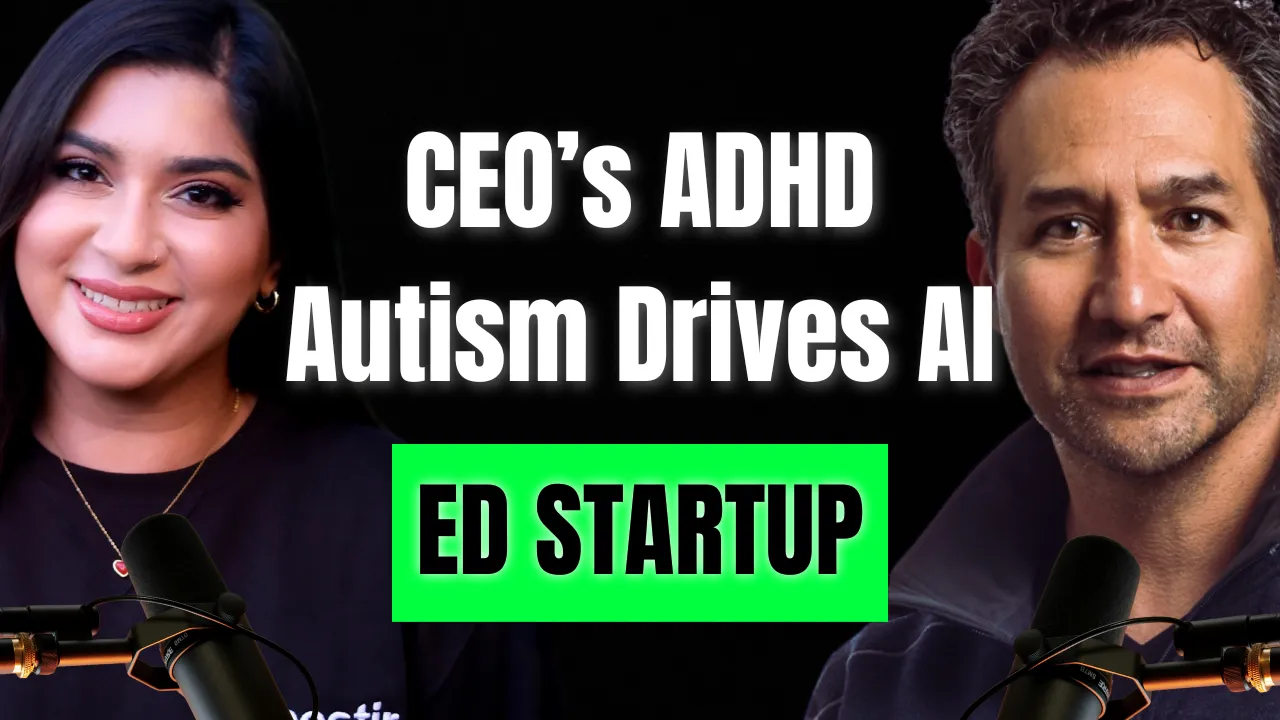
Jake Aaron Villarreal: I'm Jake Aaron Villarreal, born and raised in Silicon Valley. Here to take you behind the scenes to share what it's like to be a startup founder, the journey they're on, problems they face, the products they build, in an effort to make our lives better. I'm excited to have with us today Simon Arkell, co-founder and CEO of Ryght AI. Simon, welcome to the show.
Simon Arkell: Thanks, Jake. Good to be with you.
Jake Aaron Villarreal: I'm excited to have you here. Before we jump in, where are you joining us from today?
Simon Arkell: So, I'm in Laguna Niguel near Laguna Beach in California, and I think pretty close to you.
Jake Aaron Villarreal: When I started this podcast, I had this vision of going behind the scenes to share what it's like to be a startup founder in Silicon Valley, where I'm born and raised. And weekly, we dive deep in the trenches to find the wins, the losses, and the lessons learned with the hopes that it helps you run a better startup. But here's the thing. If you've gotten any value out of these conversations or been inspired at all, hit the subscribe button. And I get it, your podcast feed's probably overflowing. But to stay up to date what's going on in Silicon Valley, stick with us because at the end of the day, we're all just trying to build something that matters. And we're better when we do it together. So, hit that subscribe button and follow us wherever you find your podcasts. Now, let's get back to the show.
Yeah. Well, it's a great Friday. We got good weather here and just it's a different world from Silicon Valley, but really not that far away if you think about it. You get on a flight and an hour you're in the heart of the pulse of all sorts of technology innovation. But we're going to talk about your innovation here today. And before we do that, let's give the listeners a little background of yourself. So Simon is an accomplished Australian-American entrepreneur with seven startups under his belt, five of them venture-backed. He's also co-founded Deep Lens, Prediction Software, and other venture-backed companies. He's also a two-time Olympian, having come to the US on an athletic scholarship in the 80s, where he honed his craft as a pole vaulter to go on to become Australian and Commonwealth champion and record holder and two-time Olympian representing Australia in the 92 and 96 Olympic Games.
So, Simon, I got to share with you, you're the first Olympian we we have on this show, and I'm excited to to learn a little bit more about some of those parallels between building a career and competing and winning and how that kind of aligns with startup world and just being an entrepreneur in general. So, we'll get to that, but before we do, give us a little background of yourself. What were some of the experiences you had early in life that shaped you into becoming who you are today from a business perspective and just in general?
Simon Arkell: Well, you know, coming over here as a as an athlete from a foreign country and landing in Albuquerque, New Mexico, which might as well have been landing on the moon. [laughter] It was so completely different, not only physically, but culturally. It was it was quite the step. And as a young kid, all I ever wanted to do was, you know, go to the Olympic Games in my sport. So I came to the US, was lucky enough to, you know, get a foot in the door into the NCAA. Ended up improving a lot while I was over here competing in the NCAA Division One and just getting some great experiences all over the world. You know, doing what I love to do and eventually getting paid to do it, but most importantly forming a lot of great lifelong relationships, friendships, experiences of competing in front of huge crowds. But, you know, I don't think a lot of what formed me came from the good stuff because I think everyone can can look good and things can be easy when things are going well. But when you're putting yourself out there to actually be doing it when everyone's looking, but fail miserably over and over again in many different facets of my life has, I think, helped probably beyond anything I ever did successfully.
Jake Aaron Villarreal: Yeah. Well, you know, this is interesting because I [clears throat] did track in high school. And not to segue from our conversation here, but you know, when you're on that track and it's you against other people, there's really no other teammates unless you're in some sort of combination running or relay or whatnot. But you know, in some ways it's kind of like you're in the arena and it's you against them and you know, you either win or you lose. Everyone's watching and adrenaline's flowing and you're running your race or you're doing your pole vaulting. It can be challenging, scary, but also exciting when you win. When you talk about the space that you got into, pole vaulting, how did you get into that? Because you could do a lot of different things, but that's not something you wake up and pick up a pole and start running down a lane with. Like, how what what inspired you to do pole vaulting?
Simon Arkell: I you know what I think why do people end up becoming professional surfers or anything in life really? I think if you if it really feels like the thing, it's like love at first sight. And it definitely was for me and my buddy back in Australia. We were 11, 12 years old and just tried this thing. I was like, "Okay, this is it. It is so damn fun." But it's also an Olympic sport. Kind of checks that box. And because it was really hard to do, it's easy to be really bad at it. My buddy happened to be really good at it early on. It was just natural for him. So, I I got to keep going to the local club because they would have slammed the door in my face had it just been me on my own merits. But, you know, if it's a passion and you have that sort of mentality and you keep doing it, you get better. That's what happened.
Jake Aaron Villarreal: Yeah, I like that word passion. If you can find it, keep doing it and you become better. So, we'll talk a little bit more about passion as we go deeper in the conversation, but I want to start with your company, a little bit more personal conversation here. You know, Simon, you've built seven startups, but one of them was sparked by attending Megan's Wings, the charity, which was started by your friends who were Megan's parents, and she shortly passed away after. Take me back to that moment. What did you see at that event that made you think, "I have to do something about this?"
Simon Arkell: Well, f-firstly, yeah, my old college athlete friends from New Mexico who were not from New Mexico, but they competed just like I did for the university, moved to California, married, had kids, and and Megan was diagnosed when she was six years old, passed away when she was 10. And I had lost touch with the family and then, you know, met shortly after Megan passed away and then attended one of their events and it was a fundraiser. And I was so emotionally distraught by just the pain that that sort of loss could cause not only for them, Dave [clears throat] and Kim, but also other parents who were attending and speaking at that event.
And I, you know, bawling my eyes out at this this event firstly realized that, you know, living in a pretty nice part of the world and I had a, you know, a number of friends who've done well for themselves that it would be a travesty if I didn't try and help in some way. And so my buddy Manoj and I um who's in Laguna Beach decided to put on an event every year and we did it at the the headquarters for Ketel One Vodka which is called Nolet Spirits. And Carl Nolet and his wife who were friends because our kids went to the same school as the owner of the distillery back in Europe, had, you know, their big headquarters and ballroom here in Orange County. And so they offered that up for free. They paid for all the drinks for the night every year. And we invited just 86 people. That was the capacity of this place. But over nine or 10 years of doing that in a row, we raised over a million dollars for the charity. And what it did was help the parents of children who were diagnosed with cancer.
But over and over again as the MC and organizer of that event, I just saw so many examples of, you know, these poor parents who had to quit their jobs in order to care for their children. And so it became a really great passion. Now in parallel, I had a company called Prediction Software, which we sold back in 2016. And I got a call from one of my old co-customers from Prediction one day. He said, "Hey, I've got an opportunity with some tech at the hospital where I worked to license it and maybe, but I don't know anything about starting a company. Do you think there's a company here?" And what it did was used AI to help in the fight against cancer, and and we started a company called Deep Lens. And Deep Lens, with a third co-founder, ended up, you know, raising VC. This is what what I do kind of, raise VC to build software and then hope people buy it one day, and we'll get into product-market fit later on. But I had an emotional response at the opportunity to start this company because it segued or intersected my experience for many years in software and analytics and startups with cancer. And it became like the thing I decided to do for the rest of my career, which is to somehow use cancer to help these incredible warriors called scientists who are out there coming up with brand new therapies to try and save lives. It's it's it's a great space to be in.
Jake Aaron Villarreal: Yeah. Well, walk us through what your current company actually does. How are you using AI to transform, you know, clinical trial site selection and patient enrollment, which is kind of what we talked about in our earlier call. Walk us through what that looks like, how it works.
Simon Arkell: Yeah. Well, firstly, for those who don't know the industry, and I knew nothing about it before starting Deep Lens. If I did, I may not have started the company to be honest. But it's a completely broken system. It is so inefficient that these incredible scientists who are coming up with these great medicines will not have that medicine see the light of day, if it does, for at least a dozen years after they design the molecule to create the drug. Because these trials have to go through Phase 0, Phase 1, Phase 2, Phase 3, and then Phase 4, which is the registration with the FDA, final work to be done. And then it could become a commercially available drug that you might see advertised on TV every night, which gets a bit annoying, too, I must say. And that is a 12 year time frame.
The reason why it's 12 years and not six is because it's still working the way it worked 25 years ago. To start a clinical trial after you've registered it, which is called IND, you start in basically a a Phase 1 trial, which is just to see if there's any toxicity. Phase 2 means dosage and toxicity, so you kind of ramp up the amount of the dosage. And then when you get through successful data in those two phases, you go into Phase 3, which is a much broader, maybe global trial. And in in the case of oncology, it's really, really complex and it's very hard to find the patients. And so the reason why studies fail outside of bad drugs or toxicity, number one reason is that they just can't find enough patients. And they might spend hundreds of millions of dollars and then shut down. Well, the reason why they can't find enough patients is not because there aren't enough patients out there, although it's getting really competitive for those patients. Now, patients who do qualify for the trial, 95% of those who qualify for a trial never find out about that trial. And so, you've got this massive disparity between availability of the drug and therefore availability of the patient.
And so, the reasons for this are very, very complex and it's a very, very manually intensive industry. But effectively you need to find sites and then what are called investigators, the doctors that would be responsible at that site for the trial, and they have to have the capability to get enough patients onto the trial. Well, sites get activated for all the wrong reasons in many cases. So effectively a site might get set up and activated for a trial because someone at the drug company, this is called a sponsor, knows the PI and went to went to med school with them, or they've worked with that site before and they did okay so they'll probably do okay on this study, or the site self-reports lots of patients but doesn't report the fact that there might be six or seven competing studies that are competing for the same patient that you would like. And anyway, there's just many, many manual things and broken communication between the two sides, the sites and their patients, and the sponsor which is the biopharma client.
And so what we do with AI is we've had a vision since day one based on lessons learned from my last company Deep Lens, which had a very successful exit in 2022. But there were some kind of problems with that model that prohibited scale and availability for the sponsor, the customer. And that is that if both sides of the equation in this flywheel, the sponsors (the biopharma) and the sites and therefore their patients, have the same AI and the same system, there should be a real-time exchange of value and data. Whenever there's a need here, you should know immediately whether there's a match and you shouldn't have to do what they currently do, which is pour through thousands of sites in a spreadsheet that they purchase from somewhere, come up with a final list after days or weeks of analyzing it, sending a cold email out to those sites, which either go to the wrong person or basically get ignored, and then typically the wrong site would get activated just because the site might want it because it's revenue for them just to get involved. And so it's just a broken system. And so we've changed that by creating a real-time system between both sides of that flywheel. And the applications that we built are native to generative and agentic AI. And it's mind-blowing what this stuff can now do. And we just have this vision that at scale it could literally change the world as it relates to getting drugs to patients much more quickly so they can have their lives saved.
Jake Aaron Villarreal: Yeah. Well, you know, cancer affects a lot of people and you know, I've got friends that have had it at different times in their lives, too. And you know, sometimes it's a question of "like where do I go to get help? What, you know, maybe this isn't working, but where do I get that new trial product that's coming out and how do I get there?" And you know, it's, it seems like there needs to be more guidance there too, of services around what your options are. Because oftentimes you're kind of in a reactive mode, you're trying to save your life and you don't know where to go and how to get there. So it seems like this industry, it's a $140 billion industry, it's manual, there's been a lot of innovation over the years, but how is AI today different than AI in the past of how it could have been applied to this problem?
Simon Arkell: Well, I did apply it to this problem in the past at Deep Lens and we were using the very latest AI back then, but guess what? It wasn't generative AI. It wasn't agentic AI. The old AI was, on unstructured data, was using NLP, natural language processing, where you still had to tag the data as if it was, as if you were structuring it and putting it into rows and columns. The the the old school AI and before that we called it predictive analytics, now called supervised machine learning, is based on really structuring the data properly so you can get an accurate output. But then if you move to a new site or location or customer, if the data is not in exactly the same format that it was when you trained the model, it breaks and now you have to retrain the model. So it just doesn't scale.
We also learned too that if you needed access to the medical record, the EMR at the sites, then you could sign a site up and that would take a long time because it's the EMR, it's patient data. But to actually go live with that required um security reviews, but also getting on the waitlist of the software vendor that runs the medical record software. And Flatiron Health is big in the community in the US in oncology, or Epic for big academic medical centers. I mean, I I'd die of old age before I got into some of those. And so, we had like a hell of a lot of inertia. The other problem was we needed sites to be running our software before we could claim them as part of our network.
So, we rethought this and said, "Well, with this new AI where you can just throw unstructured data at it and it makes sense of everything and it can do amazing tricks with the data, um, what if we completely broke the old paradigm and put in a new system where we create what's called an AI site twin." It's like a digital twin of every clinical research site in the world. And there's 200,000 of them. So we've got actually 100,000 in the database and line of sight to the 200,000, and we use AI agents to populate those digital twins with data and therefore analytics on every site. So now we have an analytical model of every clinical trial site in the world. So when our customers load a clinical trial protocol, which is the recipe for the trial, we immediately match them to the best sites that can succeed. And it takes into account many different variables as to why that site can succeed. And so it's just a completely rethought approach. No one else is doing it that way. And it's starting to really show a lot of a lot of promise. We've got some big customers. We've got big pipeline opportunities. We have the world's biggest consulting firm that just agreed to invest in the company and we've got seven VCs in our company. So, it's really starting to take off.
Jake Aaron Villarreal: Yeah. Wow. That sounds incredible. You know, if you're a listener out there listening to this and you're affected by cancer, either personally or someone you love, and they want to explore clinical trials, what's one thing they can do today or tomorrow that most people don't know about?
Simon Arkell: Yeah, it's a good question. There is a website, but you need a PhD to read the damn thing to be honest. It's the government-mandated website called clinicaltrials.gov. And it's just I don't think it's even worth going to, but you know, people can definitely do that. The number one thing I would do is get a molecular test, a genomic test. So, what you want to do is you want to identify any genetic anomalies that you may have. If you do, and you get tests, and there are some, you know, major commercial labs out there that your oncologist can send your blood work to or basically a a biopsy of the tumor itself, and it gets sequenced and then your genome comes back. And then it helps you understand any any of these mutations that you may have because a vast majority of cancer treatments these days, especially in research in trials, target the genetic mutation.
And so like we learned with mRNA vaccines etc. during COVID, these new therapies are just incredible. Old school chemotherapy is where you just douse the body with poison and you hope that the tumor dies before the patient does literally. But now you can just get a vaccine. You could get a therapy. It could be an injection. And basically these little these little pre-trained machines will go in and turn off a protein and then kill the cancer, like whatever it happens to be. And there are many different ways of doing this and every every cancer is different because cancer is an umbrella term for thousands of different tumors and types of cancer. But there are huge strides being made in these precision therapies and you won't ever know if you're eligible for them unless you get a a a genetic test. And so those are available. The labs are called CARIS, Foundation Medicine, Tempus, NeoGenomics, the list goes on.
Another type of test which is brand new is for patients who've already been diagnosed and it's called an MRD test, which means minimum residual disease. And the MRD test allows you to basically identify, you know, the abnormality and the type of mutation you may have that caused the cancer that you just survived. But then an MRD test can be done to see if there's any residual chance of that coming back in the future. And you want the therapy initially to go down to zero traceability of the of the tumor, but then for it to be able to continually kind of test it to see if there's any residual trace of that particular mutation and tumor coming back. And so it's a new type of testing, but it could be really revolutionary.
Jake Aaron Villarreal: Yeah, it's amazing. It's like the one disease that seems like impacts so many people. And you would just think at this point that there would be like a solution or ability to solve this with the technology we have and the scientists and the medicines, but seems to always...
Simon Arkell: Thousand, there's thousands of diseases and each one attacks different body parts and like it's a really complex thing. They talk about survivability, not even cures in most cases. Like, you know, "We improved the 5-year survival rate with this new therapy," and that's applauded, but not coming close in many cases to actually curing it. I'm with you, though. My, one of my best friends died six months ago in Adelaide in Australia. He's, you know, a 55 year old guy who had everything to live for. Seven-year battle. He fought bravely, Adam. My mother died three years ago from cancer. You know, everyone's still recovering from that. It's just brutal. And everyone is affected by it. So, it feels like a really good place to spend one's time.
Jake Aaron Villarreal: Yeah. I love the fact that you're solving, working to solve a problem that just impacts so many people at so many different levels in so many different ways. And it's not just physical, it's also psychological because, you know, the worry, the strategy, the next steps, the, you know, after things happen, it's just it's something that needs a lot of attention and more so in today's world. So, I'm really excited that you're building this because you probably could have done anything. You've got all the experience of building companies and you've got a lot of experience under your belt.
Let's switch gears a little bit here and talk about that experience. So, you know, you first have to understand what a problem in the market is that you want to solve and then can you build something that people are willing to pay for and then how do you get visibility for that product and where does the product-market fit, which is as important as anything. So, you know, walk us through your experiences and what are some of the learnings you've had when it comes to really going from zero revenue, new idea? Yeah. What are you looking for in signals? What is it that helps you find your product-market fit and when do you actually say, "Hm, maybe we should pivot?"
Simon Arkell: Yeah. No, really good question. I think it's the hardest thing in doing startups. Product-market fit at the very basic level means that your phone starts ringing not the other way around and that's easier easier said than done for sure. There are so many things that go into building a company that, you know, could get that escape velocity as they call it. And I won't even start a company unless I know there's a unique and therefore investable story because everything I build is, you know, millions of dollars to get software out the door that before anyone can even buy it you have to spend and millions of dollars. And so you need VCs to buy into the opportunity. It has to fit their thesis for the space.
And so when I started and co-founded Prediction Software in '09, it was right after the global financial crisis but there was a really good storyline. My co-founder had just sold a, his company very successfully to Microsoft, had an inside look into this world of pre-AI called predictive analytics that that was going to be democratized, and and we built a really good storyline and that led to funding. We raised $46 million with that company with some really big-name strategic investors and individuals, Accenture, GE Software, Marc Benioff personally, EMC like it was great.
Jake Aaron Villarreal: Yeah.
Simon Arkell: And and then after that company I started Deep Lens. Deep Lens was really an interesting time because it was 2017. Uh we really kicked off in '18 and there was this whole idea that that that AI was going to be something but it was way before ChatGPT but it was, AI was really starting to get a lot of buzz in the industry. But I wanted to start something that was very focused on the deep learning aspects of AI because that creates, you know, what they call moats and defensibility in the business. So fast forward to Ryght, same thing. We needed the right story and we had one. ChatGPT. I just sold my company Deep Lens very successfully and had some rockstar, you know, co-founder/investor friends who were now, you know, coming in on board and so we had some great industry luminaries.
So the storyline becomes so important if you want to get at least the initial investors through the door. Then of course you have to build something and you have to be really, really smart about where you think the industry is going and that is de-risked if you have industry experience which I did in this which helps the investors as well. But more importantly you want that experience and your smarts and ability to pivot to be linked to, you know, your finger being on the pulse of that industry. And you can learn that without having had previous experience. But as soon as you can get people to start paying for your solution to their problem, I call it a problem with a checkbook attached, then you know you're on to something.
Now, initial sales are great, but remember there are early movers in this space. If you've ever read Crossing the Chasm and Innovator's Dilemma, you'll know everything I'm talking about here. And and so you might think you're brilliant and I did this at at Prediction, signed one big hospital system up that was worth almost 4 million in revenue for us and then, um, and then it turned out they were the only one. I thought, you know, everyone would want that and we'd be billionaires. Well, it was a little more tricky than that. So if you can find sales repeatability, meaning the same thing can be sold over and over again at high margin because you've already built it once and it's solving the same type of problem for the same type of customer. Then that sales repeatability is what gives you confidence that you can hit product-market fit and get to scale. You cannot get to scale unless you get to sales repeatability first. And you can't get to sales repeatability until you finish the product and it actually does things that solve the problem for the first customer.
So to me it's a constant battle to try and really figure out, be prepared to pivot or evolve very, very quickly and to learn what the signals are early on so that you can make those changes before you run out of money. My co-founder in this who's a smart guy, PhD in electrical engineering, he's done a ton of companies and has sold them successfully. He was quite amazed that I am so commercially focused so early in the company because before we had a product I was out selling it. Because really what I wanted to do was have those hundred at bats in order to hear the questions, hear the objections and try and pivot and evolve the story and the solution so we knew what to build before anyone had actually purchased it.
Jake Aaron Villarreal: Yeah, I think that's smart to do those interviews and to get the feedback so you're going down a path that's solving a problem that they need. I mean, you can build something and guess, but ultimately that's taking you down a path with low probability in my opinion and we've seen both sides of that. We've experienced it ourselves. So, we, I 100% agree with where where you're where you're going with that. You know, there's the product and the product idea and bringing it to market, but below all of that are people. Like without the people and the team, products don't go anywhere. What are some of the lessons you can share with the listeners that are first-time founders about the DNA and the people you hire, the type of process you've worked through that's helped you identify the right people? What are one or two things that you can leave them with in terms of strategy that's been successful for you?
Simon Arkell: Yeah, I think the people side of the equation is always the toughest thing. You know, the the CEO and founder have [snorts] some major responsibilities obviously to the shareholders. And the number one job of a CEO outside of building a great team and product and generating revenue is to not run out of cash. And you can not run out of cash in two ways. You can not run out of cash by selling lots of product or you can not run out of cash by raising lots of capital. But if you run out of cash, it's your fault. Like it's the CEO's number one job. Nothing else matters. There have been thousands, hundreds of thousands, millions of companies that had incredible promise, incredible, incredible technology, but they weren't around anymore to win. And it's that simple. I just heard a quote from someone last weekend about Charlie Munger, Berkshire Hathaway, and he said, "It's it's great to finish first, but first you must finish." So, you don't get to be lucky unless you're still in the game. You got to be in it to win it.
Now, along the way, there are a few things you have to do very well. You can't build a great product without a great team. So, you must pick. And I've made some terrible mistakes in the past of picking technical leaders or co-founders. And I thought I was good at it until I wasn't. But I've also found really, really good people. And I hate to say it that they were usually not the ones that looked the best on paper. They were the ones that I just had intuition about. I don't think you can have intuition unless you've been doing it a lot. And so, having done this so many times now, the type of person I can pick is a little intuitive because I've I've had some horrific experiences before, including with team members. But sales is hard because if anyone's reasonably good at sales, they're going to do well in the interviews, but it doesn't mean they're going to put up the numbers.
And so, picking a team is really important. But also when you realize that it's not the right person, you've got to move at lightning speed to move them out of the company. They say you should hire slow and fire fast. And I agree with that. Although I think we get pretty attached and to the emergency of needing people when you need them. You'd know a bit about this, I'm sure. But like taking your time and doing it properly can help. Intuition has a lot to do with it. But when you realize it's the wrong person, you got to move them out. And I I hate to say it, but at this company, I've been doing that very very quickly just because I don't want to fall foul of the other main thing, which is not run out of money. You can't keep paying someone a salary if they're not a 10x employee.
Jake Aaron Villarreal: Yeah. You know, we've worked with hundreds and hundreds of companies, many of them startups, and today almost 100% of them are AI startups. And we're seeing some interesting patterns and trends. But you know the question that we always ask and the question that we get asked from the companies we work with is you know, we ask them you know, "who do you need and who do you need to let go to move your business forward?"
Simon Arkell: Yeah.
Jake Aaron Villarreal: And always be thinking about how you're going to optimize your business with those two questions are pretty easy. But to your point, we we see a lot where people hold on to the underachievers because you're hoping they can figure it out or get better or at some point get it right. And yeah, the quicker you can move on, it doesn't sound really heartfelt, but that's it's the truth. Like [laughter] you're there at a with a certain objective. You're trying to save lives, literally.
Simon Arkell: Yeah. Well, the good good news is there's very little unemployment in the industry and so anyone you let go is going to find something pretty pretty quickly. Secondly, I think it's really important to not hold on to people because you think that big deal is just around the corner. I had a chat with my co-founder Alex about this yesterday and you know he's been involved in the past with a company that had $30 million in the bank but was spending yeah, a million a month. And when they got down to you know, eight or 10 people um and were maybe out of money or close to it, they wish that they were at eight or 10 people when they still had 30 million in the bank because then they could have done some incredible things if they just had the time. Again, don't run out of money, but don't have happy ears. It's I love that saying, but it's "gee, I just had the best phone call with this customer. They're totally going to buy and it's amazing. It's going to be game-changing." And then invariably, especially at a big company, something happens. You know, the, your champion gets fired or repositioned. A recent one for us, you know, big global pharma company, "oh, it's AI, so that's going up to a more global strategic view with the C-suite now. So they're taking a step back from, you know, immediate pro- just whatever it happens to be," there's always reasons for delay. And whenever you think that 10 clients are all going to close at the same time and what are you going to do and you panic, it never ever ever happens that way. So it's easy to kind of drink your own Kool-Aid and get caught up in the emotion and then you overinvest or you under-terminate as a result of that.
Jake Aaron Villarreal: Yeah. Yeah. We see a lot of ebb and flow and patterns when people hire and when they assess their talent and the patterns are pretty similar across the industry which is really cool to understand. What we typically see because we're on the recruitment side with organizations where they come to us it's usually kind of like a doctor or lawyer. You don't come to us unless you actually have the pain, like "I get, someone's leaving, I got to backfill them" or you know, "we get so much demand on the sales side we have to actually add more people now." And so there's certain triggers that are helpful, but like how do you change that from being less reactive and more proactive, whether it's working with a third party or internally? And what we found is if you could begin to build relationships proactively for certain like strategic roles that you know you're going to need in 6, 12 months, and it could be simple outreach on LinkedIn or wherever. You're not really in a bad position when it comes to taking those next steps to take someone to coffee or have a deeper discussion because you already have that network kind of pipeline built up. And so we called it, we call it building a bullpen. We actually provide that service to a lot of companies where they're not hiring today but in 3, 6, 12 months they will and they just want that network and that's been very relaxing for for the founders we work with because they they have kind of like a plan A and a plan B in place and it's something I don't think it's...
Simon Arkell: Good for you, good for you too to have that recency effect. So staying in front of people... you know your sales cycles might be quicker than ours I mean we're in an industry with six to 18 month sales cycles for the bigger deals. Although, you know, we closed a a six-figure deal after one phone call in 3 weeks and two days from first contact and and that was unheard of. Of course, everyone in the company was saying, "This is going to be easy. We'll just do this with every..." I'm [snorts] like, "Guys, [laughter] let's call that an anomaly because it didn't happen that way."
Jake Aaron Villarreal: Yeah, I hear you. Well, let's fast forward to 2030.
Simon Arkell: Mhm.
Jake Aaron Villarreal: If your current company achieves everything you're building toward, paint a picture. What does a cancer patient's journey look like that's radically different then than it is today?
Simon Arkell: Yeah, good question. Firstly, based on the original vision for the company, in a world where both sides of the flywheel, the sponsors (those developing drugs) and those sites and their patients are all part of the same AI system, then there will be a real-time exchange of data and therefore a real-time exchange of value and things can happen in a digital parallelized autonomous way and not analog. Currently, as I mentioned earlier, you know, you come up with a list after weeks of analysis of potential sites in the 10 countries that you need to run your clinical trial and you send a fax to those sites and ask them a list of questions. Well, if you already have the answers to the questions, there shouldn't be any question and answer. If you already have all the data and analytics that you know and need to know about sites that are running these trials and their patients, then there should be a pre-arranged, pre-agreed handshake that when a certain trial or study comes along that fits the following parameters for my site's capabilities, my PI, my doctor's experience, and my patients' profiles else, whether that's their molecular markers or just the type of cancer they have or disease they have, then there should be an immediate activation of that site and an immediate enrollment of those patients who pre-consented to be on a study that could be the best thing for them to save their lives. And so in 2030, a drug company will upload what's called their protocol, which is again that recipe for the trial. And the next day there will be 30 sites that are already enrolling patients on that study and getting through the trial so that that drug can get to commercial availability. And instead of it taking 12 years, it should take two years. That's the future of Ryght.
Jake Aaron Villarreal: Yeah, I love that. Accelerating the process and solving, how many tens of millions of lives will you save every year if this industry can get out of its own way and just figure that out.
Simon Arkell: Yeah, that's the outcome everyone's looking for. So, I'm glad that you're playing a part in that and you might touch certain lives or on the other end listening to this podcast as we speak that who knows, maybe you're saving their lives and they don't even know it. But I want to end with this. You're an Olympian. You've been an Olympian. There's a lot of effort and dedication and focus and blood, sweat, and tears that go into that. It's not very different than a a founder of a startup. Talk about some of what you learned as an Olympian has really helped you as a startup founder and what should other startup founders also be potentially using or doing or thinking like that would help them?
Simon Arkell: Yeah. Well, I love this one, of course, and I mentioned it at the beginning. It's about the the fail, the failures being more informative than the successes. Anyone can look good when things are going well. Uh anyone can have integrity when things are going well in business or or sport, but it's the the times when no one's looking, the times when you're, you know, dealing with abject failure and embarrassment because everyone's looking, remember, that really define who you are. I love this concept of the highlight reel, but also the squiggly line. So, I'll kind of describe both concepts.
One is the highlight reel. So, if you go to YouTube and you type in my name, there'll be a highlight reel and it shows probably a dozen or so vaults jumps and I look like a freaking world record holder. Like the best athlete that ever lived because I'm just showing 12 of my best competitions ever all at once and and it's set to music and it looks cool. But literally behind every one of those jumps were at least a hundred failures of missing the bar, losing the competition, injuring myself, what have you. Cry in your pillow failures where you're embarrassed because you did something stupid when everyone was looking. I screwed up in the Olympic Games one one of the times. I've screwed up at World Championships. I've screwed up at National Championships. But I've also had some incredible times and run victory laps with my national flag in front of 80,000 people and you know been being a rockstar for a short hot minute.
And so what I learned from that is that failure—everyone says this. It's like on everyone's wall in a gym really. It's like failure actually helps define who you are and realize that you know life is a squiggly line. Business is a squiggly line. Sports is a squiggly line. In other words, I dare you to find me a human who you would say is one of the most successful people or the most successful in their field and and show that it was just a straight line from the time they came out of high school to the time they became that Olympic champion or that Nobel laureate or winner of the whatever Olympic champion etc. But but instead what happened was they looked good. They had potential. They did extremely well and then they broke their leg or they got in a car accident or their wife left them or their company went bankrupt. But you know what they did? They dusted themselves off. They felt sorry for themselves for 5 minutes. They picked themselves up. They dusted themselves off and they just kept going. And you don't get to win. You don't get to be lucky unless you're still in the game. And that's all it is. It's just accepting that again cliche the journey is the reward, but accepting that you're just on this journey. Like I don't really have a destination anymore. I just do stuff that I think is going to help in some way. I don't need tons of money. I don't need anything. I never did. It was never about money before I had money. It wasn't about money. It was about just doing the thing that was so freaking awesome that I got excited to get up every morning and do it. But I got kicked in the teeth so many damn times. At times I was like wondering if it's all worth it. But there was no alternative in my mind. You just did it.
Jake Aaron Villarreal: Yeah. I love that. God, it's so true. And so many times, you know, you go into battle and you get battle wounded and then you get, you know, battle scarred and then you get battle tested and then you're better for it if you keep going. But sometimes people start companies like as an entrepreneur and they fail and they say, "You know what? Just really wasn't my time to do that. I'm going to go back and get a job," and they never take advantage of the lessons learned that they could have applied for that next opportunity. So, you know, the Olympian mindset, the winner's mindset, the entrepreneur's mindset, whatever you want to call it, is keep getting back up, keep going, because you can find and will find your answers if you do. So, I'm just really excited to hear from an Olympian. The first time we've had that on our show. We're going to promote this big time. And if anybody wants to find you, Simon, or wants to find your company, Ryght AI, if you can spell it for them so they know exactly what to look for online, where do they go?
Simon Arkell: Yeah, it's it's spelled weirdly because, you know, domain names being what they are. It's ryght.ai.
Jake Aaron Villarreal: Great. All right. Well, thanks so much for coming and sharing your story. I really appreciate it. And for the listeners for listening, it means a lot to me. You spent your time with us today. I'm your host Jake Aaron Villarreal signing off for now, but can't wait to catch up with you all in the next episode. Until then, Simon, the world. Take care. If you like what we're doing, don't forget to subscribe, leave a review on Apple Podcasts or wherever you listen. And follow us on YouTube where we go behind the scenes to learn what it takes to be a startup founder.












.jpg)








.webp)
.webp)
.webp)
.webp)