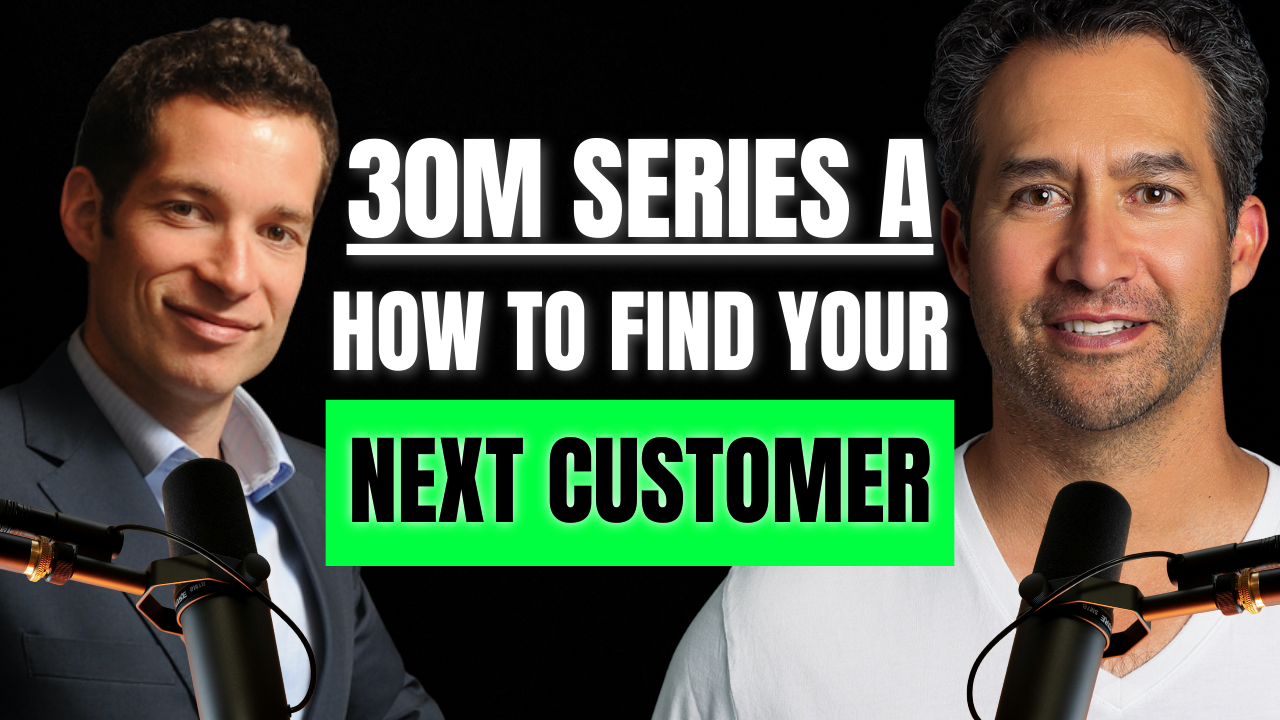
Jake Aaron Villarreal: I'm Jake Aaron Villarreal, born and raised in Silicon Valley and here to take you behind the scenes to share what it's like to be a startup founder, problems they face, the products they build in an effort to make our lives better. I'm excited to have with us today Joe Gagnon, founder and CEO of Raynmaker. Joe, welcome to the show.
Joe Gagnon: Jake, thanks for having me. It's going to be fun.
Jake Aaron Villarreal: Well, yeah, I'm excited to have you and it is going to be fun. We had a call a few weeks back and really enjoyed what you have been working on and bringing to market, and, and your background is just, you know, history of great experiences. So before we jump in, where are you joining us from today?
Joe Gagnon: Denver, Colorado. You know, Front Range, right at the front of the mountains here.
Jake Aaron Villarreal: All right. What's the weather like out there today? You gotten some snow or is it cold or you...
Joe Gagnon: You know, it's a little bit crazy. I think we're going to hit 65 degrees middle of the day. I mean, of course, it'll get cold tonight down into the 30s, but we're getting this late fall, kind of into early winter, I think.
Jake Aaron Villarreal: Yeah. Wow. I got to get out there and do some skiing here soon. Well, thanks for hopping on. For the listeners, a little bit more about Joe. He leads the company as the co-founder and CEO, Raynmaker, the company which is creating the future of autonomous sales for SMBs. A seasoned entrepreneur, ultra-endurance athlete, and author of Living Intentionally, Joe blends AI era vision with real-world grit to help founders and teams operate with purpose, discipline, and ambition.
So Joe, you got a storied career, a lot of experience, have built six software companies. Walk us through a little bit of the things that have shaped you into really being the entrepreneur that you are and really at this timeline around the transformational AI and kind of what led you to where you're at today.
Joe Gagnon: Yeah, good question, Jake. You know, sometimes sort of wonder how we end up where we did because I don't think many of us really had a direct plan. "Oh, I'm going to be this at some point." I got sort of quite fortunate early part of my career to work on some transformative technology platforms. You know, the era of the World Wide Web that really changed how retail storefronts were built. I got to work on that in the 90s, and I started realizing that there was both the opportunity to change how shopping happened, but also a bit of the resistance to, "Oh my gosh, I'm going to cannibalize you know, my storefront." And we learned deeply that it was an extension, right? Extension of the brand, extension of the customer's life. And so from that start, I started seeing that technology had this opportunity for growth, change, improvement in productivity, customer experiences. And I sort of caught the bug.
You know, the next bug was mobile computing. And oh my gosh, I built an online ordering system for restaurants. We were about 15 years too early, but on an iPad and then an iPhone, you know, in the App Store, I think we were app number 10,000. You know, we were really early. We put a Square reader on an iPad to replace a point-of-sale device. And again found that we could sort of change the experience, that customer experience of how to order food. And then we went to the cloud and we started sharing data. And so Jake, you could see the pattern formed. Like these big technology shifts allowed me to dive in and build software that changed sort of the nature of the, the relationship. I'm probably a B2B2C guy. I build platforms for businesses to serve consumers.
And so we hit AI, you know, two, three years ago whenever any of us really touched OpenAI for the first time, we said, "Oh, this one's different." Like, may not work perfectly, but boy, if we thought we did transformation before, now I think it's sort of like, you know, whiteboard. It's just blank and we can draw whatever way we want it to be. We might actually be able to deliver on that remarkable customer experience I've been working on for 30 years. Maybe surprise and delight could happen every day. Maybe we could, as we've leaned in with Raynmaker, democratize enterprise capability so that a small business owner could actually sell better. And so on and on and on. I've realized and learned that, you know, we can build software, build it into software companies, transform businesses, improve experiences, and actually have had a lot of fun doing it. So, wash, rinse, repeat. Never getting bored doing it. Loving it every day.
Jake Aaron Villarreal: Yeah. Really cool. Well, there's a lot of small business owners out there. Talk about those that are listening to this that might be operating their own organization or they could be looking to launch a company. What does your product do for them as an autonomous AI sales agent or component of their process?
Joe Gagnon: Yeah. I think if we step back for a second and think about what is the American dream and what drives the American economy, and that is small businesses, right? We got 30 plus million small business in the United States. The American dream is to start a business, run that business, take care of your family, enjoy the work that you deliver, and you know, it happens every day. Sometimes it grows into a franchise, sometimes into iconic businesses. But at the end of the day, this is people who want to run their own business. Now, when you have this dream, what you don't dream so far as I believe is, "I want to be a great salesperson." Like, you know, "I want to sell my service." But really more than anything, I want to deliver that service. So it could be house cleaning, lawn mowing, bug spraying, dog walking, whatever the small business is, and you want to be able to support your customers.
And the more you do it, the more you realize that sales are integral to what you do. And so what we realized was there was a real gap in the tech stack. You know, there's CRM systems, which is mostly post-sale or some data along the way. You got marketing systems that get us leads, but no tech really that helped the process of selling. And we sort of think of selling as this, you know, I don't know, used car salesperson thing that none of us like the feeling we're doing it. We're like, "No, no, no, no. Let's actually think about what's really happening. It's an exchange of information to empower the customer to make a good decision about a product." That's what sales should be.
And so we said, well, if that's really the essence of it, could we leverage AI with other systems, databases, and user interfaces, voice as well, to actually create, you know, a higher level, a more consistent, a more compelling, information-rich environment? So that the small business owner can then buy a lead, you know, whatever way they get it from their website or from Google or wherever else, pass that lead, whether it's a phone call or text message to our Raynmaker platform. And the Raynmaker platform would then have that conversation with the consumer. And the consumer would get all the information they want. And at some point you would say, "Well, can we take your order?" And the person says yes. We could actually real-time schedule that, in real-time take payment, summarize that data, send it to the owner so they could actually deliver the service. And this could happen... the autonomous piece is that there isn't a human in the loop here. We have no sort of backup plan, but that's because, well, we don't need one. We can deliver a more consistent, higher level, information-rich sales environment for that small business owner. So, that's the essence of what we're building.
Jake Aaron Villarreal: So, you know, and sales has got multiple different steps in it. Some are, you know, a two-step, a four-step, more complex. You're selling to Congress, you know, you have multiple stages and steps. Are you talking about the type of sale where, like you talked about, you go out, you buy your leads, or you have inbound coming in, and then you're listening to what the customer's questions are, and you're, you're able to give them answers to what your product or service does and get them to commit and give you a credit card or send in an order, however it works? More the inbound side of the sales?
Joe Gagnon: Yeah, actually, we do both inbound and outbound. I think the idea of outbound, that concept, I'll explain in a second, is going to go away. That is a result of constraints, not good design. But on inbound, imagine you wanted to eliminate mosquitoes in your backyard. You know, you got your kids, you're going to have a big birthday party, I don't know, whatever it is. You just don't want mosquitoes. You go find a pest control company. You go on their website. You got a bunch of questions, you can't figure it out. So, you do fill out a lead form. You can call them if you want. Get someone on the phone.
So when that phone rings, it would come to the Raynmaker platform and we would have a normal conversation with that person. Because what we've done ahead of that is we've taken all of their web content, all of their sales content. We've married it with our workflow methodology on how to sell. We understand how to make offers. We understand the nuances of objection handling. We understand the sentiment and the feeling of this consumer. And so we have this active dialogue. Now, there are some people who might know it's an AI and some people will be like, "Wow, this is just a good conversation." It's as if you're talking to a person who's very experienced at selling, like the owner. I mean, you can even change the way the voice happens and the tonality and the speed of the conversation back and forth to make it work to the way your brand works.
But effectively, you're trying to then answer for Jake a question like, you know, "Well, I have two kids and a dog. You know, will anyone, you know, be affected by the, the bug spraying chemicals that you use?" And the agent would say, "No, it's actually organic. It's been tested. It's proven that it doesn't have any effect." You say, "What about my neighbors?" It would be able to answer that question. You know, "Well, I have a pond. Do I have to worry about the fish?" You know, so it can take any of the normal objections that someone would have and at some point you have all your questions answered and you would say, "Look, the service is $149 a month. Would you like to buy it?" And you'd say yes.
So that whole conversation now we could switch over to house cleaning. We could switch over to whatever we change when we do the onboarding of our customer. They answer some questions. We consume all their content and we create a custom version that leverages our... we call it the "Rain Brain," which is basically our knowledge of how to sell with their data, with the AI technology. And together we're basically creating your best employee. And so it doesn't really matter what's being sold. Even the most complex, as long as the information is available, we can consume it and make it available to the conversation.
Jake Aaron Villarreal: Yeah. Well, there's a lot of different routes you can go in many different small business areas that, that could use something like this. What, what are the surprises that you didn't think about that you could apply this type of solution to?
Joe Gagnon: Yeah. Well, I think first surprise, which is what the entrepreneur... like, you know, look, the entrepreneur has to be intentionally naive and intentionally curious. You can't think about reality. If you think about reality, you'd never be an entrepreneur. Like, "I can make this work." So, this is a rather complex tech stack. I mean, we have an orchestration layer. We have a knowledge base. We have our LLM, we have a tuner, you know, we have a voice-to-text, text, text-to-voice converter, we have APIs for payment and scheduling and CRM. All this has to sit in the cloud and it has to work in real-time. So, first we underestimated how long it would take and how hard that would be to build. Nonetheless, we still built it in the matter of seven months. So, very difficult, hard to replicate and then a lot of testing.
The second is of course you would expect the same reaction that you would want. Like some [snorts] people like, "Well, I don't want to talk to an AI and I don't want to use an AI. I don't want to do that voice thing." Like look, we're not here trying to tell someone how to run their business. We're just trying to tell you how you could improve how you run their business with technology. You know, I don't know. You could pay with cash today. You probably won't pay with cash for the next rest of your life. You know, we like tap instead of swipe. We like all... like as tech moves on we get more comfortable with it. So we're learning where the discomfort is.
We're also learning that someone says, you know, "I have a business in the southeast. I'd like a southern drawl so that someone feels comfortable." We try it out and then they're like, "Oh, I really didn't want that. That slows down the conversation. Can you give me like a, a white female who lives in Ohio who's 30 years old?" And so we'll give that voice archetype. So we're learning there and then [clears throat] there's a lot of integrations. People already have systems. We got to fit in the middle of that. So it's another part of the learning exercise. We started building this back in April of this year, '25. You know, we have a hundred customers up and running today. We should end with you know thousands by the end of '26. We're learning all the time. And you know we don't mind the complaints. We don't mind someone says "I don't want to do this." We, by the way, Jake, there's a couple things I'll tell you in a second, but we don't hide that it's an AI because we want to be transparent. We don't have a human in the loop, but we will pass data to the small business owner if they want to follow up. So, we make sure that they don't lose any leads or opportunities. It's just we don't run a call center that you could transfer to if you didn't want to talk to the AI because we believe the AI is better.
Jake Aaron Villarreal: Yeah, makes sense. So, I don't know, if I'm a mechanic or I'm selling tires or I'm, you know, in a small service sector that I have inbound calls or I have leads that come into me or we buy leads. This sounds like a solution that if nothing else should be tested and you could measure how is it working with AI and how is it working without AI. The question I think a lot of companies might have is what does it take to implement to... I mean, I don't have a technician on site. How easy is this to start to use, to try? Is there an onboarding timeframe that they need to commit to? Like how does this work?
Joe Gagnon: Yeah, that's a great question. We have actually three versions of the platform. One is we call Raynmaker Answer. If you're not ready for the payment and scheduling part of this, it can actually answer all of your calls or be off hours or weekends. Not just take the data, but do qualifying questions and do a great summary for the owner to follow up. So, it's a good way to sort of get your feet wet. You know, you're not taking a lot of risk. It's doing some work that makes your life easier and our qualifying questions do help.
The onboarding is relatively easy. We have a form online. Someone fills out the form. We get the data we want, and then as I said before, we consume their website. You know, we actually go through it. We go through what's in the public world around reviews and information. So, we get more knowledgeable. There isn't a lot of technical skill required. There are... sometimes people don't know how to answer a question. So we're... have a team of implementation specialists who do help get that going. So in the beginning it is a little bit of like, "Oh wow, that seems like a lot." But once it's up and running, it's sort of pretty much when we say autonomous, it's not just autonomous, you know, it's self-correcting. We do recursive learning, so it learns as it goes and it improves.
So if you just wanted to get into it, it's a couple hours at most, would bring you up online. And we can put Answer in place if you feel more comfortable and you can start with one unit like if you were a multi-unit location. Then if you wanted to move to the next level, we would add payment in there. So you get someone to the point where they pay, want to pay because they're going to buy it. We would send a Stripe link, secure way to take payment, and then the person would pay and then you could follow up with scheduling. And then if you want the whole platform: payment, scheduling, the APIs, all the connectivity, then that's the third one. And so we make this easy for someone to get in, start with a few, start with maybe the, the early entry product like Answer, and then grow your way into it as you become more comfortable and your customers become more comfortable.
Jake Aaron Villarreal: Yeah. Well, a lot of companies in this world of AI have different models. Some are an easy-to-use subscription, some are outcome-based, some are, you know, revenue share-based. Like what's your, what's your model?
Joe Gagnon: You know, when we made the commitment to go after small medium business, what we realized is that we have to have a pricing model that's really simple for them to understand and is not a big financial burden. So, the Answer product is $149 a month. You know, you can't do much more for $140. [laughter] The, the product that has Answer plus payment is $695 a month, and then the full-blown "everything" package is $995 a month. So, if you thought about this, even comparing to a part-time person, it's still at the top end less expensive. And we did that on purpose. We did that on purpose because we want to enable the small business owner to lean in.
Look, you know, Jake, you know this. You probably talked to a lot of people on your podcast who selling to big enterprises, Fortune 500. They're doing multi-million dollar deals and all that kind of stuff. Sure, this platform can grow into that. Really, at the end of the day, our commitment is to the business owner who wants to achieve the American dream of owning their own business and not having to sit at a soccer game watching their kids, but their phone is linked to their ear trying to talk to some new prospect or a customer, you know? So that is why we're going after this space because it's to be honest, everyone ignores it. They're like, "Well, it's too hard. It's too difficult." They're like, "Yeah, well, we're going to go right at it."
Jake Aaron Villarreal: Yeah. Well, I know that you wrote in your book that, you know, the bison runs through the storm, which is not always the easiest path, but they get through it. And it sounds like you're taking, you're eating your own dog food and taking that same approach going right at it.
Joe Gagnon: Yeah. The book and, and pulling out that... yeah. You know, I love the bison. It's like my spirit animal. They're the coolest. Like they, the most powerful animal that's also the calmest, you know. Just don't mess with them though, right? Then they can run like 30 miles an hour, 2,000 pounds. They are like wild. They also just out there eating, staying in the wilderness, just loving life.
Jake Aaron Villarreal: Yeah.
Joe Gagnon: But yeah, they do. They, when a big storm comes in on the plains, they just walk right through it and then before you know it, it's clear sailing.
Jake Aaron Villarreal: Yeah. Yeah. I love the bison, too. Well, you've done 10,000 AI sales calls since summer.
Joe Gagnon: Yep.
Jake Aaron Villarreal: What, what, and maybe you already hit on this, but what's one thing that it taught you and you were somewhat surprised on, prior to planning out what you expected to hear or see in your system?
Joe Gagnon: I think there is some, I think right now most people know they're talking to an AI.
Jake Aaron Villarreal: Mhm.
Joe Gagnon: So, I've been a little bit surprised by how they don't get bothered by it at all. Like, "Oh, you know, the truth is I just need information." Like, "Yeah, doesn't matter." We thought we'd get more objections. We thought we'd get more hang-ups. We get some, you know, there are people who just don't want something some way, but no one's here to tell someone how to live, right? So, that I would think we were surprised at. Um, the variability is not that great. There aren't that many objections in a specific domain. There isn't that much information in, in the information systems world, right? Like this is not, there's not millions of objections. So that's allowed us to get better at objection handling. I thought there would be a higher variation. It comes back to very common ways of doing it.
And I think that the, the cadence and the bantering that goes on, sometimes people just have fun talking to it. So I didn't think that would happen. On our website we have a, a... Rex is the name of the agent, our AI agent. And so we have a recorded phone call for a dog training customer of ours. And he, we gave him the San Francisco vibe and he's got the sort of lowkey, you can figure this guy's riding a skateboard after work. And it's fun to listen to the conversation because you get a real sense of how after a little while they don't even know this is a human and AI. It's like it's about my dog and it's about my life. And so that has been really fun to see. Like you just lose track and it's really been a bit surprising to be honest.
Jake Aaron Villarreal: Yeah. Well, I think the more that we hear and learn about AI, the more we're accepting what it can do for you and the benefits and just really trying it. I mean, I, like many entrepreneurs and owners of businesses, have a business coach. And it's great to, you know, understand where your blind spots are and, you know, strategize and work on different parts of the business. And then you know, an AI coach was introduced to me by them, by the organization. And quite honestly, it is so good it almost makes me second guess like, "Hm, do I need to keep my coach?" They're part of the same organization. And it's very, very good. And it, you know, it's an AI but it also gives you the answers that someone can give you that maybe you don't have a scheduled time to talk. And right, there's some complexity that maybe you can dive deeper, and it learns you. And ultimately, you know, that's an industry that could be disrupted very easily if the technology continues to evolve.
So I wouldn't, just for my coach, I'm not going to leave you because of this, but you know [laughter], it's definitely, it's getting really, really good, you know. The voice, the tone, the understanding, the empathy, the direction, take action with a certain assertiveness. So things are changing. I, I think if that, you're transparent about it upfront, yes, it makes it even easier because you know what you're getting into versus you feel like you're being conned, and now you don't want, now you don't want to be part of that. So yeah...
Joe Gagnon: You know, Jake, I was mentioned this before when we started the company. I wrote the, the Raynmaker Frontier Manifesto. I wanted to sort of tell people in the company, out in the world what we believe, you know. And it's a lot about what we talked about, you know, democratizing capability for small business owners on down. But the second document that I wrote was the Raynmaker Constitution. [snorts] And so this was a set of principles and ideals that we were going to follow in a world where people do feel somewhat uncomfortable with AI. We wanted to assert that we're here to inform and not to manipulate. Right? We're here to change the idea of information asymmetry which happens in sales and we're here to ensure that the person has the information that they need, that it's represented properly, and that there's no manipulation.
So this way, through our observability layer and the Raynmaker Control Tower, we can show someone that what we're really here to do is to best represent your product so the consumer can make a good decision and feel comfortable doing that. And [snorts] so that was our commitment we make to be transparent but also to be principled, to say we understand and, and accept the way people think and so what would you do about that? By the way, it's harder to implement this kind of constitution for humans than it is for the AI. And so when we wonder about it, actually I wonder more about like the training that we've given to people and what they do. Why someone, why do people feel uncomfortable with salespeople like generally? And so there's some root cause. We're working at that because at the end of the day, what this system should be about [snorts] is presenting the best information for that service or product to a consumer who wants to buy that service or product so that they can make a good decision to the benefits that they would get from having that. That's really what sales is about. It's not about manipulation. It's about informing so I can buy what I need. That's what we stand for and that's the way we run the business.
Jake Aaron Villarreal: Well, Joe, you might be the first leader of a company I've spoken to that actually has built a manifesto for the company and how it operates. I think the other one I could think of is just in story is Jerry Maguire writing a manifesto about [laughter] his beliefs and values about an agency and about how to, how to operate with candor and at the same time with values. So, it's really cool that you did that. You know, you, you said that the curio... you, you, you, you operate with the curiosity of a 5-year-old, the energy of a 25-year-old, and the wisdom of a 75-year-old. What does that actually look like in practice when you're building in the age of AI?
Joe Gagnon: Yeah, I think that first it starts with like, "I'm going to try it myself." You know, I actually just recently built the Raynmaker Sales Assessment tool. I didn't ask someone on the team to do it. I'm like, "I wonder if I can do this." And I figured out a way to do it, you know, to consume content, to have a prompt that can actually give us some good insight. I think that, so it starts with initiative and an intention. And so that's how I show up every day. I don't show up with either delegate or, you know, boredom or drudgery. I've, I've started each day with excitement, you know, and, and I want to do more. So that's what I start with.
The second is learn by doing. You know, learn what these tools can do. Find out, find both the edges and the depth. And the more you put into it, the more you get back. And then I think it's about communicating that to the rest of the team so they bring the same kind of insight and energy to what we're doing. It, truth is like my engineering team is less than 10 people. The last company I ran, it was 90. We're getting more done with 10 than we did with 90 because we're AI-enabled, building in an AI world with this kind of both curiosity and intention. And so that's what's different and new and that's what's exciting. And there's no age. It doesn't matter if you're 22 or 70, right? Doesn't matter across that spectrum because what we've done is we've changed and put better tools in everyone's hands. So you don't have to only be the person working for 25 years to be able to do something. And I'm having probably the most fun that I've had. It's why I keep writing and doing this. You know, we're changing our own lives and the lives hopefully of our customers and our customers' customers.
Jake Aaron Villarreal: Yeah. Well, I know you're diving pretty deep in not just building the company, but also, you know, you're working with a behavioral neuroscientist and forensic linguistic linguist to interpret the emotional state of the buyer in real time. It sounds like science fiction. What does that actually mean for closing a sale on a lawn care product or service or pest control service? Walk us through that a little bit.
Joe Gagnon: I think that, you know, if you, if you step back, right, the way we operate as humans every day, the predominance of what we do we don't think about, we just do it right, you know. But I think of three levels. You know, we got instinct. Like this is the basic needs that are met, like we know how to eat, we know how to do all those things, right? Then we have intuition. This is sort of the non-conscious thinking that we do every day. We don't think about it, but we sort of have a good sense of it. And then there's the insight, you know. This is derivative knowledge, [clears throat] experiences we've had, you know, they're very explicit. We know "don't put your hand on the stove," for example, or "here's a good technique."
So, we take that model and say, how do we build instinct into the system? That's our workflow. That's the foundation. It's actually how selling happens. On the high end of this, the intuition... the insight is very explicit. It comes from all these years of experience. The intuition part, we don't really sometimes know why we're doing what we're doing. You know, Jake walks down the street next day and he's like, "I'm not going to go down that alley. There's something..." like you've been thinking about all this stuff, but just not consciously. So, when you're in a selling opportunity and you're talking to a consumer, some of their intuition is clicking in.
And we believe that there are ways to start to get at how they're feeling and fill in. So the brain says intuition is a bunch of thinking that went on without conscious knowledge. But once you get more information, it turns into explicit knowledge, something you can act on consciously. And we think if we can understand your sentiment through things like how fast are you talking, how many pauses do you have, you know, where do you stall, you know, how does the emotion come through? So this forensic linguist is helping us through the way that you can tell through intonation and speech patterns where someone is in this sort of emotional intuitive cycle.
From that, we could then very explicitly bring more content or empathy to the conversation and then we make them more comfortable in their decision because sometimes you don't know why you don't decide. We're going to try and help you figure out why you can't figure it out and make it easier for you. So, we believe it'll help conversion rates for our small business owner because we're listening with a very different ear in the AI system than even the human can do. So, it's some of the real innovations we're working toward, is to change the dynamic of how this conversation happens and how a sale gets consummated.
Jake Aaron Villarreal: Yeah. Well, unlocking the unknown when it comes to the sales process, I think has been worked on for hundreds of years. If AI can help unlock that now in a very short time, it should open the floodgates for companies looking to, you know, use AI in, in a way that can truly help them that's data-driven and not just guessing, right?
Joe Gagnon: Yeah. While there might be some pretty funky ways to describe what's really happening in energy systems like that we can't see or know, it's better to just say, "Look, the end of the day, there are patterns. We see the patterns and then we act on those patterns." It's not that dissimilar to what a doctor would do, right? They don't always know exactly, but they've seen a pattern and they say, "Oh, that looks like this. Let's do that." And so, the more experienced, the more you know that, the more calls we listen to, or the more that we're engaging with customers, the better we get at that. And that's different than we can do with an employee. By the way, whoever is a call center employee. What if they leave? They leave with all that knowledge. We don't share that across everyone else. Here, we're going to be able to create a long-term knowledge base that is very specific to this customer so they can leverage it and build off of that.
Jake Aaron Villarreal: Yeah. Well, pattern recognition is such a key strategy for companies that are growing. I mean, I know you've had multiple companies, so I, I, I'm sure you've used that strategy in different ways. Now with AI, it's just making it easier to identify what you should be doing, what you shouldn't be doing, and how you can optimize your company in all, in all facets. But sales is such a key area and go-to-market. We're seeing, for companies across the board, spending a lot more money on tooling with AI to help their go-to-market teams whether it's on the sales side or the marketing side. And to have something that is truly autonomous where it's no human in a loop is, is fascinating to me.
You know, one of the highlights in our previous call when we were kind of leading up to this podcast was what you shared about going out to an end-of-life trade show for funeral homes and cemeteries, right? That's not an obvious market. What did that experience teach you about where this technology fits in ways people aren't expecting?
Joe Gagnon: Yeah, I think that everyone would say, "Boy, that is a time where massive empathy is required and only a human could deliver that." But the more we talked to people who run the businesses, the more they said it actually is a moment that is very awkward regardless of the empathy, and the consumer who just really wants information. While they want respect, this, they're not looking for what we think they're looking for from the funeral home director. They just say, you know, it's like, "This is reality. You know, what does a cremation cost? What does a casket cost? How many days?" It is an information exchange in a very difficult time and the AI can actually work better and more consistently than the people who actually run the place.
And so what we found is that they really like the idea of both and... and by the way, we can build a lot of empathy into the dialogue that goes into the knowledge base. But what we found so far is that there are some of these use cases that are somewhat unpredictable where we think only the human can work. But maybe we've told ourselves that story and maybe that's actually not really the truth of the matter, because if you're on the phone crying, like, do you need a person? Most of us don't really, really do that with another person. So this is a way to more consistently, with the right level of feeling, give people what they need. And so I think you're going to see... but I also didn't know that, you know, there were big roll-ups of funeral home companies in the country. You know, 100, 200 all connected together trying to build some systems to make them operate better. So yeah, there are many more like this I think, Jake, which we're going to be surprised by.
Jake Aaron Villarreal: Yeah. Well, I'm excited to see what happens in the future with Raynmaker. I think it's a platform that if you're a business owner at any level, you should be looking at. I think that the kind of a dream for any operator is, can I use systems that can run my company so I can go on vacation more with my family? Can I run systems that can help us think more strategically and free up our time to focus on areas that maybe are more impactful to the business? I think there's going to be more of this coming whether it's on the sales side or the marketing side or supply chain, financial, lots of agents, lots of operations that will be impacted with technology but also with human in the loop. But moving forward, human not in the loop I think is ultimately where a lot of, a lot of focus is going to be going.
Joe Gagnon: Yeah. There's two things, and I think you, you're spot on. One I'd say is like, every one of us would like to have more resources, and now with AI we get more resources which makes us operate better. And then secondly, it goes back to the reason I started a business, a small business, is I want to focus on delivering a service and building relationships with customers. And to do that, you need to be more effective because time is limited. And so if I can do that, then it is a very satisfying life experience. Gets back to that American dream, which is really hard when you're resource limited and you're time constrained. And so that's what we should think about AI as doing, which is, you know, the farmer who used to have to dig the ditch with their shovel, that went to the plow, that went to the mechanized tractor, that went to the satellite driven, you know... it changed how they were able to work and how they were able to live. And I think we're going to be able to do the same kind of benefit for all small business owners. And we're excited to be part of that journey.
Jake Aaron Villarreal: But Joe, yeah, I, I agree with you. But I also, I want to give you sort of accolades for having the courage, because you're building, you know, in a contrarian way that, you know, some are "Hey, we want the human in the loop," and some are "We don't want the human in the loop," but there's a clear path for the business and we're excited to see your success. So if anybody wants to find you or wants to find Raynmaker, where do they go?
Joe Gagnon: Yeah, so we're on the web of course at raynmaker.ai. We have a YouTube channel and an Instagram channel so we can share some of the videos of the stories that we're telling. You know, for me, if you're ever curious about my writing, I write a daily blog on Substack at Joe Curious, which is sort of a good name for me. And then my book, Living Intentionally, is on Amazon. And I would appreciate any support there. And you know, I just offer to everyone, engage and embrace. Make it the way you want it to. Don't be afraid of it and then magical things will happen. AI is an enabler. We're not going to be pets of robots. We're going to just make it a better world, sharing the abundance that is around us and make for the life that we all sort of had dreamed of with our American dream.
Jake Aaron Villarreal: Yeah, that's beautiful. Joe, thanks for coming on. Look forward to seeing what happens in 2026 and catching up with you then. And for the listeners for listening, it means a lot to me you spent your time with us today. I'm your host Jake Aaron Villarreal signing off for now, but can't wait to catch up with you all in the next episode. Until then, Joe, the world, take care. If you like what we're doing, don't forget to subscribe, leave a review on Apple Podcast or wherever you listen, and follow us on YouTube where we go behind the scenes to learn what it takes to be a startup founder.






















.jpg)












.webp)



.webp)
.webp)
.webp)