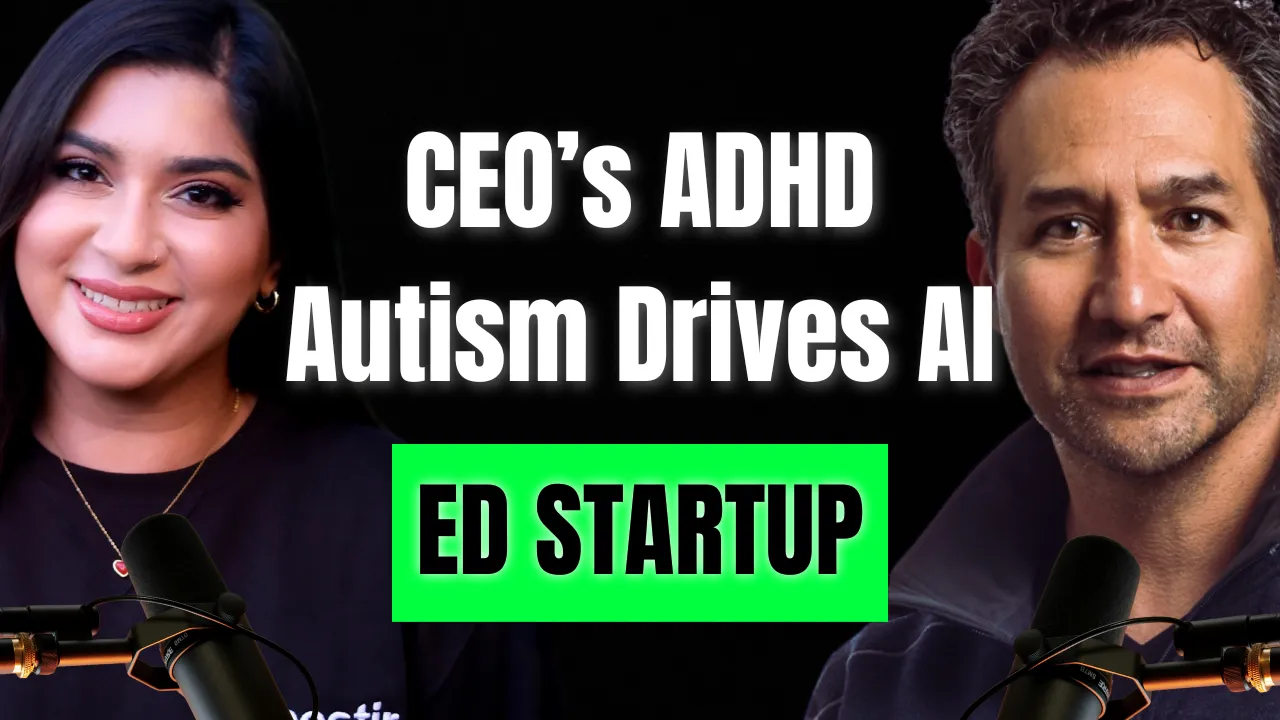
Jake Aaron Villarreal: I'm Jake Aaron Villarreal, born and raised in Silicon Valley and here to take you behind the scenes to share what it's like to be a startup founder, the journey they're on, the problems they face, the products they build in an effort to transform industries. I'm excited to have with us today Christina Lopes, the co-founder and CEO of FidoCure. Christina, welcome to the show.
Christina Lopes: Jake, it's a pleasure to be here.
Jake Aaron Villarreal: Well, I'm excited to have you here. It's uh, oftentimes we're focused on companies that are building technologies that help in industries in manufacturing and different components of AI. Uh but what you're building has a human and a pet feel to it and we'll walk into exactly what it is you're building. Uh for the listeners, a little background on Christina. She's not only the co-founder but leads the company which is a platform leveraging AI to personalize cancer treatments and develop drugs for dogs. A World Economic Forum Young Global Leader and Inc. Magazine Top 100 Female Founder, Christina has expanded FidoCure to over 1,350 clinics globally, treating 5,500 dogs and more. Christina, great background. Can't wait to get into your story here. Where are you joining us from today?
Christina Lopes: I'm in Palo Alto, actually. So, joining you from the heart of Silicon Valley.
Jake Aaron Villarreal: Hundreds of AI startups are launching every month, battling to build their founding teams. As a leader, your job is to get results. When it comes to hiring, that's where it gets tough. So, you go out and you try a recruitment firm, but they don't understand your story. They're off target, and when they send you candidates, it's a waste of time. We believe you should never have your time wasted. That's why we launched Match Relevant, because your story is more than just an open role. It's your founder's journey, the problem you're solving, the product you're building, and why it matters. When we work with companies, we make sure we understand your whole story. So, when we go out and do a search, we're on target, it's worth their time, they're interested, and more importantly, it's worth yours. And when it comes to hiring engineers, we work to make sure we get it right by deploying a team of seasoned CTOs that have built some of Silicon Valley's best companies. They can collaborate with you in the technical interviewing process. They can be a sounding board, or they can run it for you. When it comes to building teams, there's no time to waste. Let's make it count. If you have a role that needs to be filled, book a time with a hiring guide at matchrelevant.com and learn how we do it.
I love it. I'm from there, which is why we have the title of the podcast and excited to to have you join. Where, where are you from originally?
Christina Lopes: So, uh unlike you though, I'm not born in Silicon Valley. I'm I'm adopted, call it. Um, I was born actually in Brazil, so quite a ways away in a very remote town, um, in the mountains of Rio, but in the middle of really nowhere. So, um, so yeah. So, and I've lived also in the east coast of the United States, but, um, I'm not from around here.
Jake Aaron Villarreal: Gotcha. Well, welcome to the West Coast. I know you've been here for some time. Um, give us a little background of your origin story. How did you get into technology, into the space that you're focused on today? And just in general, walk us through your background. Were you the, the, the little girl that had the lemonade stand on the corner growing up? Were you always looking at building opportunities for yourself? Walk us through your background.
Christina Lopes: So, um, that's a great way to frame it. Um, so I was in Brazil growing up and Brazil had actually become financially a failed state. So there was hyperinflation. Every day prices changed. There was a lot of economic instability. Um there was the first democratic elections. The president like died the next day. So it was just a really tumultuous time. And so I actually immigrated to the US just with my mother, and to Massachusetts. And we were literally the poorest people in my whole town. It was like a town known for the like, soccer mom. Like we didn't have a car. So it was, it was pretty drastic.
Um there was obviously uh much more of a stable environment for sure. But already coming and being an immigrant very early on uh already gives you huge, how do you call it... like vantage point, right? And my mom was actually Irish. So my parents met in the MIT ecosystem in the '60s. My dad from Brazil, my mom from Ireland. So even in Brazil, I had already been quite different, you know, mom with red hair. Um, so kind of the origin story is I always had a perspective that maybe was not the status quo. So if you think about conventional thinking leads to conventional everything, I definitely was not conventional from the start. Uh, my dad was a quantum physicist. He had abilities to explain things in, you know, the um Einstein like, like from the point of view of a very, very theoretical physics. He left notes for me to clean up Barbie dolls in computer code. So it was a very unusual kind of upbringing.
Um so that all gave me this concept of not being housed, right? So if you're very, you know, settled in one place you kind of think the world is this way, you might not have an idea of a possibility. But when you've seen different ways, different values, and I traveled a lot, you know, different things are possible. And then you layer on that that my dad was quite intellectually... you know, the life of the mind was very alive, um coupled with, you know, the real struggle, the real economic struggles in Brazil, but then as an immigrant. So all of that kind of fueled a passion for building, for creating something better, but always that mission that it, it, it can't be this way, like it must be better. And I don't know if I would have had that uh conviction if I hadn't seen different worlds, different countries, different cultures do things in different ways. Does that make sense?
Jake Aaron Villarreal: Yeah, I like that word conviction because we hear that a lot when we talk to founders about the companies they're building, but it's also from the upbringing that they have. And if you have conviction, oftentimes you find a way to get things done. And you also find a way to lead where people will follow because they believe in your conviction of a product or a service or a mission that you're on. So that to me is a really good word that you, that you brought up. You're from Brazil. You come to the US, you've got into building the company you have today, which is, you know, AI and technology and data. What was the path to getting you on that trajectory of building what you have today, but also, you know, the startup world? What is this your start, first startup or do you have experience as leaders?
Christina Lopes: I am a first-time founder. No, I am a first-time founder. So, um, so I'll back up a little bit. So my first kind of like, let's say foray into career was more in emerging markets finance. So that same mission and conviction of "we can bring technology, we can bring capital, we can bring people right ideas and we can actually like be very um into improving," right? Like it's the state of the world, the state of people's lives. So I always always worked on on that side and coming from, you know, a place I had a financial issue, I was very finance-minded.
What I started to learn was I was very intrigued by companies and building companies and kind of the whole, that whole aura. And I had a streak in me that was this thing that was more entrepreneurial just in terms of energy and desire almost like kind of that um, a type of just a just like a proclivity. I had it more than the usual person working in finance. Um, I was very large funds and had fantastic opportunities, but I would go a next level that wasn't super usual.
In that journey uh, I started to get more and more into healthcare. So I served on the board of Planned Parenthood for the entire Western Hemisphere, 30 million health services.
Jake Aaron Villarreal: Yeah.
Christina Lopes: I was very big and it was a very like um, it was an unusual opportunity. I was very young and I really took it like with a lot of responsibility. So I started to get very intrigued about healthcare and I started working on deals in the healthcare space because I've been a generalist and once you start getting into health, you, you know, it's like, it's like you can't go back. It's amazing. Um, I didn't think pet healthcare yet though. That was like way out there. Uh, but you'll get where I'm going, where I was actually heading Cerberus Capital, a very big uh private equity fund. I was actually heading it for Brazil and Latin America in Brazil.
And my dad sadly got cancer and I had had pet dogs with cancer. And what struck me, which was very like an unusual, what looked to me very obvious but it's definitely not obvious, was wow, both get metastasized, both, you know, like the cancer is bad, but it might be chemo and radiation that kills them. Coming from not oncology and like the establishment, call it, in US healthcare, I was a bit shocked uh frankly. I was like, this is not a broken market of, you know, like why, why don't the... why aren't there better drugs? Why don't, aren't they getting to the last mile of care? Um, and I'd always worked again in developing countries, right? And so I had seen when there's a lot of resource scarceness, and I'd worked a lot in that. It was shocking to me that such a like, well-funded, you know, oncology uh space would have still such lack of uh progress, quite frankly. So I thought it was a market failure.
At the same time, Joe Biden was actually releasing the Cancer Moonshot. He was Vice President at Davos, at the World Economic Forum. Because my dad had cancer, I was like, "I'm going to go, I'm going to find who, who are the best people." So I went and uh I spoke to him and actually I spoke to the person who headed the Moonshot and I surfaced this crazy idea of like, if data... they were very focused already on data. This is 2016 like, the I think around 2016... the lack of data and data integrity and data connectivity within healthcare so that you could use longitudinal medical records to glean insights, important insights, and they were already quite into that. Um so I started to learn well, if there's a lack of data and there's HIPAA from a tech point of view, which is a friction for you to really understand right. Um, of the, well, pet dogs, um, you know, they don't have HIPAA. They get cancers. The cancers I think are similar... I'm not an expert, but you know, now I am an expert, but I was not... and you know, could there be a world in which we really reimagine animal testing entirely into something where we help pet dogs, could be other species um, that develop a disease naturally? We learn, but what we're looking for is what works and then we help humans with that signal.
And it was this whole concept of radical reimagination because traditional animal testing, you take lab animals that you, that are healthy, you... it's quite nasty. You induce disease. It's like very bad and you don't even produce good data. It's not predictive. So I was like, "This is a crazy idea." Uh, I was surrounded by some veterinary folks that were also kind of guiding me uh, very close folks. So um, you know, concurrently at the National Academy of Medicine, there was a special meeting you know, as, as things go and weird ideas sometimes converge. There was a top meeting happening about, about this like comparing species in oncology. So cross-species, leveraging evolution almost. And I went to the meeting and basically everybody at the meeting is somehow on my team like, long story short. So I thought, "We're going to make a company." I was, I was very encouraged and then I got into Y Combinator under Sam Altman and that's how I went, came. So basically it was like boom, boom, boom. And then, you know, in Y Combinator being part of let's say a first vintage of folks really thinking biological data sets and what does that mean. But I'll stop there because that was very long-winded, but I hope interesting.
Jake Aaron Villarreal: Yeah, no doubt. I mean, I think the fact that sometimes you don't know what problem you're trying to solve until you start to research what the industry currently does and is there an opportunity to do something different. And I think those are the best solutions or the best companies who really see that, look at something and reimagine what it could be. But there's a lot more to build because it hasn't really been done before or you're trying to figure out how to go and kind of build the plane as you fly it. So, I think that's, that's amazing that this is your first startup and that's an idea that's really an incredible innovative idea to think about trying to to create. So, Y Combinator is great building blocks of how to look at trying to put a company together and to build it and to get funding and all those things they teach you. Um, when you started to put the company together and then you had to go out and build it, did you bootstrap? Did you go out and get funding? Where are you at as a company today?
Christina Lopes: So, we have raised $25 million. Um our biggest funder is uh Andreessen Horowitz, the Bio fund. And uh we obviously have YC. We also have Polaris out of Boston that led our last round and um and we also have amazing, a couple of other amazing funds involved. Lerer Hippeau in New York and then Tao Ventures and here in Silicon Valley and, and a few others that are, are just been amazing. And um, so we did not bootstrap. We had funding, had funding, you know, you kind of create it, we had a pre-seed um, then seed, then Series A, and we're in our journey for our next, our next, our next guidepost.
Jake Aaron Villarreal: Yeah. Funding. You know, I always thought that there would be an advantage if you came from the capital markets or you had experience in private equity or at a VC firm before you start a company because you kind of know what you're looking to hear as you invest in startups. Do you feel like that gave you an advantage of when you brought your idea to the table and then went out and presented what you were looking to get in terms of um funding to the VC market?
Christina Lopes: It's a, that's actually a great question. I had even helped run very cutting edge IPOs like multi-billion dollar IPOs and I was like part of the team like in the frontline of the IPO, like you know pitching um. And this was a little different actually. So I understood at a big picture. I'd never been in very set categories right. So I was always in category creation by being in emerging markets and working with developing countries. It was never like, "I did AT&T," you know, I just didn't even know what that is. I was doing like securitizing microfinance, Climate 1.0, you know, cutting edge technologies that I would be very creative on the structuring of how to fund them. And I was bold.
The difference, the difference and why YC was very helpful to me here is Silicon Valley has a different language. It's like a different, you know, each place, if you're going to raise money. So one thing is Wall Street, New York City. Um, but Silicon Valley has a different, like there's a different way. There are different things that are attractive and even that's changing. Maybe what was attractive a few years ago is the same thing now, right? So you kind of have to immerse yourself in that, whatever is the language of excellence in that place that you're at. So I would say it helped me um understand that, but it didn't close the gap of like how you shape a narrative um in the most compelling way to speak to the hearts and minds in that realm which is more like Silicon Valley. So that was a hard um, and it's also very interesting because I found it was very um, it wasn't like a world you could easily access. It was hard to figure out.
Uh YC was very helpful, very helpful. It's almost like a machine of that, you know, to learn how to... we spent an extraordinarily long time on the sentence, few words of what we do. Uh high emphasis on communication, clarity, and then definitely on the short pitch. So, so YC was very good. Like I I I I was already a mother, first time founder. I had little children. It's at night, in case people don't know that, you know, sometimes I had to bring them.
Jake Aaron Villarreal: Yeah, I know.
Christina Lopes: Yeah, I was that one. I was a very different one. But you know what? I loved it. So, so YC was very helpful in that. But I noticed now, as we're evolving, and as the... and I'll talk maybe in a moment about the humanization of pets. This whole world which I was part of, part of the system, has become a category itself, a very actually attractive category. Um, so as that's happening and I'm spending a little more time in New York and I'm talking now back a bit more with the folks, my later stage folks, I'm seeing, "Oh wow, no, no, no. I I could I could do an IPO. Like I could take this to NASDAQ." But so I would almost say this mile is becoming easier for me, not harder. So the early early one is is uh is is a, for me was more challenging.
Jake Aaron Villarreal: Wow, that's interesting. Well, I want to talk a little bit about the category you brought up that you kind of helped shape, but let's go a little bit deeper than that. What's the problem that you're solving today with the problem? And what was your thesis that you said, "You know what, we can actually build something and we're going to use AI and we're going to solve this problem or help move an industry in a certain direction." Walk us through what that is.
Christina Lopes: Yeah. So, as I was saying, right, initially I was like, "Wow, there, there's just got to be better medicines, quite frankly, for cancer." I mean, I just couldn't, I almost just couldn't believe it. So, I learned that there was a data gap, a very large biological data gap. You know, you do all these podcasts, you know, Gen AI for example, many images of, I don't know, an airplane, right, on the internet. When it comes to biology, it can be in the bio space, it can be climate, the data sets don't exist. They really don't. It's actually very archaic. So uh there may be a data lake here and you think, "Oh, if you, if you glean it with this other one..." No, it doesn't work that way.
So if you want to solve very important biological problems, I would argue, and leverage AI, we were lucky to be Day One fit-for-purpose. We structured everything such that we could have voluminous structured data that's well curated. So we already walked in thinking this way. Okay. And what was I after? I was after data, biological data that could inform better what medicine works for who, two-legged or four-legged. I was actually testing it on four-legged. Okay? And that can have an outsize impact. I'm not looking in anything I do in my life, not looking for incremental, you know, "oh, in the world of cancer, live another 30 days." That, that wasn't my quest. It was like, "How can we give a whole second life?" Okay, so that's how bold um.
And we developed FidoCure as a machine of precision medicine. So sophisticated diagnostics and targeted therapies. Okay. And our thinking was, "Let's put together some, these biological, this precision medicine toolbox for the pet side. Okay, we're going to deliver it with the vet, alongside the veterinarian at the last mile of care at the clinic. Okay. But we're going to collect the data in a very, very structured way, a way that would almost be impossible in humans. And also because dogs live fast, long, they don't live longer, excuse me, because they have accelerated lifespan aging, and cancer is related to aging, we can also see things much faster. And because there's no standard of care, we were able to bring in uh... and again, all FDA approved for humans, right? So like, very, very high quality, uh safety first, but we were able to perhaps go more by the biology and less by, in the human space there's all these guidelines and what insurance will cover. Like we didn't have to operate under any of that. It could be almost like more truthful biologically.
So with that, we put together this platform. We are at, as you said, over a thousand vet clinics. We started to collect data very copiously and build this in-vivo massive data set. And we leverage AI to figure out the needle in the haystack of like what drug is working better for what tumor, for what you know genomic signature, like all sorts of parameters. Um, and frankly, we wouldn't be able to do that if we didn't have such a pristine data set because AI amplifies a signal. So, if you have, you know, if you always had junk in, you have junk out. With AI, it's even worse. So, we were very, very deliberate, very conscious. And so, we've published in Nature. Our, you know, AI leadership is Stanford Health AI Faculty Director. On the genomic side, we work with the Broad of MIT and Harvard, the number one. So, I was also very careful to bring in the absolute best to help us. So, anyway, I hope I hope that gave you an idea of the pro-, of the problem we're solving and a little gleaning into the product.
Jake Aaron Villarreal: Yeah. No, that's, that's great. Who's the, who's the benefactor of what you're creating? Is it pets? Is it going to be humans? Is it the veterinarian that has like, now a different thinking about how they can help solve a problem for their, their clients? Like who is the biggest benefactor of what you're building?
Christina Lopes: All of the above. And I would add the pet parent also as pets. So what we're demonstrating and again we p-... we've been publishing prolifically. So we're demonstrating we're improving outcomes, patient outcomes, but not again by a little bit. By like 3x pet patient outcomes. We are validating that what we thought was relevant from the human world of oncology is relevant biologically for pet dogs. And so we're benefiting them. And then what we're learning in pet dogs, we already helped a human drug on the other side of the leash.
Jake Aaron Villarreal: Um, advance, yes.
Christina Lopes: At Mass General, it's public so I can say this. It's Eisai Global Pharma. We partnered. Um, they had a drug uh for human breast cancer. They wanted to see if it could work in a sarcoma, a different type of tumor. Um, very hard, very expensive to take a drug to the human clinic, to Mass General in this case and a few other clinics. So we interrogated the drug, we used our data in pet dogs in the correlate sarcoma and not only we helped the company make the decision, but we also were predictive. So um that's on the human side and that's one example.
What we're doing really in a great way in the sense of, as we're learning which drugs are working better for dogs, we are now the category leader and creator and really a portfolio of therapeutics for pet dogs. So all very de-risked, high quality, but we're figuring out where specifically, right. Maybe in humans in, they work for one label like lung cancer, breast cancer, in dogs um, the anti-tumor, anti-cancer activity is actually, we're seeing it in a, in a slightly different context that's really important. And it's really exciting to be doing that and seeing we're giving these pets another chance at life. Um, so I'll stop there.
Jake Aaron Villarreal: Yeah, I like what you said about "second life" or that second opportunity to maybe continue to live, not 30-day windows, but for long periods if you have cancer, human or pet in the future.
Christina Lopes: You know, it's like cancer is the one... already pre- already present, already happening.
Jake Aaron Villarreal: I love that. It's... cancer to me has always been the question mark of we've put so much research into drugs and therapeutics and why is cancer the one that just can't be cured? You know, you look across like all the different types of cancers and we had, you know, calls earlier with Stanford and top, you know, scientists and doctors, and some of them are just like, "We don't think there will be a cure for cancer. We think there'll be a good way to help, you know, extend life." But it's just, it's so smart and how it changes and learns and pivots that we don't know. It might not be one drug. Maybe it'll be two or three drugs combined. I just, to me, it seems like there should be something today. But the fact that you can accelerate not only testing to see what could work on a pet and then utilize that for how it could help humans, I think is, is amazing. What's, what's the business model?
Christina Lopes: Um, well let me, I'll just address real quick um, just something you said if I may. So one, what's tough about cancer is it's truly multifactorial. So it's the genetics, it's the environment, the nutrition, the immunology. There's just so many components. It's not like, some, some diseases have like a single gene and you know if you can knock that out like... so it's just a different, it's just, it truly and then as you said very smartly, it also changes. It's like smart.
Jake Aaron Villarreal: Yeah.
Christina Lopes: How, having said that, I'll give you something that one of our key founding advisors, Dr. Amy Abernethy, was just, you know, talking about, which is: she was a melanoma doc. And in 2005, she had a very poor prognosis for anyone that walked in. By 2015, Jimmy Carter gets on a drug and he's still alive.
Jake Aaron Villarreal: Wow. Yeah.
Christina Lopes: So, so, so there are shifts. They're just in...
Jake Aaron Villarreal: Yeah. Right.
Christina Lopes: So, there, there are shifts, really leaps really happening in specific areas. What we want to understand is more broadly, and what you said about combinations is absolutely critical and that's where from a human point of view, I think the dogs... like our model around dogs, precisely because we can see things, we can see them faster, we can combine um, and because we have the data side. So one of the rate-limiting factors has been the paucity of data. You just would be shocked how little is known up until a company called Flatiron Health and now Tempus Labs that had a great IPO actually a couple months ago. There really, data around oncology was a clinical trial that "oh maybe would happen at Stanford and UCSF or you know, Mass General and you know, somewhere in Memorial Sloan Kettering." So essentially it was very centered around these top clinical research centers and sometimes just very few of them. So you can imagine how maybe a couple percentage points of patients were really represented. So anyway, so that's, so that's something we're fixing because almost every pet dog is like an end-of-one clinical trial, like in a good way of interrogating and figuring things out with safety first, highly you know um...
In terms of business model, to, to your point, uh, we one, have been generating revenue from delivering and being a co-pilot to the veterinarian actually at the point of care. So creating options. Um most vets have not been trained in cancer. Um so they actually usually prescribe like NSAIDs, steroids, and frankly start talking about euthanasia pretty early on because they worry about the pet's well-being with cancer and you know, what will the journey be like if there are no options.
Jake Aaron Villarreal: No options. Yeah.
Christina Lopes: Few, maybe less than 10% can go to a veterinary oncologist or a hospital that's a university. So what we want to do is democratize the care and we are doing it. Um so we started to, from the data set, we have two billion proprietary data points across the cancer journey of dogs. We have one of the largest mammalian learning, mammalian data sets in the world. And so from that we started to get IP and we have a whole regulatory strategy around which therapeutics are actually the most you know, efficacious, that have the biggest um you know, from our preliminary data, have our, the biggest impact. And so that's, that's where we're quite focused today. And so really being able to own the space and own it through therapeutics, through our precision medicine platform. And then last but not least, when we do studies that help human drugs, we also generate revenue there.
Jake Aaron Villarreal: Wow, I like that. Multiple opportunities to, to build a great company with revenue channels. Um, how big is the market when it comes to just dogs?
Christina Lopes: That's a terrific question because what I have seen in a few years has been remarkable. I think you know COVID really put this uh COVID puppy boom on the center stage. But it's actually the humanization of pets is a global secular trend and you have countries like South Korea having more pet stroller sales than baby stroller sales. You have whole cities, many cities in the United States like San Francisco for example, with more pets than babies. So, um, you know, judgment aside as to what's wrong, what's right, there is an allocation of GDP shifting towards a dog as a true family member. Okay. So, how big is this market? We think it's about 50 billion globally. Okay. And we have lots of models that figure this out. And when I say the market size, I mean all the out-of-pocket spend in oncology in taking care of a dog with cancer. So it could be the clinic, diagnostics, drugs, the whole thing. This could be an underestimation because we use numbers that are published and whatnot and none of them contemplate right, these dogs that you know, came in, let's say COVID puppy boom. Sadly they will start getting cancer. It's the number one killer. It's one out of two over 10. So it's, so you know, so there's probably a boom and there's more diagnosing happening as folks like us come along and have a solution. So we're likely to see the market actually, I anticipate it will really transform.
Jake Aaron Villarreal: Yeah. You know I am not from, but live now in Laguna Beach, and I'm in Silicon Valley monthly as well. Um, every single house on our street has a has a dog. And similar to San Francisco, Laguna Beach is on a hill. So, there's not a lot of um things to do with your dogs except for go to a park or if you have a backyard, which many don't because it's kind of hillside living. They walk up and down the streets and you see all day long people walking their dogs. Some on occasion actually have issues. You see them like with bandages on their heads and I've talked to some of them and they've had cancers and it impacts that family and the kids and the whole block knows about it. It's like family members, 100%. But there's not a lot of options when you talk to them. Like, "what are you doing?" "Well, we're going to have to put the dog down." It's a family member. That's a hard conversation. So to know that there's other options out there that are coming, and that technology and studies are helping accelerate those solutions, I think is amazing.
Um, we don't often talk to companies where there's multiple wins in the process. It's not just about saving a dog or having more in, you know, information that can help a veterinarian or the humans, you know, in our case, ourselves get better solutions to, to cure our own diseases. But really having multiple wins in the process of a company, I think is an incredible mission. As you continue to grow and build your company, what do you see currently as the biggest challenge heading into 2025?
Christina Lopes: Um, that's a great question. So, heading into '25, um, I think there's, there is kind of a, a little bit of an uncertainty, you know, the United States politically, what's going to happen to, you know, um, especially on the healthcare side. But I think there's also an enthusiasm happening and a feeling that um there'll be a favorable environment for transactions, for M&A. So, so there's a kind of a, like a positive, a positivity. I don't know, you know, each day everybody's going by the day. Um and so that's, that's kind of been a little bit more positive.
I think what you know has me thinking today, maybe you catching me today is still the funding environment for early stage. Um I think that's still um you know, a lot of companies got maybe you know overfunded. I don't know, you know, something went really like distraught um a few years ago. And the downside has left the world um, especially the biotech side got very you know, there, there was a lot going on. And so good companies now, there, there's just I think the VC world is trying to figure out their exit strategy. So there's been a, like a relocation like, "Wait, hold on, it's, it's not how I did it before." So I think, you know, that's something to navigate. Um and I think a lot of founders, I mean a lot of founder groups are navigating that. Like how, you know, how, how do you navigate that and distinguish, right?
And in our case, we use AI, we're so lean, we're very, very thoughtful about efficiency, capital efficiency. And that's actually well seen today, that in the past it was just about, you know, spend, spend, spend and hire so many people. And so I, I actually kind of like the groundedness. Um, but I would say um, you know, I think the United States is still the leader really in a lot of this innovation. And so just making sure that the early stage um can, can have... I feel there's much more capital actually in the early early stage now than when I started. So I almost feel like where I'm going it's not private equity exact, you know, like it's, so that, that's what's on my mind now, just ensuring that there are you know, good uh funding vehicles and uh capital formation opportunities for companies that are thriving and um that are making an impact also.
Jake Aaron Villarreal: Yeah that makes sense. Well, you started this company. It's your first startup. You know, oftentimes we see breakthroughs in technology for companies that are building tech organizations, but sometimes there's also breakthroughs personally as a leader. So, when you started your company and where you're at today, what's a breakthrough that you can share about you personally, how you've led your company, how you've managed the operation? Give us some insights there.
Christina Lopes: Oh. So, um I I will say some of the, my personal breakthroughs are tied a bit to the science. You know, I can't help it. Um so, we were just, you know, we, we really, we really single-handedly mapped the canine cancer landscape for dogs. Like, what are the genetic drivers? Like we just really built something very, like we, like there was a gap of knowledge. So, in a few years we did what 40 years didn't do, you know? So just that feeling and then publishing, we have patents, you know, just being part of that... remember I don't have that background, so it's been such a stretch and such a leap, so that's been very gratifying.
Um I think personally, really being here and this, this is where location a bit does matter, being such at the heart of Silicon Valley and this boom of AI happening, you know, like down my street um folks that, you know, OpenAI um and all different... so like being very much at the core, the technical core and understanding things at a very, especially on the biological side as I was saying right, which is really building intentional data sets fit for purpose um, I'm really proud of that. And as I go talk in London or in Geneva or wherever, like no one can pull, like I like it when they give me very hard technical questions because I can totally handle it. Um so that's been kind of gratifying.
And then you know, I also have ideas on team building and you know, um doing very um you know, kind of um... I I do like the YC thinking so "founder mode," I I kind of am a fan. And um I think lean, stay lean, as lean as you can uh, but really top folks. So it's like more like elite athletes. Um, and I think the AI enabling tools also help you do that. So I have a team for example in Brazil where I'm from, and the English is maybe not the best, but they're really talented. And you know, it doesn't matter. I taught them how to prompt into, you know, ChatGPT, you know, "write as if, you know, you're writing to an audience of an IQ of 210" and, you know, like it just, you know. So basically, uh, we're being a, we're able to do a lot more with a lot less and I find that fascinating and I think it's just the beginning.
Jake Aaron Villarreal: Yeah, that's, that's, that's incredible. Sometimes it can also come from your upbringing and knowing that you got to figure out an opportunity or a better way in life. And you know, you can't overspend to get there. You got to get scrappy and continue to, to find a way. So I I I I'm a huge believer as well of staying lean as long as you can. And at some point there's a balance of you can't overload your people to do more than they can actually do before they burn out. So you're kind of forced to grow. But if you got the funding and you got the momentum, I think that's, you know, the time to do it. And I do agree with proximity as being power too. Being in Silicon Valley and being near Stanford and being near, you know, really intelligent people, uh, I think just helps you connect with and and find, you know, the future of your company, too. So, I think those are all...
Christina Lopes: As a non-technical founder, I really, that I was able to just walk to my neighbor's house who had one of the first big AI exits and work through my data set every Tuesday. I think we had coffee. Um, and then that's how I got kind of a VIP entry into Stanford. Um, it's just amazing. I mean, you just can't replicate that. I know the world, you can do a lot more from many places, but that I could not. Which is so casual and uh, and pretty amazing. Uh so I think, I think that's been something very special about, about being here. Um, that um, yeah.
Jake Aaron Villarreal: Yeah, that's really cool. Tell us a little bit about the organization structure. Um as we kind of wrap up here, as you look into the next year, are you growing? Are you adding people? You know, you can talk about maybe the types of people that you want to look for, attract. Maybe they might hear this and apply or find you. Is there any kind of roles that you're looking at?
Christina Lopes: Absolutely. We are looking at real-world evidence experts. That's a very specific... that, those are the people thinking like, building the data sets from everyday clinical care. This isn't pets, but could be for, it's usually we have to hire from the human side. So the idea in healthcare, healthcare is very wasteful, you know, like they don't really, like when you go or I go to a wellness visit, like that clinical journey is really valuable, um, and it's very hard to capture. So capturing everyday clinical care but in a way that then is very useful for insight. So that kind of talent is like... real world evidence experts I'm definitely after.
And um, in general, we like, I don't think more people solves the problem. I think it's the right people. I know that's like basic what I'm saying, but it really is. And you'd be surprised, and I say this to founders and other companies and group leaders, where you'd be surprised if you have, that's where mission matters. If you have a mission company, we are able to bring in folks, I mean the very best of the whole world. Um and that creates a culture of excellence, but of heart also, and creating also, sorry, um let me lower this. So c- so back to... so creating a culture of excellence where you also have heart and mind, but also you know, really create like a higher kind of, the next level of uh of let's say uh upleveling it, really is you know, basically infection. Like it's it's like positive infection, right? Like it gets everybody a little bit more attuned. Uh and so you don't need that many people, but you need some people around the table that are at kind of the very top um, and it spreads.
Jake Aaron Villarreal: Yeah, I agree with that. If you've got a great mission, it's easier to tell your story, but also get the right people to the table that might want to contribute, join, be part of it. So, that's really great. I I love what you're building. I can't wait to hear how it goes and in the next 6, 12, 18 months, continue to see the progress of what's coming out of this. Um, what's on the agenda on the road map as you look at 2025 that you're really excited about?
Christina Lopes: Um we are starting our regulatory packages. So interacting with the FDA, the Center for Veterinary Medicine. There is a center. Um they... it's very exciting because it's it's like very official and so that's going to be a really interesting. And, and being able to now uplevel the organization, the data quality, you know, for a regulator like, I'm I'm really excited. I'm excited to see what happens at the FDA. You know, it's a little bit of a funky moment, but I think it's exciting.
And um, and then certainly, you know, there will be some um, you know, interesting month. Uh, January is always interesting for, for me because uh it starts out with JP Morgan, very big event in in San Francisco for healthcare. Davos is at the end of the month. Um, there's also a very large uh pet care conference. So that's what I'm looking forward in in January. But then over the year are really building a bridge to the regulator and hopefully if we've been creating a data flywheel, I would love to create a flywheel to get more amazing drugs through the regulator to access every dog, every veterinarian.
Jake Aaron Villarreal: Yeah, great way to summarize this, this up. Well, Christina, I want to thank you so much for coming on and sharing your story. Really exciting. If anybody wants to find you or wants to find FidoCure, where do they go?
Christina Lopes: fidocure.com. Check us out on LinkedIn. Check me out on LinkedIn. Christina Lopes FidoCure. I think you can't miss. And uh, we'd be delighted to connect.
Jake Aaron Villarreal: I love it. Okay. Well, thank you so much uh for spending your time here with us today and to all the listeners for listening. It means a lot to me. You spent your time with us hearing another great story. I'm your host Jake Aaron Villarreal signing off for now, but can't wait to catch up with you all in the next episode. Until then, Christina, the world, take care. If you like what we're doing, don't forget to subscribe, leave a review on Apple Podcast or wherever you listen, and follow us on YouTube where we go behind the scenes to learn what it takes to be a startup founder.



















.jpg)












.webp)

.webp)
.webp)
.webp)